

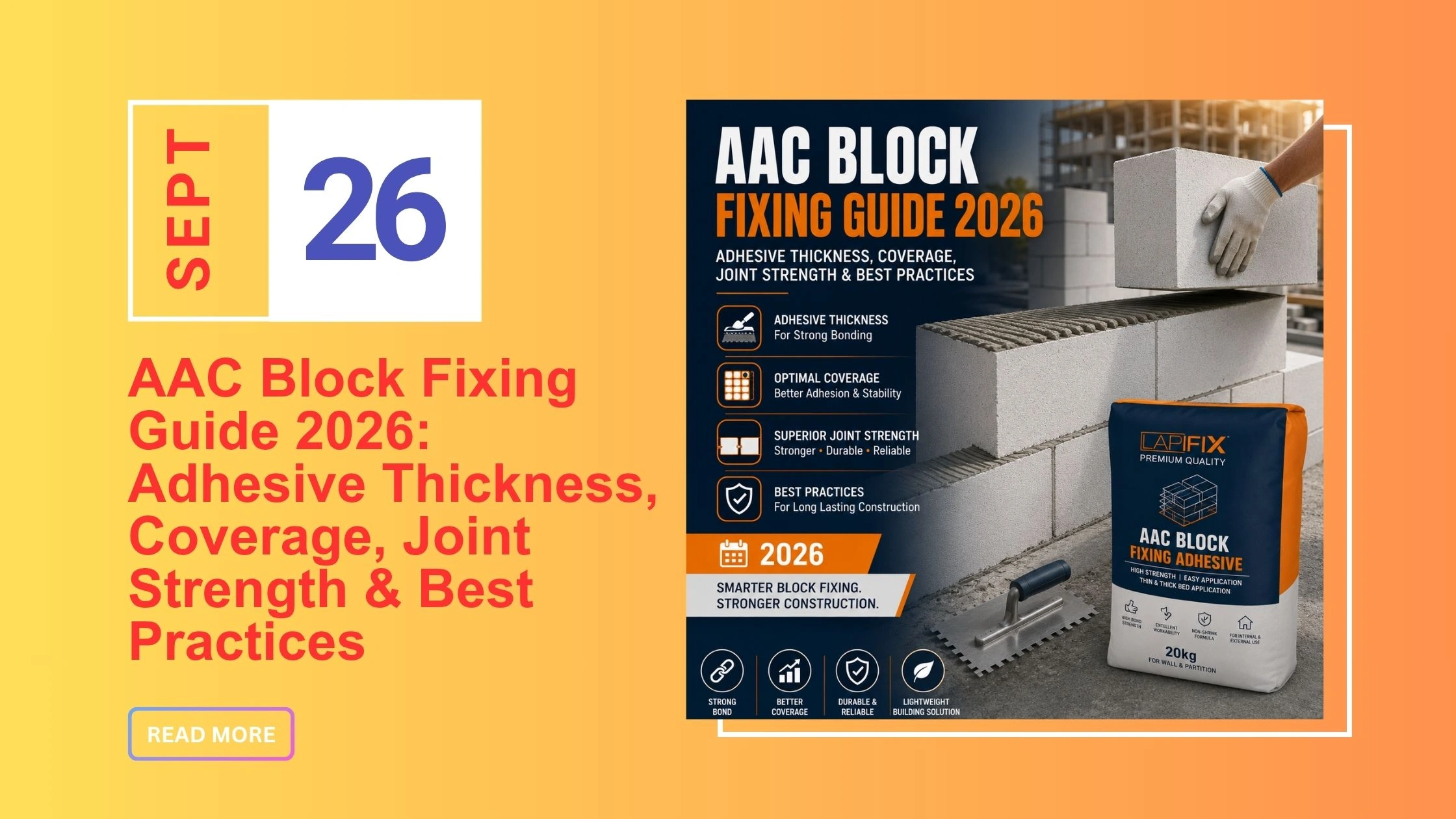
AAC blocks have changed the way modern masonry gets built. They are lightweight, accurate, easy to handle and often much quicker to install than traditional masonry units. But there is one detail that can quietly make or break the finished wall: the material joining the blocks.
That is where AAC block fixing adhesive comes into the picture. Unlike conventional thick mortar beds, a purpose-designed thin-bed adhesive creates a much thinner joint between AAC units while helping maintain consistent alignment. The result can be cleaner workmanship, reduced material consumption and a more uniform masonry system when the blocks and substrate are properly prepared.
For builders, contractors and homeowners, the bigger question is not simply which adhesive to buy. It is how to select, mix and apply it correctly. A good starting point is to review suitable AAC block fixing solutions before planning the installation.

AAC block fixing adhesive is a specially formulated dry-mix material designed for bonding autoclaved aerated concrete blocks. Instead of creating a thick mortar joint, the installer normally applies a thin, even layer across the contact surface. This approach works particularly well with dimensionally accurate AAC blocks because the blocks already have relatively uniform faces.
The real advantage is consistency. Traditional masonry mortar can create thicker joints that require more material and may introduce greater variation from one course to another. With the right AAC block fixing adhesive, the installer can maintain a controlled joint thickness while reducing unnecessary material build-up. ASTM International also maintains a specific standard covering thin-bed mortar for AAC masonry, reinforcing the importance of using products designed for this application.
Insert image of a professional worker applying thin-bed adhesive to AAC blocks here.
For commercial projects, this consistency matters even more. A wall may contain hundreds or thousands of blocks, so a small installation error repeated across every course can quickly become a major problem. Good adhesive selection therefore supports both workmanship and project efficiency.
Not every adhesive is suitable for every masonry application. Before purchasing, check the product's technical data, recommended substrates, working time, water requirement, coverage and compatibility with the specific AAC block system. The product should also suit the environmental conditions expected during installation.
A quality AAC block fixing adhesive should provide reliable adhesion without becoming difficult to spread. The mix should have a workable consistency that allows the installer to create an even layer without excessive sagging or drying too quickly. It should also support the intended joint thickness rather than forcing the installer to compensate for uneven blocks with excessive material.
The block itself matters, too. AAC units should meet the required dimensional and performance requirements for the intended application. ASTM C1691 addresses characteristics such as dimensional tolerances, compressive strength and drying shrinkage for unreinforced AAC masonry units.
This is why product selection should never happen in isolation. Think of the block, adhesive, substrate and installation method as one system. If one part does not match the others, even an excellent adhesive can struggle to deliver the expected result.
One of the biggest differences between AAC masonry and conventional brickwork is joint thickness. Thin-bed systems are designed around much thinner joints, which helps minimise thermal bridging and creates a cleaner, more consistent wall surface.
The correct AAC block fixing adhesive thickness should always follow the manufacturer's technical specification and the tolerances of the blocks being installed. In many thin-bed AAC systems, the target is only a few millimetres rather than the much thicker mortar joints associated with traditional masonry.
The important point is that thinner does not automatically mean better. If the blocks have uneven surfaces, the installer may be tempted to apply more adhesive to compensate. That can defeat the purpose of the thin-bed system. Proper block selection, surface preparation and levelling are therefore just as important as the adhesive itself.
A useful practical rule is simple: use the minimum specified thickness that provides full and consistent contact under the manufacturer's installation instructions. Do not treat adhesive as a filler for major block irregularities.
Coverage depends on several variables, including block dimensions, joint thickness, surface condition, application technique and product formulation. This means there is no single coverage figure that applies to every project.
For accurate estimating, start with the wall area and then use the manufacturer's stated coverage rate for the selected AAC block fixing adhesive. Add a sensible allowance for handling losses, mixing, site conditions and application variations. A perfectly flat wall with accurate blocks may consume less material than a project where the installer constantly adjusts for uneven surfaces.
|
Factor |
Effect on adhesive consumption |
|
Joint thickness |
Thicker joints generally use more material |
|
Block accuracy |
Uneven blocks can increase consumption |
|
Application method |
Poor spreading can create waste |
|
Surface preparation |
Dust and debris can affect contact |
|
Installer experience |
Consistent application improves efficiency |
|
Site conditions |
Heat and wind can affect working time |
For large developments, measuring actual usage during the first few courses can provide a useful benchmark. If the team is consuming dramatically more adhesive than expected, stop and investigate rather than simply ordering more bags.
Even the best AAC block fixing adhesive can perform poorly when the mixing process goes wrong. Water quantity should follow the manufacturer's instructions rather than being estimated by eye. Too much water can change the consistency and potentially affect performance, while too little can make the mixture difficult to spread properly.
Use clean water and suitable mixing equipment. Mix until the powder and water form a consistent, lump-free paste, then follow the manufacturer's instructions regarding maturation or resting time if specified. Remixing may also be required depending on the product.
Avoid adding extra water later simply because the mixture feels thicker than expected. Temperature, humidity and working time can influence how the adhesive behaves. Experienced installers learn to recognise the right consistency while still following the technical instructions.
The goal is a mixture that spreads smoothly, holds its form and allows the installer to create a consistent thin layer without dragging or tearing.
Preparation often receives less attention than mixing, yet it has a direct influence on adhesion. Dust, loose particles and excessive surface contamination can interfere with contact between the block and adhesive.
Before laying each course, check that the blocks are clean and that the supporting surface is properly prepared. The first course deserves particular attention because it establishes the level and alignment for everything above it. If that base course wanders, the wall can become progressively harder to correct.
A practical installation team should also keep the work area organised. Bags should remain protected from moisture, mixing tools should stay clean and blocks should be stored in a way that reduces unnecessary contamination.
Insert image of AAC block surface preparation and cleaning before adhesive application here.
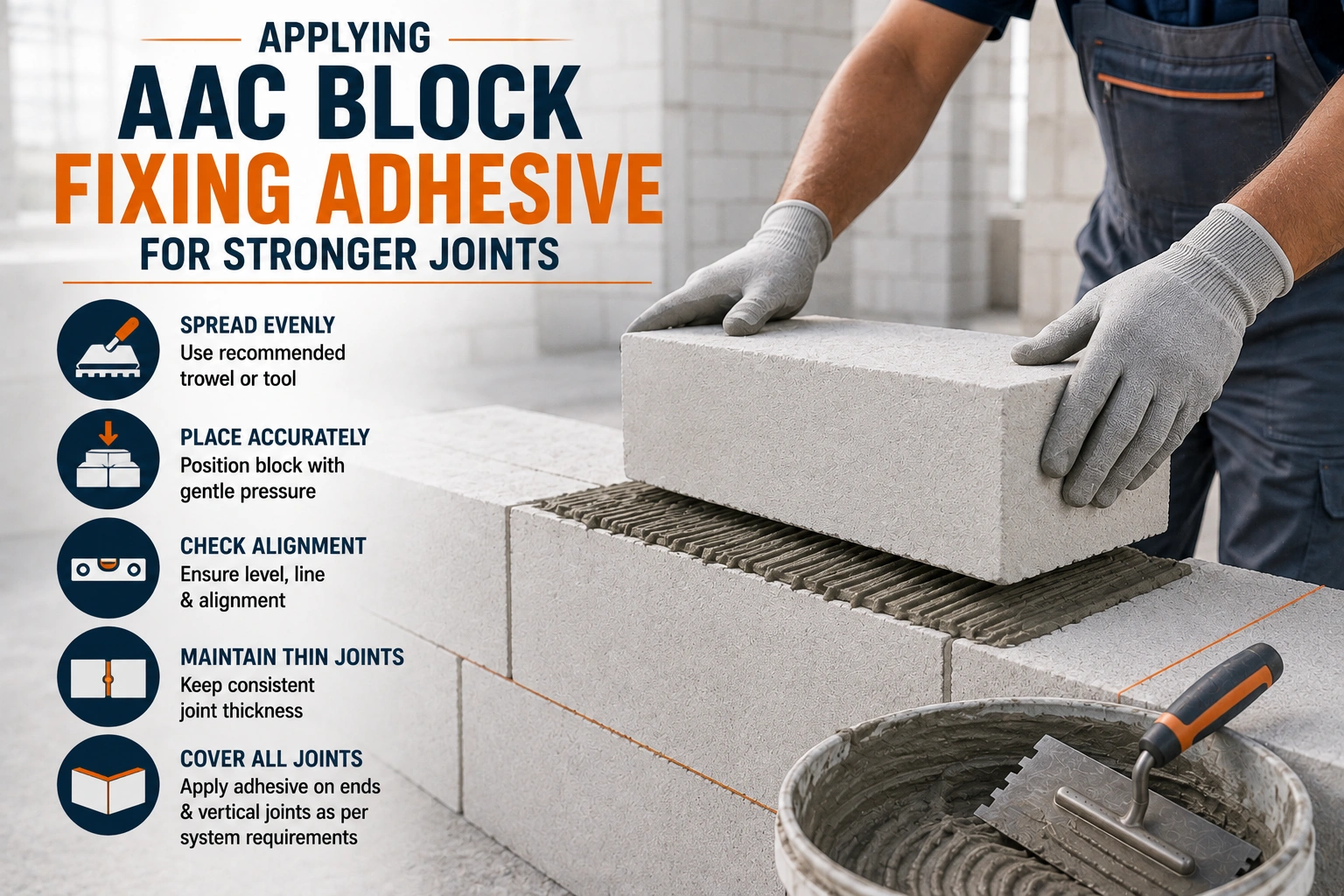
Application technique determines how effectively the adhesive connects the blocks. The installer should use the recommended trowel or application tool and spread the material evenly across the intended bonding surface.
AAC block fixing adhesive should not be treated like ordinary cement mortar. The objective is not to create a thick bed and then press the block deeply into it. Instead, the installer aims for controlled coverage and consistent contact while maintaining the specified joint thickness.
After positioning a block, check its level, line and alignment before the adhesive begins to lose workability. Small corrections are much easier immediately than after the material has started to set.
Experienced installers also pay attention to the ends of blocks and vertical joints where the system requires adhesive coverage. The exact method depends on the block manufacturer's recommendations and the adhesive system being used.
People often ask whether a stronger adhesive automatically creates a stronger wall. The answer is more complicated. Joint performance depends on the adhesive, AAC unit quality, surface preparation, joint thickness, application coverage, curing conditions and overall wall design.
ASTM C1660 specifically addresses performance requirements for thin-bed mortar used with AAC masonry, including material requirements and strength-related testing.
This is why an installer should not judge quality simply by how hard a leftover adhesive sample feels. The complete masonry system needs to perform as intended.
A strong joint also requires good contact. If an installer applies adhesive unevenly and leaves significant gaps, the nominal strength of the product cannot compensate for poor workmanship. Consistent application remains one of the most important practical factors on site.
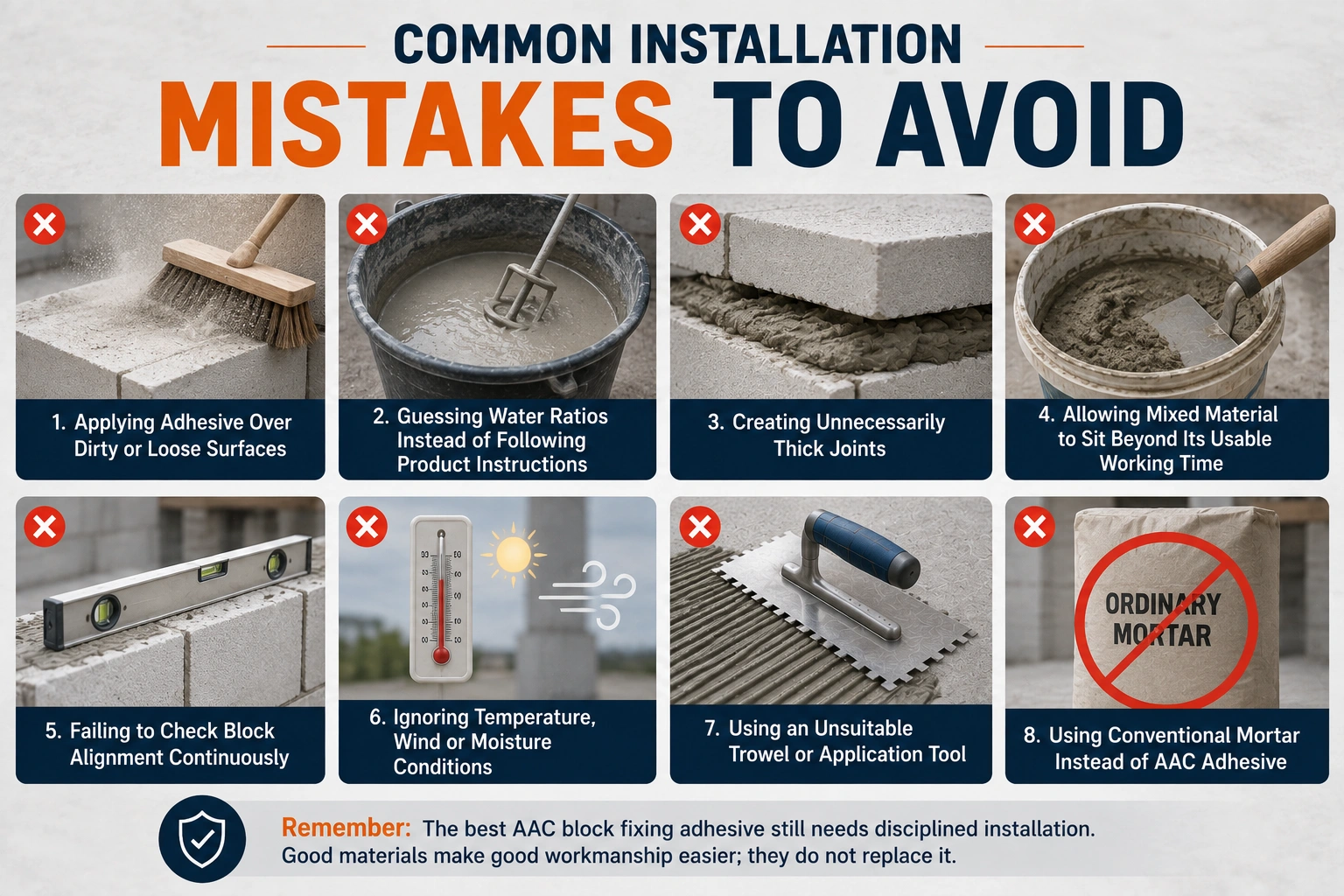
Many AAC masonry problems come from simple mistakes rather than complicated technical failures. Using too much water, applying an excessive joint thickness, working over dusty surfaces or ignoring the manufacturer's open time can all reduce consistency.
Another common mistake involves using conventional mortar where a thin-bed AAC system calls for specialist adhesive. The materials may look similar in a bag, but their formulation and intended application can differ significantly.
Watch for these common issues:
Applying adhesive over dirty or loose surfaces.
Guessing water ratios instead of following product instructions.
Creating unnecessarily thick joints.
Allowing mixed material to sit beyond its usable working time.
Failing to check block alignment continuously.
Ignoring temperature, wind or moisture conditions.
Using an unsuitable trowel or application tool.
The best AAC block fixing adhesive still needs disciplined installation. Good materials make good workmanship easier; they do not replace it.
The choice between thin-bed adhesive and conventional mortar depends on the masonry system and project requirements. Traditional mortar has a long history in brick and block construction and can accommodate certain dimensional variations. AAC thin-bed systems, on the other hand, work particularly well when manufacturers provide accurate blocks designed for thin joints.
AAC block fixing adhesive can reduce joint thickness and material usage while supporting cleaner courses. Traditional mortar may offer greater flexibility for some irregular masonry applications, but it generally creates thicker joints.
For modern AAC construction, the better comparison is not simply “which material is stronger?” Instead, ask which material matches the block system, installation method and project specification.
Temperature and weather can change installation conditions significantly. Hot, dry or windy weather may reduce working time because moisture can leave the mix faster. Cold conditions can slow setting and affect the practical workflow.
Plan the work rather than trying to fight the weather. Store bags correctly, avoid exposing mixed material to unnecessary heat or wind and follow the manufacturer's temperature and application recommendations.
On exposed construction sites, protecting the work area can make a surprisingly large difference. A few minutes spent planning shade, storage and mixing locations can prevent hours of frustrating rework later.
Large projects benefit from standardised installation procedures. The site team should know the correct water ratio, mixing method, application thickness and expected coverage before full production begins.
A short trial installation can reveal whether the selected AAC block fixing adhesive works smoothly with the chosen blocks and tools. It also gives supervisors an opportunity to measure actual consumption rather than relying entirely on theoretical estimates.
Record how many bags the team uses across a known wall area. If consumption suddenly increases, investigate the reason. The cause might be thicker joints, poor block alignment, surface contamination or inefficient spreading.
This small amount of quality control can reduce waste and create a repeatable process across multiple buildings.
Modern construction increasingly focuses on speed, material efficiency and predictable workmanship. AAC masonry fits that direction well, but only when the installation process respects the properties of the material.
A reliable AAC block fixing adhesive system should be supported by accurate blocks, clean surfaces, correct mixing, controlled application and regular alignment checks. ASTM's current AAC masonry practice also recognises construction and testing methods specifically for AAC masonry, highlighting the importance of treating the system differently from generic masonry.
For contractors, the best approach is to turn these principles into a simple site routine. Train installers before the project starts, keep technical data available on site and make the first few courses a quality-control checkpoint rather than rushing straight into production.
Insert infographic comparing traditional mortar joints with thin-bed AAC adhesive joints here.
When purchasing AAC adhesive, price per bag tells only part of the story. A cheaper product that requires more material or creates inconsistent workmanship may cost more across the entire project.
Look at the technical documentation, coverage information, recommended application method, compatibility and quality-control information. Packaging should remain intact and dry before use, because moisture exposure can affect powder products before installation even begins.
A professional supplier should also make technical information accessible. That matters when contractors need to calculate quantities, train workers or resolve questions during installation.
Lapifix, for example, positions its adhesive range around specialist construction applications rather than treating AAC bonding as an ordinary mortar task.
A successful AAC wall starts long before the final block is placed. The right product, accurate blocks, clean surfaces, correct mixing, controlled thickness and disciplined application all work together to create reliable masonry. AAC block fixing adhesive can improve installation efficiency and consistency, but only when the installer follows the product instructions and the requirements of the AAC system. For large projects, monitoring coverage and workmanship from the first course can also prevent expensive problems later.
If you are planning an AAC block project and want a practical adhesive solution backed by clear product information, explore the AAC adhesive range and product details or speak with the team about your requirements. Choosing the right AAC block fixing adhesive at the planning stage can make the installation cleaner, more predictable and easier to manage from the first course to the finished wall.
AAC block fixing adhesive bonds autoclaved aerated concrete masonry units using a thin-bed application. It is designed to create controlled joints between compatible AAC blocks while supporting consistent masonry installation.
The correct thickness depends on the specific product and AAC system. Many thin-bed applications use only a few millimetres of material, but installers should always follow the manufacturer's stated joint thickness rather than relying on a generic number.
You should not automatically substitute conventional mortar for a specialist AAC thin-bed product. The correct material depends on the block manufacturer's system, project specification and local construction requirements.
Calculate the wall area and compare it with the manufacturer's stated coverage for the chosen product and application thickness. Then include a reasonable allowance for site waste and installation variations.
Not necessarily. Excessive thickness can move the installation away from the intended thin-bed system. Wall performance depends on the complete masonry system, including block quality, adhesive, coverage, joint thickness, alignment and workmanship.