

Delhi's construction landscape has changed dramatically. From apartment renovations and residential developments to commercial interiors, retail spaces and large-scale projects, modern tiling demands more than simply choosing a good-looking tile. The adhesive underneath it plays a major role in how securely and consistently that tile performs over time.
That is why choosing among reliable tile adhesive manufacturers in Delhi deserves more attention than it often gets. The right adhesive needs to match the tile, substrate, location and expected conditions. A product suitable for a standard indoor ceramic floor may not be the right choice for a large-format porcelain installation, exterior wall or demanding commercial area.
For contractors, architects, builders, dealers and project owners, the buying decision should therefore go beyond price per bag. Product classification, technical performance, application suitability, consistency and manufacturer support all matter. This guide explains what to look for when comparing tile adhesive manufacturers and suppliers serving the Delhi market.
Tile installation is often judged by what you can see: alignment, grout lines, finish and overall appearance. The adhesive, however, works quietly underneath the surface. Its job is to create a reliable bond between the tile and substrate while handling the conditions of the installation.
Delhi's construction projects can involve everything from standard residential interiors to high-traffic commercial spaces. Different locations can expose tiles to moisture, temperature variation, movement and mechanical stress. That means adhesive selection should be based on the application rather than simply choosing the most economical product.
A quality tile adhesive can also make installation more predictable for contractors. Consistent workability, open time and adjustment time can help installers position tiles accurately instead of racing against the clock.
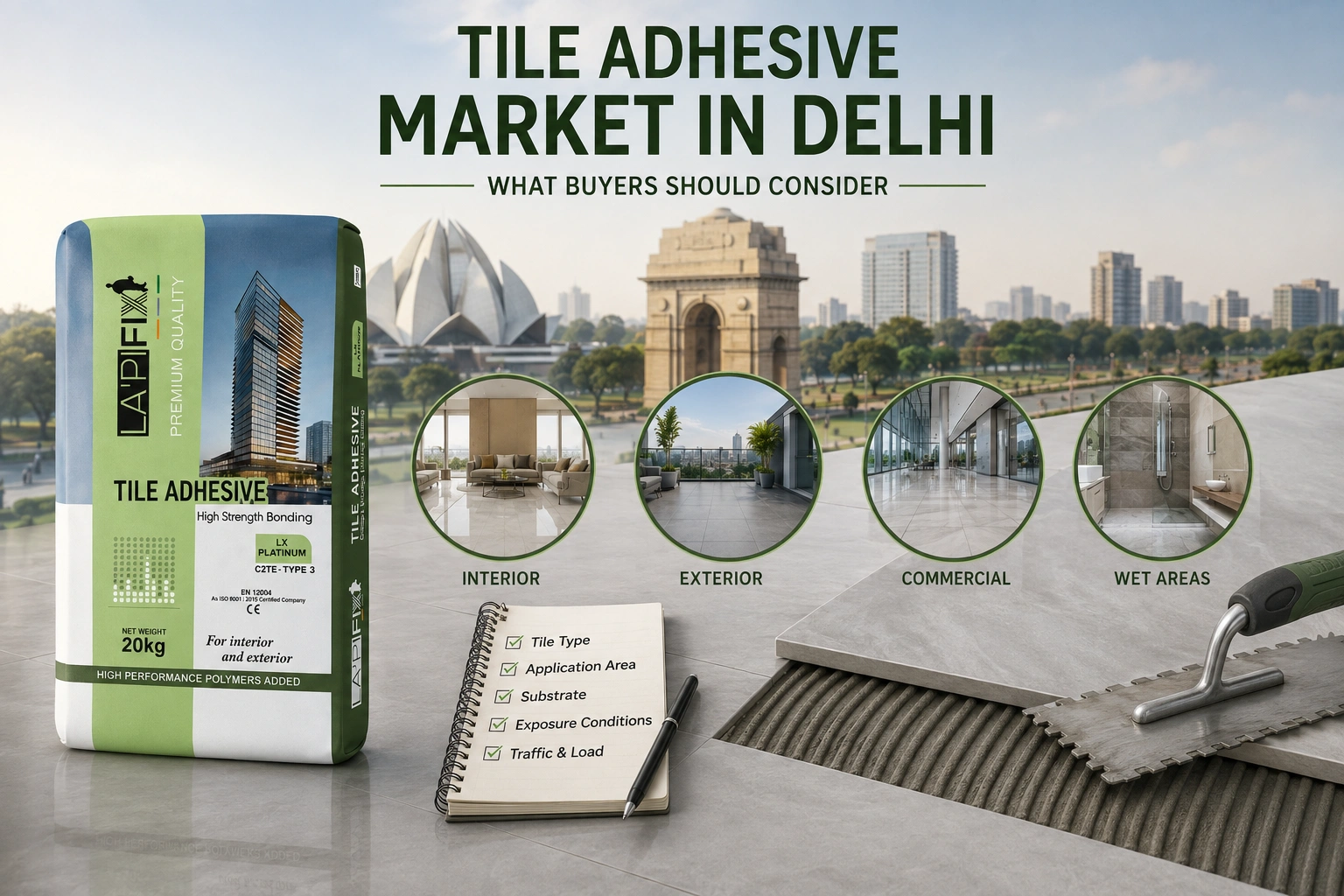
Delhi has a broad construction ecosystem involving builders, contractors, architects, tile dealers, interior designers and homeowners. That creates demand for different adhesive solutions rather than one universal product.
A contractor working on a standard residential floor may have very different requirements from a commercial project involving large-format porcelain tiles. Similarly, an exterior application needs an adhesive appropriate for environmental exposure.
This is why buyers searching for a tile adhesive manufacturer in Delhi should first define the application. Ask what type of tile is being installed, where it is being installed, what substrate is involved and whether the area is exposed to moisture, heat, movement or heavy traffic.
Once those factors are clear, comparing manufacturers becomes much easier.
Tile adhesives are available in different performance classes and formulations. Understanding these categories helps buyers avoid the classic mistake of using the same adhesive everywhere.
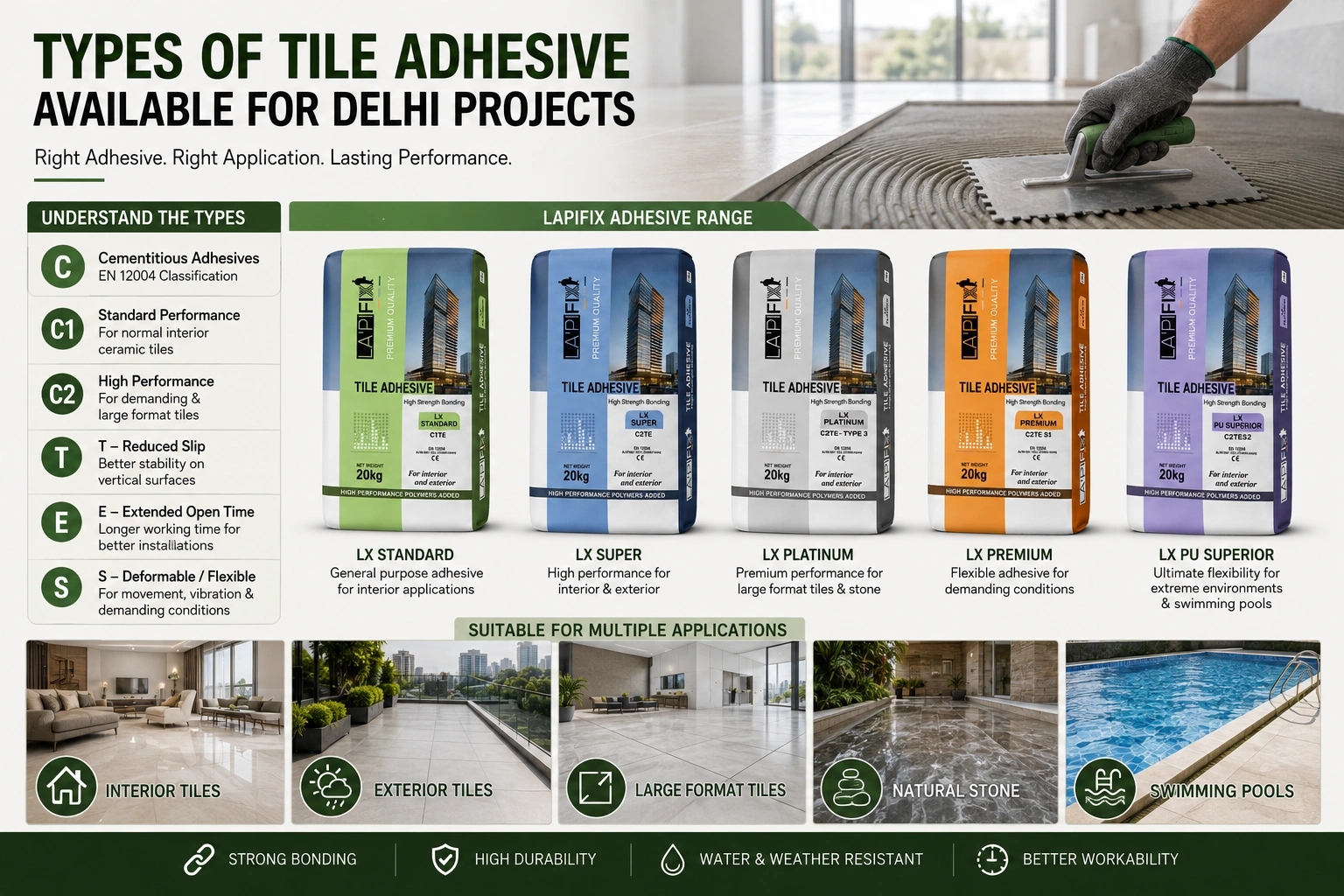
Cementitious adhesives are widely used for tile installations and are classified under the C category in EN 12004. Within that category, C1 and C2 represent different performance levels, while additional designations such as T, E and S indicate specific properties.
For example, a standard interior ceramic tile application may have different requirements from a large-format porcelain installation. A flexible adhesive may be more appropriate where movement or demanding environmental conditions need to be considered.
Lapifix currently offers several adhesive products, including Lx Standard, Lx Super, Lx Platinum, Lx Premium and Lx PU Superior. The manufacturer's published product range covers applications including ceramic and porcelain tiles, tile-on-tile installation, external tiles, large-format tiles, natural stone and swimming-pool applications.
C1 and C2 are not simply marketing labels. They refer to performance classifications under EN 12004 for cementitious tile adhesives.
C1 represents a standard-performance cementitious adhesive, while C2 represents an improved-performance cementitious adhesive. The correct class depends on the installation requirements and manufacturer's technical recommendations.
For example, Lapifix Lx Standard is published as a C1T adhesive and is designed for internal floor applications involving ceramic and porcelain/vitrified tiles. Lx Super is classified as C2TE and is positioned for ceramic and porcelain/vitrified tiles, including tile-on-tile applications.
The important lesson for Delhi buyers is not that C2 is automatically “better” for every job. Instead, choose the classification that matches the tile, substrate and installation environment.
Large tiles, external installations and demanding substrates can require more flexibility than a basic internal-floor application.
Flexible tile adhesives are designed to accommodate certain movements and stresses within the installation system. This can be particularly relevant where substrates may experience movement, temperature variation or other demanding conditions.
Lapifix Lx Premium, for example, is described by the manufacturer as a highly flexible, rubber-modified adhesive for external tiles and stones, large-format vitrified tiles, natural stone, swimming pools and other demanding applications. It is listed as C2TE S1 under EN 12004.
This demonstrates why selecting an adhesive based purely on the word “strong” is not enough. Flexibility and application suitability can be equally important.
Porcelain and vitrified tiles have different characteristics from many conventional ceramic tiles. Their low water absorption and dense structure mean adhesive selection deserves particular attention.
For Delhi residential and commercial projects, buyers should consider the tile format, substrate, installation location and manufacturer's recommended application.
Tile size also matters. Large-format tiles create different installation demands from smaller conventional tiles, particularly when achieving adequate contact between the adhesive and tile.
A product intended for large-format applications should therefore be evaluated based on its technical data and recommended installation method rather than simply assuming that any general-purpose tile adhesive will perform equally well.
Large-format tiles have become increasingly popular in contemporary interiors because they create fewer grout lines and a more continuous visual appearance. They also introduce different installation challenges.
Handling a large tile requires careful substrate preparation, correct adhesive selection and appropriate application technique. Coverage becomes especially important because voids beneath a large tile can create weak points.
Lapifix Lx Platinum is positioned for large-format tiles and natural stone, including external and vertical applications. Its published classification is C2TE, with the manufacturer specifying a 20 kg packing size.
For large-format projects, buyers should discuss the exact tile dimensions and substrate with the adhesive manufacturer or technical team before selecting the product.
Wall and floor applications can place different demands on an adhesive.
Wall tiles need an adhesive that provides suitable initial grab and bond performance while allowing accurate positioning. Floors may experience pedestrian traffic, impact and loading that require different performance considerations.
The same adhesive may be suitable for both applications in some circumstances, but buyers should always follow the product's stated application range.
For contractors purchasing tile adhesive in Delhi, this is one reason technical data sheets are so useful. They provide a much better basis for selection than a product name or a salesperson's generic recommendation.
A reliable manufacturer should be able to explain its products clearly and provide technical information that helps buyers make informed decisions.
Start by examining the manufacturer's product range. Does it offer different performance levels for different applications, or is there essentially one product marketed for everything?
Next, review technical information such as classification, open time, adjustability time, pot life, adhesion performance, recommended applications and packing size. These details help contractors understand how the adhesive will behave on site.
Manufacturer consistency is also important. A tile adhesive needs to perform predictably from one batch to another. In commercial construction, inconsistent material can create installation problems and unnecessary delays.
These three terms are often used interchangeably, but they describe different roles.
A manufacturer produces the adhesive and controls the formulation and production process. A supplier may distribute products to contractors, dealers or project customers. A dealer typically operates closer to the end customer and may provide local availability and product guidance.
None of these roles is automatically better. The right choice depends on your project size, location, required quantity and need for technical assistance.
For large projects, purchasing through an established manufacturer or authorised distribution network can make supply planning easier. For smaller projects, a local dealer may offer convenience and quick availability.
The key is to ensure that the product is genuine, correctly stored and appropriate for your intended application.
A good tile adhesive is not defined by one specification. Performance depends on how several characteristics work together.
Bond strength is important, but so are workability, open time, adjustability, water resistance where required and suitability for the substrate and tile.
For installers, practical handling matters too. An adhesive that is difficult to mix or apply can slow the job even if its laboratory performance looks impressive.
Lapifix's published product information, for example, provides application-specific technical data for products such as Lx Standard, Lx Super, Lx Platinum and Lx Premium rather than presenting the entire range as one universal adhesive.
That application-specific approach is useful when evaluating products.
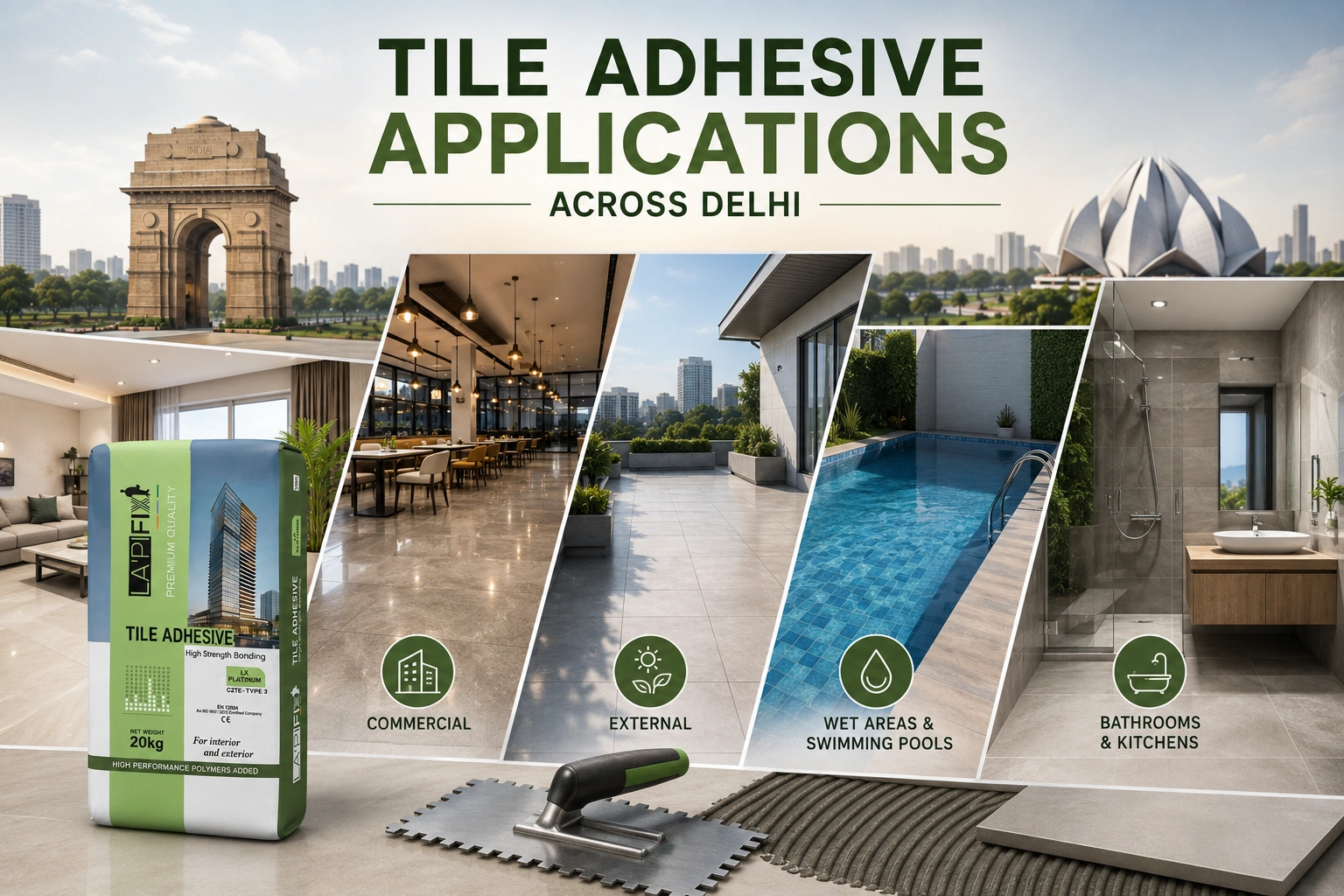
Tile adhesive requirements can vary significantly depending on the project.
Residential apartments may require adhesives for bedroom floors, living areas, kitchens and bathrooms. Commercial projects can involve offices, restaurants, retail stores and hospitality spaces with heavier traffic and more demanding schedules.
External walls and terraces introduce environmental exposure, while swimming pools and wet areas require products selected specifically for those conditions.
The best tile adhesive supplier in Delhi should therefore be able to discuss your application rather than simply asking how many bags you need.
Before placing a bulk order, contractors should verify the product's technical suitability and practical availability.
A useful buying process includes checking:
Tile type and dimensions
Substrate condition
Indoor or outdoor application
Wall or floor installation
Moisture and temperature exposure
Required adhesive classification
Coverage and consumption
Pot life and working time
Open and adjustment times
Packaging and storage conditions
This small checklist can prevent a surprisingly expensive mistake: buying a product that is technically good but unsuitable for the specific installation.
The cost of tile adhesive in Delhi depends on several factors, including adhesive classification, formulation, application, packaging, brand, quantity and distribution.
A basic C1 adhesive will generally serve different applications from a premium flexible C2TE S1 product, so comparing their prices without comparing their specifications is not particularly useful.
For contractors, the better question is often the cost of achieving the required installation performance. A slightly higher-priced adhesive may make sense if it provides the necessary technical performance, reduces installation problems or is better suited to the tile.
Coverage also matters. Always consider consumption per square metre rather than looking only at the price of one bag.
One common mistake is choosing adhesive solely on price. The cheapest bag can become expensive if it results in poor coverage, difficult application or premature tile problems.
Another mistake is using a standard adhesive for a demanding application without checking its technical suitability. Large-format tiles, exterior installations and challenging substrates may require products with specific performance characteristics.
Poor storage is another overlooked issue. Cement-based products should be stored according to the manufacturer's recommendations, protected from moisture and used within the stated shelf life.
Finally, avoid treating adhesive selection and installation technique as separate subjects. Even a high-quality product cannot compensate for inadequate substrate preparation or incorrect application.
Lapifix is a manufacturer and exporter of tile adhesives, grouts and construction chemical products based in Morbi, Gujarat. Its published product portfolio includes multiple adhesive grades and related products such as tile grout, epoxy grout and block-fixing solutions.
For Delhi buyers, the relevance is the breadth of the product range. Lx Standard is positioned for internal floor applications, while Lx Super, Lx Platinum and Lx Premium address progressively more demanding applications, including tile-on-tile, external surfaces, large-format tiles and natural stone.
This makes it possible to select an adhesive according to the project instead of forcing every application into one generic product category.
The first step is to define the project rather than the product.
Tell the manufacturer or supplier what tile you are installing, its size, the substrate, location, expected traffic and environmental exposure. If you are working with a large-format tile, natural stone or an unusual substrate, provide those details upfront.
For bulk orders, also confirm packaging, delivery schedules, batch information, storage requirements and technical support.
This is particularly important for contractors managing multiple sites. Reliable supply can be just as important as adhesive performance when project deadlines are tight.
Choosing among tile adhesive manufacturers in Delhi should never come down to a simple price-per-bag comparison. The right decision considers tile type, size, substrate, application environment, adhesive classification, flexibility, workability and long-term performance. C1, C2 and flexible adhesive products serve different requirements, while large-format, porcelain, vitrified, external and demanding installations need more careful product selection. A reliable manufacturer or supplier should provide clear technical information and help match the adhesive to the actual project.
Lapifix offers a range of tile adhesive solutions designed for different installation requirements, from its Lx Standard and Lx Super products to Lx Platinum and Lx Premium for more demanding applications. If you are a Delhi contractor, builder, architect, dealer or project buyer looking for suitable adhesive solutions, you can explore Lapifix's tile adhesive range or contact the Lapifix team to discuss your project requirements.
There is no single adhesive that is best for every Delhi project. The correct product depends on tile type, size, substrate, location and environmental conditions. Standard internal ceramic installations may require a different adhesive from large-format porcelain, exterior tiles or natural stone.
C1 and C2 are performance classifications for cementitious tile adhesives under EN 12004. C2 represents improved performance compared with C1, but the appropriate class should be selected according to the installation requirements rather than assuming that the highest classification is always necessary.
Some products are suitable for both walls and floors, while others are designed for specific applications. Always check the manufacturer's technical documentation and application recommendations before using an adhesive for a particular surface.
Large-format tiles can place additional demands on an installation, so an adhesive with suitable flexibility and performance may be recommended depending on the substrate and application. The tile manufacturer and adhesive manufacturer's technical guidance should be considered together.
Check product classifications, technical documentation, manufacturer reputation, application suitability, product availability and technical support. For larger projects, also consider supply consistency and the supplier's ability to handle your required quantity and delivery schedule.