

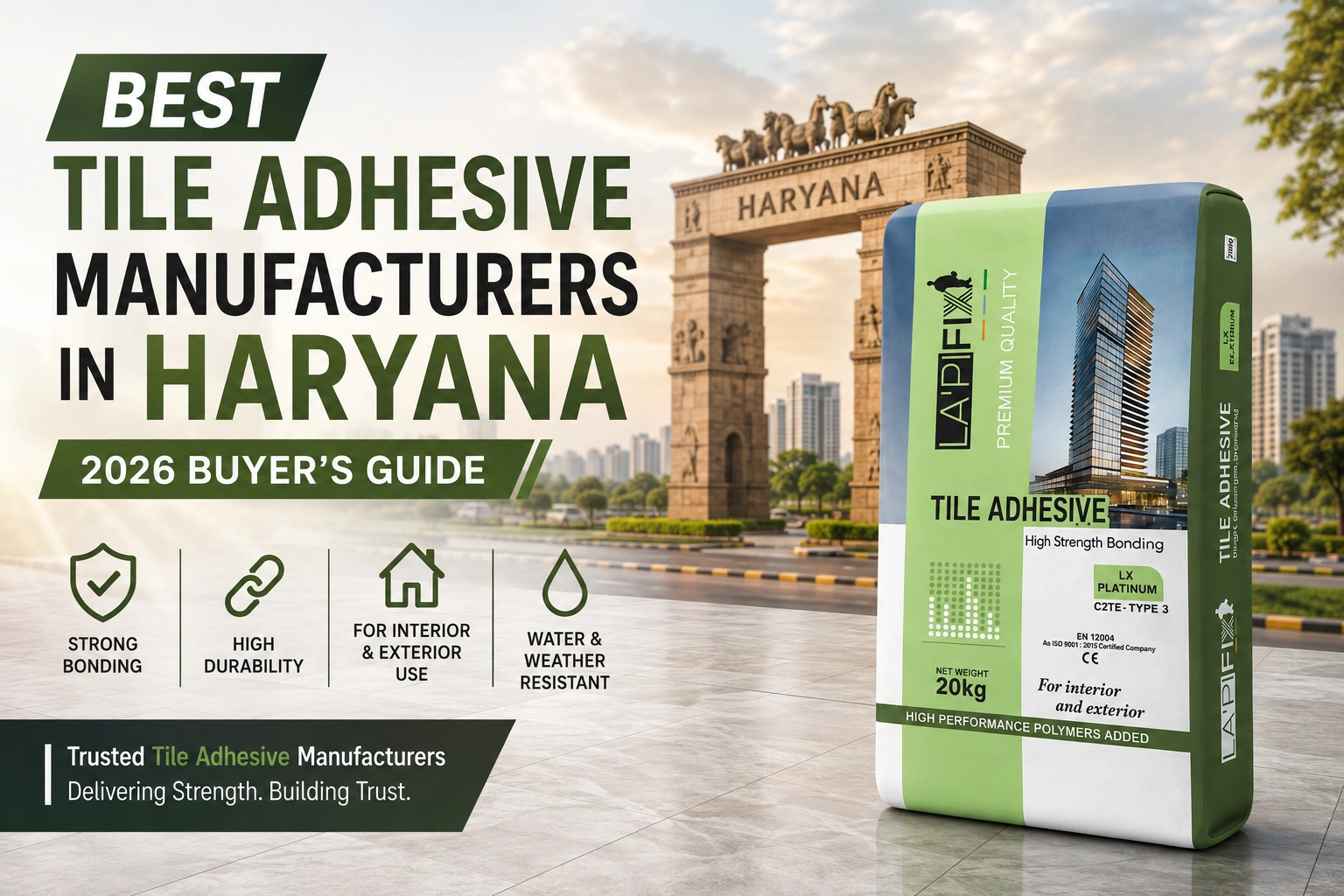
A tile may be the part of a wall or floor everyone notices, but the adhesive underneath it is doing the quiet heavy lifting. In Haryana, where residential construction, commercial development, industrial spaces and renovation projects continue to create demand for dependable building materials, choosing the right adhesive is more than a simple price comparison.
For contractors, builders, architects, dealers and homeowners, finding reliable tile adhesive manufacturers in Haryana means looking beyond the bag. The adhesive needs to suit the tile, substrate, installation area and expected conditions. A product that works perfectly for a standard internal ceramic floor may not be the right choice for large-format porcelain, an exterior wall or a demanding commercial project.
That is why this guide focuses on how to evaluate manufacturers, suppliers and products before placing an order. We will look at adhesive types, technical specifications, applications, pricing factors and common buying mistakes, with practical considerations for Haryana projects.
For a broader understanding of modern adhesive solutions, you can also explore Lapifix's tile adhesive range, where different products are positioned for different installation requirements.
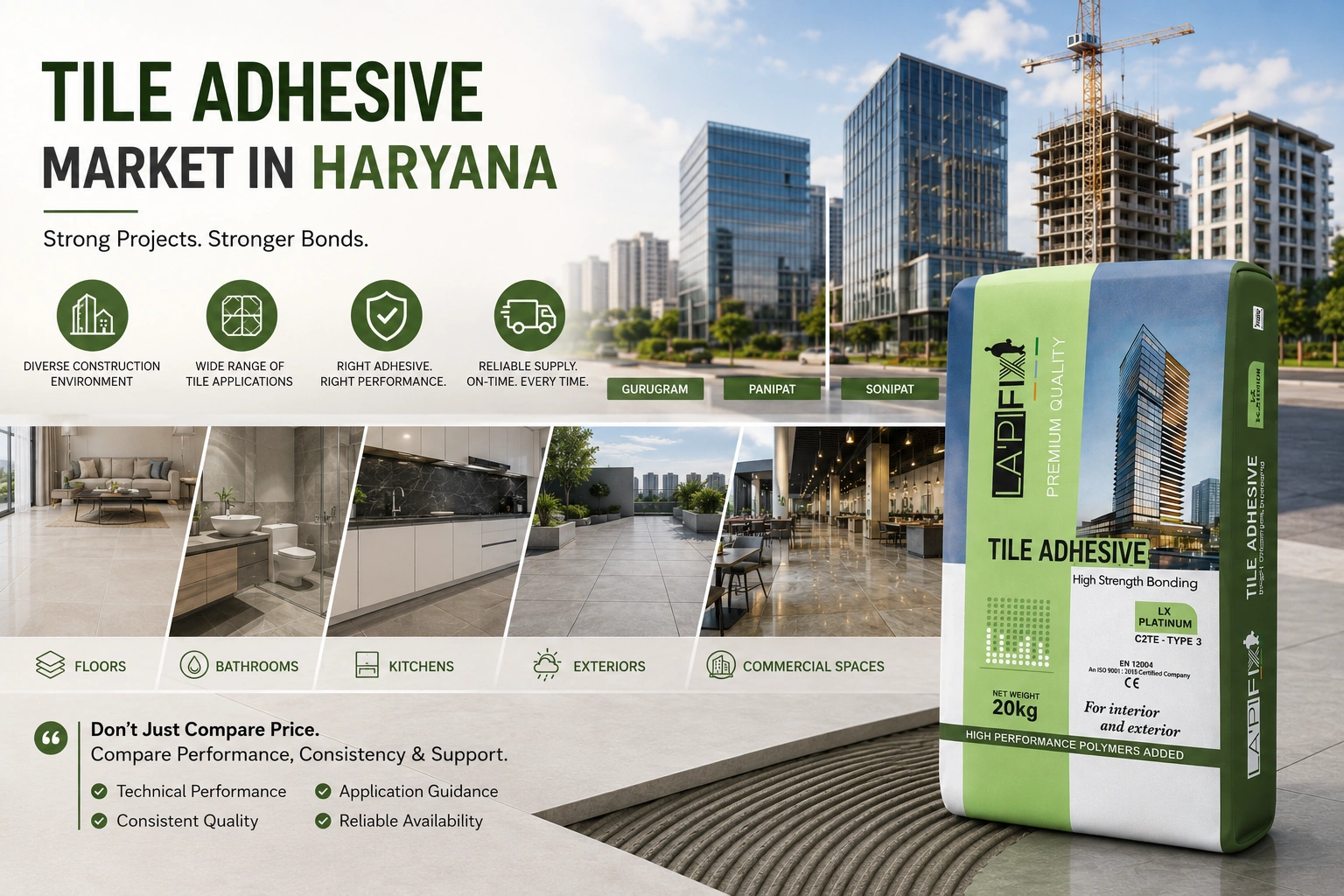
Haryana has a diverse construction environment. The requirements of a residential project in Gurugram can be very different from those of an industrial building near Panipat, a housing project around Sonipat or a commercial development in Faridabad. That variety creates demand for different types of tile fixing adhesive rather than one universal solution.
Modern projects increasingly use ceramic, porcelain, vitrified, large-format and stone tiles across floors, walls, bathrooms, kitchens, commercial interiors and external surfaces. Each application can place different demands on the adhesive.
This makes product selection particularly important. Instead of asking only, “Which adhesive is cheapest?”, project buyers should ask, “Which adhesive is technically suitable for this installation?”
The best tile adhesive company in Haryana, therefore, is not necessarily the company selling the lowest-priced bag. A more useful comparison considers technical performance, consistency, product range, application guidance, availability and support.
For larger projects, reliable supply is equally important. A contractor cannot afford to stop a tiling crew because the required adhesive is suddenly unavailable.
Tile installation is a system rather than a single product. The tile, substrate, adhesive and installation technique all influence the final result.
A good manufacturer should provide clear information about where each adhesive can be used. This includes details such as recommended tile types, substrate compatibility, application area, mixing requirements and relevant performance classifications.
Consistency also matters. Contractors working across multiple rooms or project sites need an adhesive that behaves predictably during mixing and application. Variations in workability can affect productivity, coverage and installation quality.
Another important factor is technical support. When a project involves large-format tiles, tile-on-tile installation, external surfaces or unusual substrates, having access to accurate product guidance can be more valuable than choosing a product based purely on its price.
A manufacturer's credibility should therefore be assessed through its product documentation, technical information, manufacturing capabilities and ability to support the intended application.
Tile adhesives come in different formulations and performance levels. The right choice depends on the application rather than simply the tile's appearance.
Cementitious adhesives are widely used for modern tile installations. Within this broad category, different performance classes are available for different requirements. Buyers may also encounter classifications and designations relating to properties such as slip resistance, extended open time and deformability.
For example, a standard internal floor application may have relatively straightforward requirements, while a large-format external installation can demand stronger performance and greater flexibility.
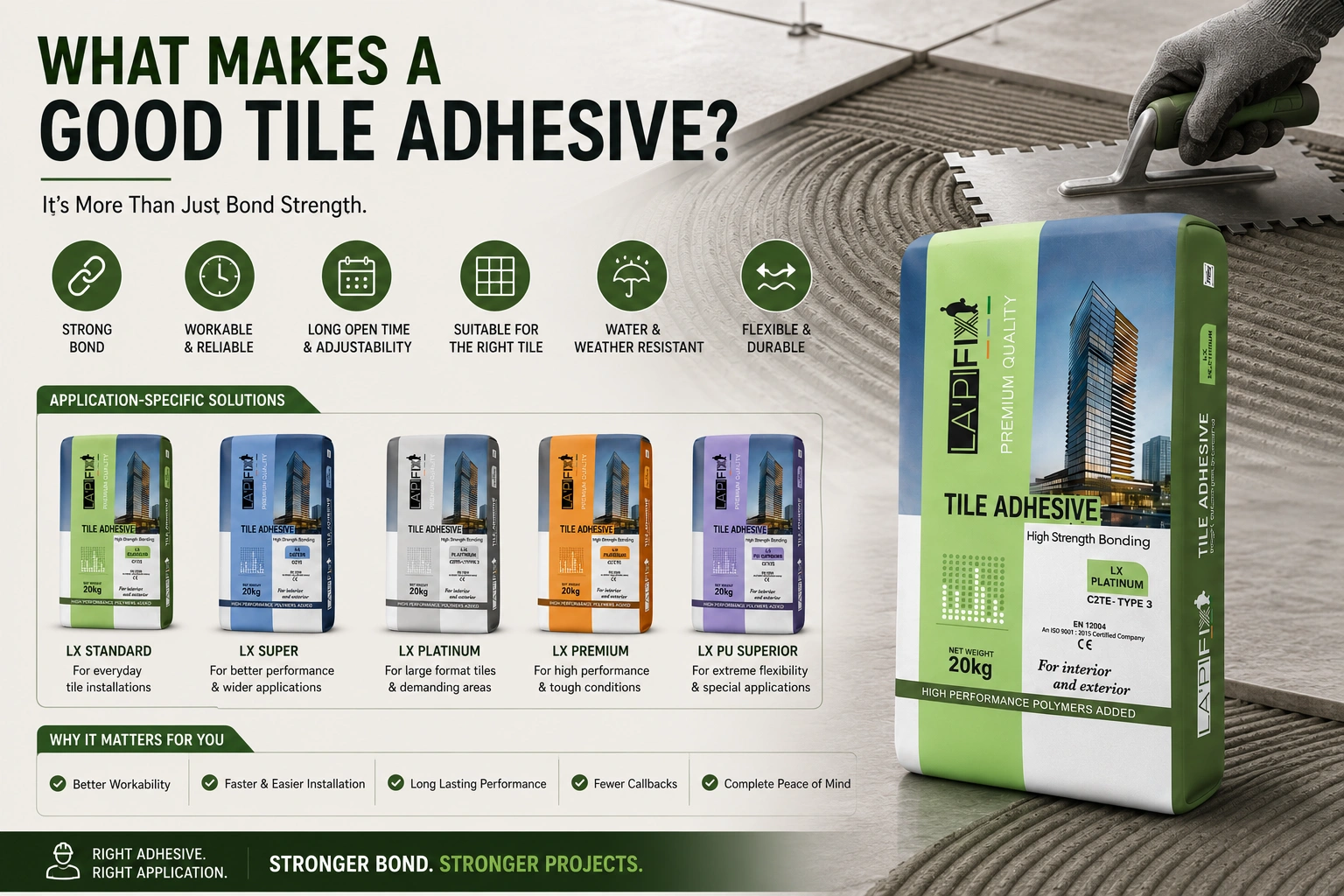
Lapifix's current adhesive portfolio includes Lx Standard, Lx Super, Lx Platinum, Lx Premium and Lx PU Superior. The range is positioned for applications including ceramic and porcelain/vitrified tiles, tile-on-tile work, external tiles, large-format tiles, natural stone and other demanding installations.
The important point is that there is no single “best” adhesive for every job. Selection should start with the installation conditions.
When comparing tile adhesive manufacturers in Haryana, start with the information they are willing to provide.
A trustworthy manufacturer should be able to explain what each product is designed for. Product pages and technical data should ideally provide useful information about application areas, performance classification, working characteristics and recommended tile types.
The manufacturer should also demonstrate consistency in its product range. If one product is marketed as suitable for virtually every possible installation, it is worth asking for more specific technical guidance.
Manufacturing location is another factor, but it should not be treated as the only measure of quality. A manufacturer outside Haryana can still be a practical supplier if its distribution network, delivery capability and technical support are reliable.
For project buyers, the best supplier relationship is usually one that combines product availability with useful technical guidance.
The technical data sheet is one of your best friends when buying tile adhesive. It may not be the most thrilling bedtime reading, but it can save a contractor from an expensive installation mistake.
For example, the Bureau of Indian Standards recognises IS 15477:2019 for adhesives used with ceramic, mosaic and stone tiles. The BIS product manual includes classifications and testing requirements covering characteristics such as tensile adhesion strength, shear adhesion strength, open time, adjustment time, slip and deformability where applicable.
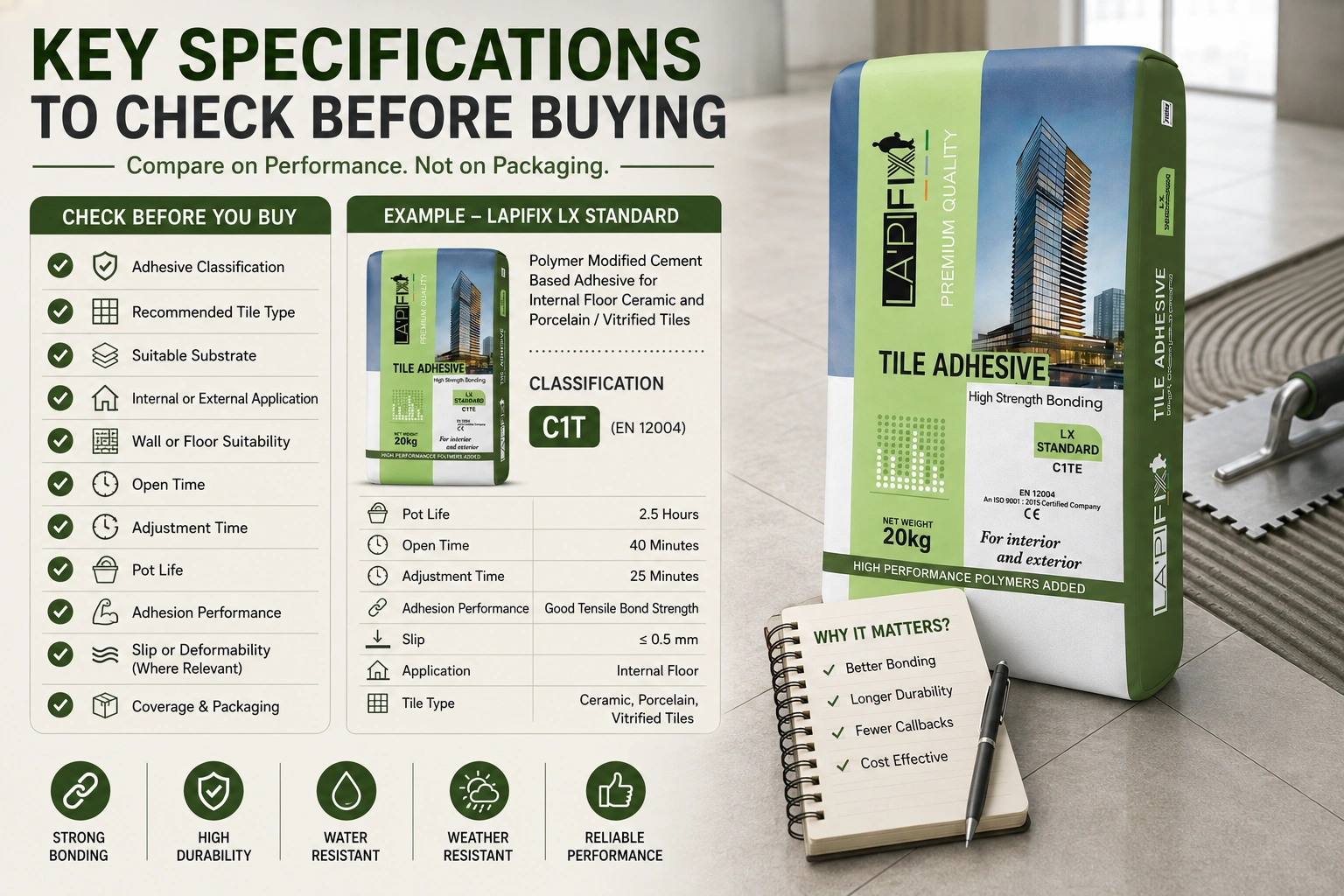
Before purchasing, check:
Adhesive classification
Recommended tile type
Suitable substrate
Internal or external application
Wall or floor suitability
Open time
Adjustment time
Pot life
Adhesion performance
Slip or deformability requirements where relevant
Coverage and packaging
These specifications help you compare products on performance rather than packaging claims.
Lapifix Lx Standard, for example, is published as a polymer-modified cement-based adhesive for internal floor ceramic and porcelain/vitrified tile applications and is classified C1T under EN 12004. Its published technical information includes a 2.5-hour pot life, 40-minute open time and 25-minute adjustment time.
Different areas of a building place different demands on adhesive performance.
Floor installations need to handle foot traffic and the stresses associated with the substrate and tile. Wall applications require appropriate adhesion and, depending on the tile and installation, resistance to slip.
Bathrooms and other wet areas introduce moisture considerations. External walls can experience weather and temperature changes. Large-format tiles create additional installation challenges because achieving good adhesive coverage becomes particularly important.
For this reason, a contractor should not simply order “tile adhesive” without explaining the application.
A professional tile adhesive supplier in Haryana should be able to ask useful questions about the project before recommending a product. Tile size, tile material, substrate, location and exposure conditions all help determine which product makes sense.
The terms manufacturer, supplier and dealer can sound interchangeable, but they describe different positions in the distribution chain.
A manufacturer produces the adhesive and is responsible for formulation and production. A supplier may distribute products to contractors, dealers or project buyers. A dealer typically provides local product availability and serves customers within a particular market.
For a small renovation, buying through a local tile adhesive dealer in Haryana may be convenient. For a large construction project, working with a manufacturer or established distributor may provide better support for bulk purchasing and consistent supply.
Neither model is automatically superior. The important question is whether the seller can provide genuine products, appropriate technical information and dependable supply.
If a project has specific performance requirements, the buyer should also be able to trace the product back to the manufacturer and its technical documentation.
A good tile adhesive is not defined by one impressive number printed on a bag.
Bond strength matters, but so do workability, open time, adjustability, compatibility with the substrate and suitability for the tile. Depending on the application, flexibility, water resistance, slip resistance or deformability may also be important.
For installers, practical handling is crucial. An adhesive that mixes consistently and provides a reasonable working window can make the installation process more manageable.
Lapifix positions its adhesive range around different installation requirements rather than treating every application identically. Its published range includes products from Lx Standard through higher-performance options such as Lx Platinum and Lx Premium.
That application-specific approach is useful for contractors because the adhesive can be selected according to the actual project.
Experienced contractors know that the cheapest material is not always the cheapest option once labour, wastage, delays and rework enter the equation.
A properly selected adhesive can make installation more predictable. When the product matches the tile and substrate, installers can work according to the manufacturer's recommended mixing and application procedure.
This becomes even more important on larger projects. If a contractor is installing thousands of square metres of tile, a small difference in coverage or working characteristics can become significant across the entire project.
Professional adhesive solutions also give contractors access to technical information that helps standardise installation practices across teams.
In other words, the adhesive is not just another construction material. It is part of the installation system.
The cost of tile adhesive in Haryana varies according to formulation, classification, application, brand, packaging, order quantity and distribution.
A basic adhesive designed for a straightforward internal application should not be compared directly with a premium flexible product intended for large-format tiles or demanding external conditions. They are solving different problems.
Coverage is another important consideration. A bag that costs less but provides poorer practical coverage may not result in a lower project cost.
For contractors, the better calculation is the cost per square metre of suitable installation, rather than simply the purchase price of one bag.
Bulk purchasing can also influence commercial pricing, but buyers should confirm delivery costs, product availability and storage requirements before assuming that the lowest quoted price represents the best deal.
One of the most common mistakes is selecting an adhesive only because it is inexpensive. The adhesive may be technically unsuitable for the tile or application, creating problems later.
Another mistake is assuming that every porcelain, vitrified or ceramic tile requires exactly the same adhesive. Tile size, substrate and installation conditions can change the requirements significantly.
Ignoring the substrate is another problem. A good adhesive cannot compensate for a poorly prepared surface.
Contractors should also avoid relying entirely on informal recommendations. What worked on one project may not be appropriate for another.
Finally, don't forget storage. Cement-based adhesive should be kept according to the manufacturer's storage instructions and protected from moisture. A technically suitable product can still cause problems if it has been stored incorrectly or used beyond its recommended shelf life.
Insert image of a contractor checking a tile adhesive technical data sheet before installation here.
The right tile adhesive products in Haryana should be selected according to the actual requirements of the project.
For a standard internal floor, a product designed specifically for that application may be sufficient. A tile-on-tile installation may require a different performance level. Large-format tiles, external surfaces, natural stone or demanding environments can call for higher-performance or flexible solutions.
Lapifix provides several adhesive options for these different scenarios. Its Lx Super product, for example, is described for ceramic and porcelain/vitrified tiles on internal floors and walls, including tile-on-tile applications, while Lx Platinum is positioned for external tiles and stones, swimming pools, tile-on-tile work and wall cladding.
The practical lesson is straightforward: select the product after understanding the installation, not before.
Choosing among tile adhesive manufacturers in Haryana should be based on application suitability, technical performance, product consistency and supply reliability—not simply the lowest price per bag. Contractors and project owners should consider the tile type, substrate, installation location, size and environmental conditions before selecting an adhesive. Checking classifications and technical specifications can make the buying decision much more reliable, particularly for large-format, porcelain, vitrified, external and other demanding applications.
Lapifix offers a range of tile adhesive solutions covering different installation requirements, from Lx Standard for specified internal floor applications to products such as Lx Super, Lx Platinum and Lx Premium for more demanding uses. If you are a contractor, builder, architect, dealer or project buyer looking for suitable tile adhesive solutions for Haryana, explore Lapifix's adhesive products or contact the Lapifix team to discuss your requirements.
There is no single tile adhesive that is best for every project in Haryana. The appropriate product depends on the tile type, size, substrate, location and environmental conditions. Standard internal ceramic installations can have different requirements from large-format porcelain, external tiles or natural stone.
Look for manufacturers that provide clear technical documentation, application-specific product information, consistent product ranges and technical support. Also consider supply capability, product availability, packaging, storage requirements and the manufacturer's ability to support your project requirements.
C1 and C2 refer to performance classifications for cementitious tile adhesives under EN 12004. C2 represents improved performance compared with C1, but that does not mean C2 is automatically necessary for every installation. The appropriate classification depends on the project's technical requirements.
Some tile adhesives are designed for both wall and floor applications, while others have more specific application recommendations. Always check the manufacturer's technical documentation before selecting a product, particularly for large, heavy or specialised tiles.
The required quantity depends on the tile size, substrate condition, adhesive thickness, trowel selection, installation technique and product consumption rate. Rather than estimating only from the number of bags, calculate the expected coverage per bag using the manufacturer's technical information.