

The construction industry has undergone a massive transformation over the last decade, especially with the rising adoption of AAC (Autoclaved Aerated Concrete) blocks across residential, commercial, and industrial projects. In 2026, AAC blocks remain one of the most preferred masonry units because of their lightweight structure, thermal insulation, eco-friendly profile, and high durability.
However, the performance of AAC blocks heavily depends on the mortar you choose. For years, cement-sand mortar dominated the market. But with modern construction standards, fast-paced project timelines, and the need for precision in thin-joint masonry, block-fixing mortar (also known as AAC block adhesive or polymer-modified mortar) has emerged as the superior alternative.
In this article, we break down the complete comparison of block fixing mortar vs cement mortar, supported with data, technical insights, and construction best practices. The goal is to help builders, engineers, and contractors make the right choice for high-quality AAC block construction in 2026.
Lapifix, a trusted name in the adhesives and construction chemicals space, has contributed significantly to advancing modern AAC block installation through high-performance block fixing solutions.
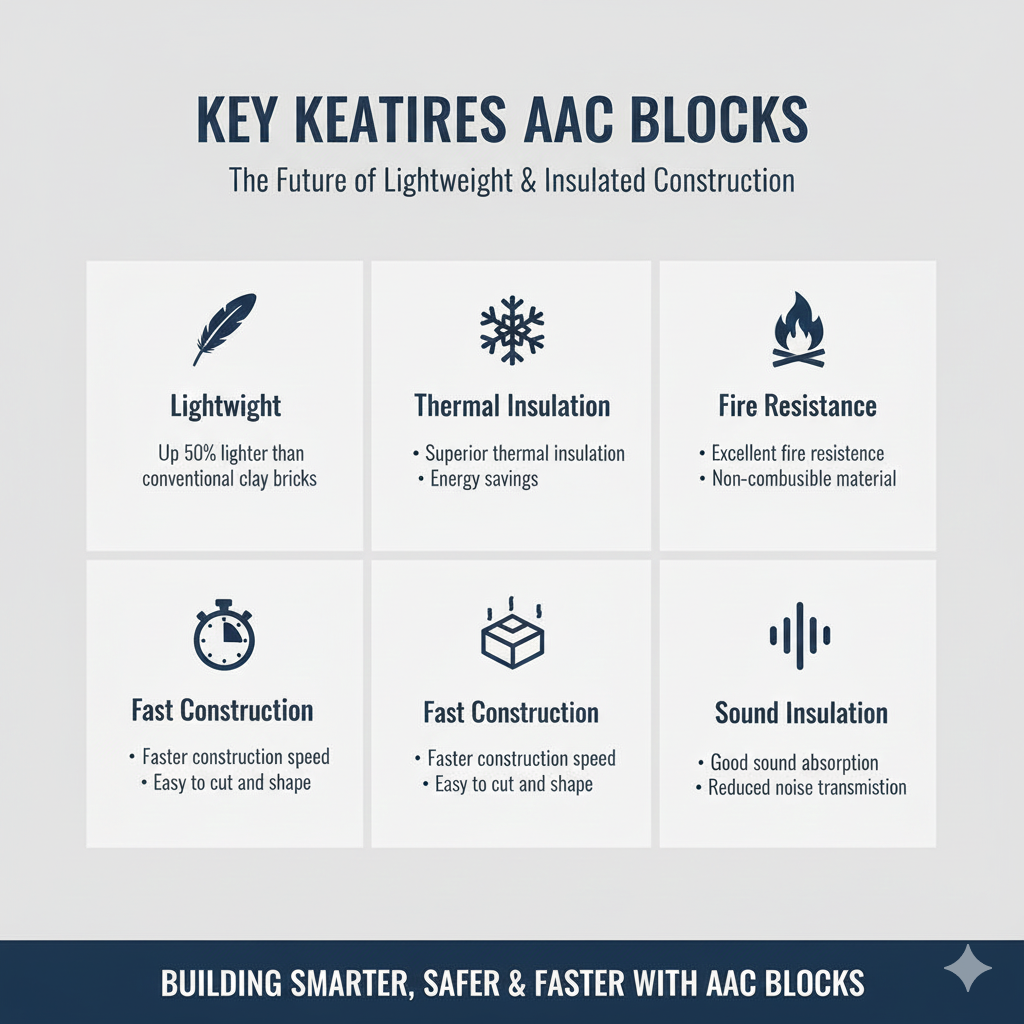
AAC blocks are lightweight, precast foam concrete building materials that offer excellent structural, thermal, and acoustic performance. Made from cement, lime, sand, water, and an expansion agent, AAC blocks are cured in autoclaved chambers, which give them their unique cellular structure.
Up to 50% lighter than conventional clay bricks
Superior thermal insulation
Reduced dead load on structures
Faster construction speed
Excellent fire resistance
Because AAC blocks are porous and lightweight, they require a mortar that can bond firmly without adding excess weight or thickness. This is where block fixing mortar plays a crucial role.
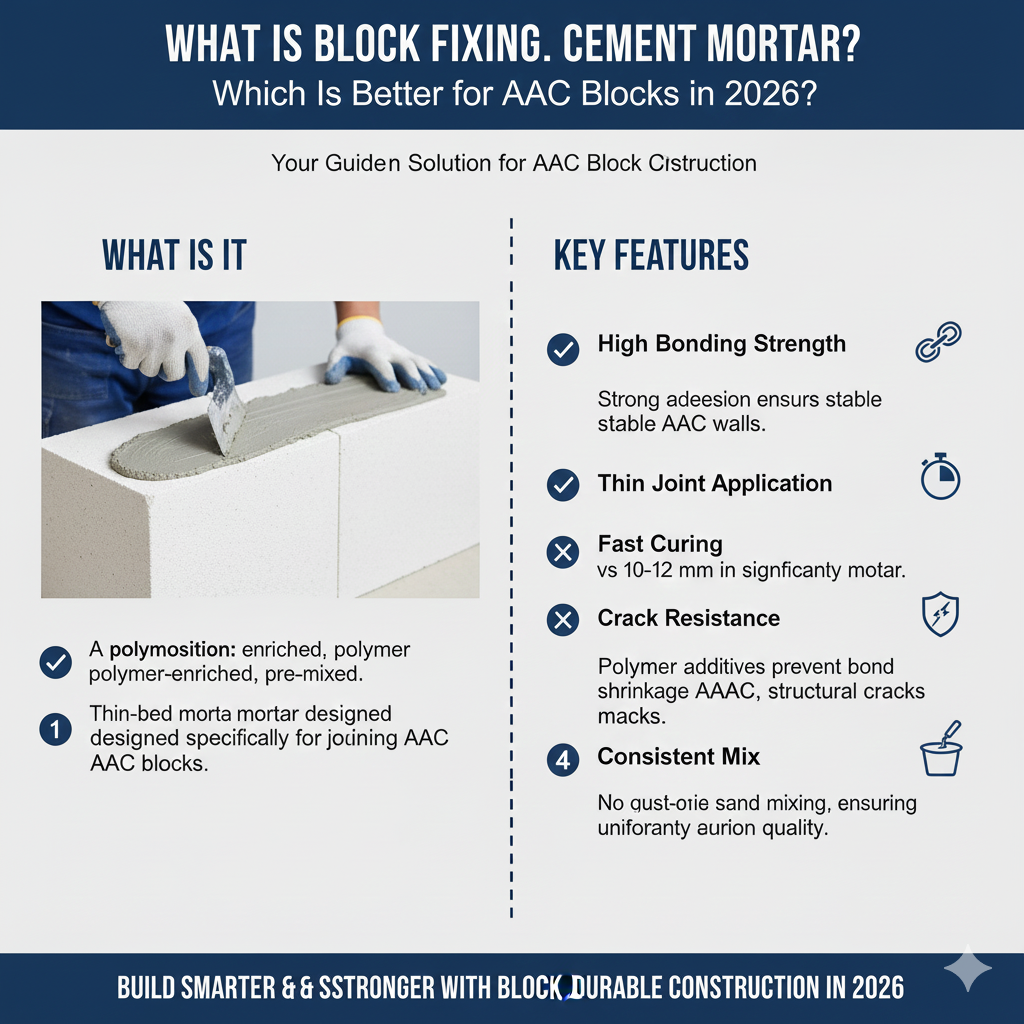
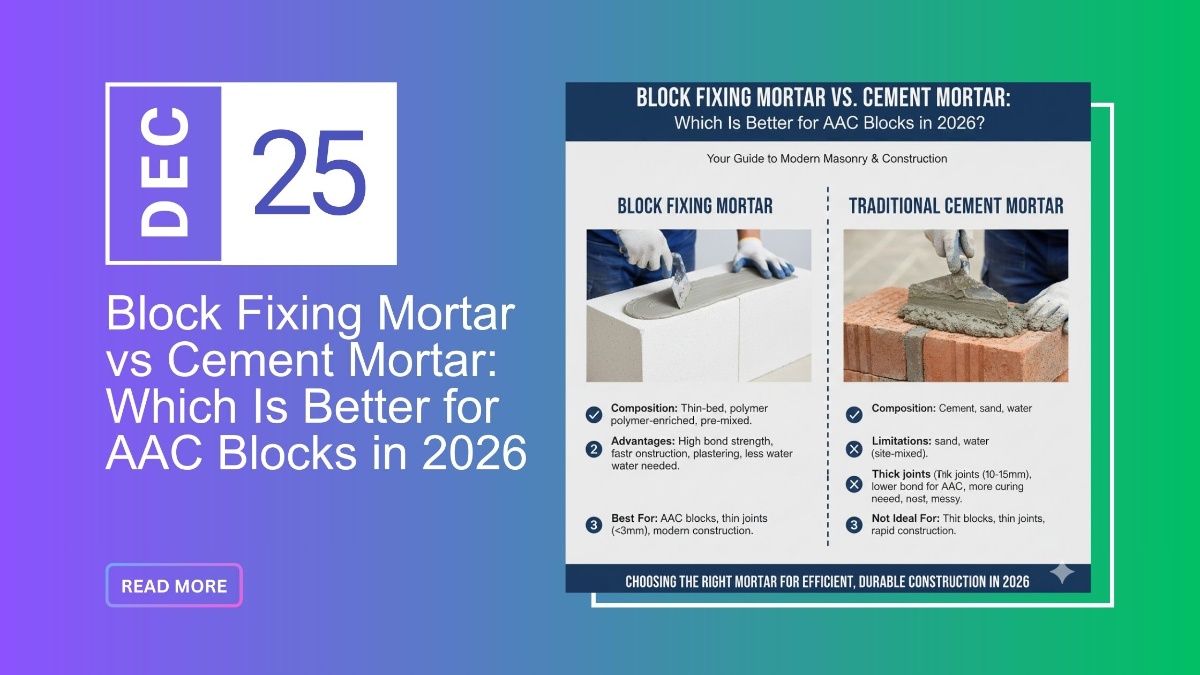
Block fixing mortar is a polymer-modified, ready-to-use thin-bed adhesive designed specifically for AAC blocks, concrete blocks, and lightweight masonry units. It is pre-mixed in controlled manufacturing environments to ensure consistent quality and performance.
Compared to traditional cement mortar, block-fixing mortar requires much thinner joints only 2–3 mm, which drastically improves the structural uniformity and reduces thermal bridging.
Block adhesive contains polymers, graded sand, and special additives that enhance bonding strength, flexibility, and workability. When applied between AAC blocks, it forms a strong interlocking layer that prevents cracks, improves wall alignment, and boosts overall durability.
High Bonding Strength: Strong adhesion ensures stable AAC block walls.
Thin Joint Application: Only 2–3 mm vs 10–12 mm in cement mortar.
Fast Curing: Reduces construction timelines significantly.
Crack Resistance: Polymer additives prevent shrinkage and structural cracks.
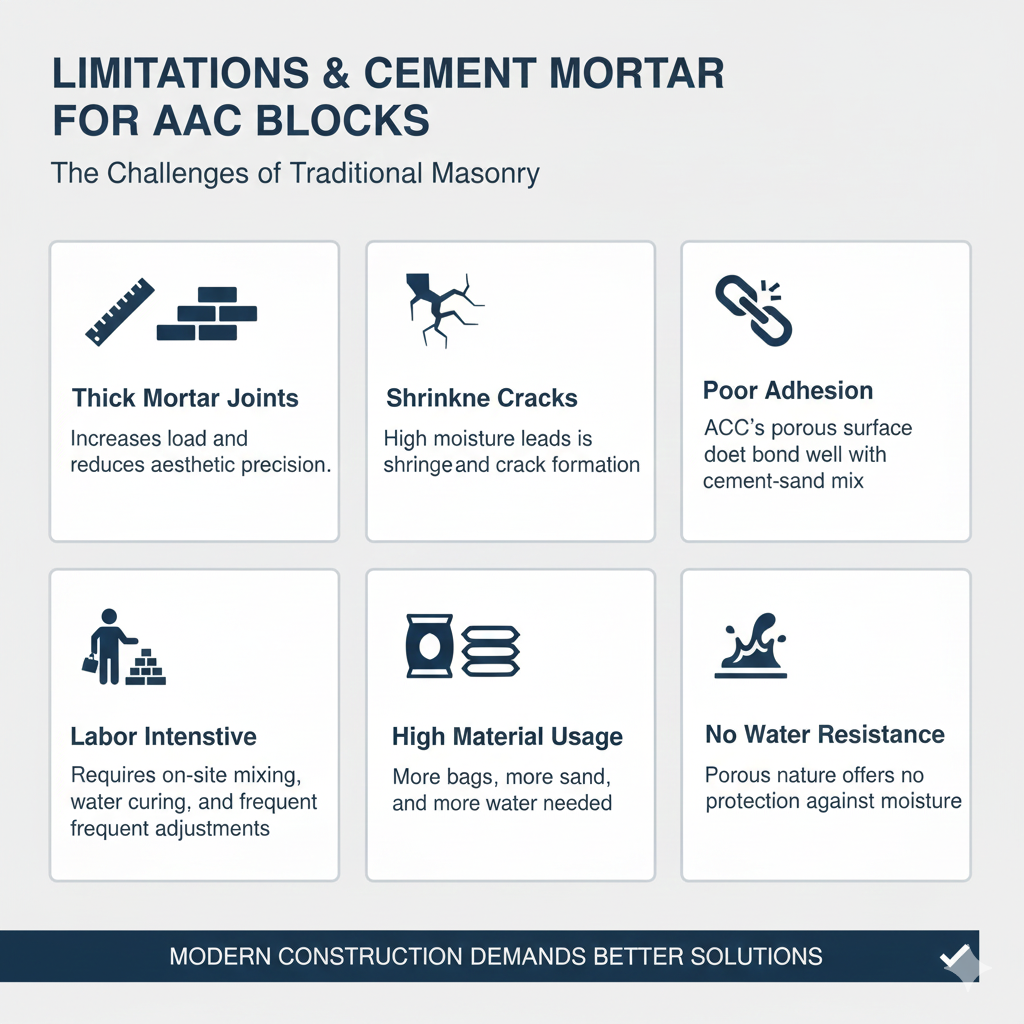
Cement mortar is a traditional mixture of cement, sand, and water, widely used in masonry for decades. While it offers basic bonding capabilities, it comes with several limitations when used with AAC blocks.
Cement mortar requires thick application layers typically 10–12 mm and depends heavily on the sand quality, curing practices, and mix ratio. These factors often lead to inconsistency and unreliable results on modern construction sites.
Thick Mortar Joints: Increases load and reduces aesthetic precision.
Shrinkage Cracks: High moisture leads to shrinkage and crack formation.
Poor Adhesion: AAC’s porous surface does not bond well with cement-sand mix.
Labor Intensive: Requires on-site mixing, water curing, and frequent adjustments.
High Material Usage: More bags, more sand, and more water needed.
| Feature | Block Fixing Mortar | Cement Mortar |
|---|---|---|
| Joint Thickness | 2–3 mm | 10–12 mm |
| Bond Strength | High | Moderate |
| Shrinkage | Minimal | High |
| Application Time | Fast | Slow |
| Durability | Excellent | Moderate |
| Cost Efficiency | High long-term | Low short-term |
| Crack Formation | Low | High |
| Curing | Minimal | Heavy water curing |
| Consistency | Factory-made | Depends on sand & mixing |
AAC blocks have a unique porous structure that makes them lightweight and thermally efficient, but this same feature demands a mortar with exceptionally high grip. Traditional cement mortar struggles to penetrate the microscopic pores of AAC, resulting in weak bonding, uneven joints, and long-term structural issues. To achieve the required adhesion strength for AAC, the mortar needs to form a mechanical interlock that can withstand thermal expansion, vibration, and load transfer.
This is where polymer bonding plays a crucial role. Block fixing mortar contains specially engineered polymers that enhance flexibility and bonding performance. These polymers seep into the tiny air pockets of AAC blocks and create a strong adhesive film, significantly improving mortar grip strength. As a result, walls built with polymer-modified adhesives exhibit better stability, reduced joint failures, and increased durability.
When weak adhesion occurs as seen with cement mortar it leads to separation between blocks, crack formation, hollow sounds, and compromised wall alignment. Over time, these issues can increase maintenance costs and affect structural safety. High-grip, polymer-enhanced mortar eliminates these risks and ensures long-term reliability for AAC block construction.
Construction speed is one of the biggest deciding factors when choosing between block fixing mortar and traditional cement mortar. Block fixing mortar provides a major advantage because it is formulated as an easy application mortar. Since it is a ready mix AAC adhesive, workers only need to add water and apply, eliminating the time-consuming steps of sand measurement, manual mixing, and repeated adjustments. This consistency speeds up work on-site and minimizes human error.
The thin-bed application also contributes to fast installation AAC processes. Masons can spread the mortar quickly using notched trowels, place AAC blocks with greater accuracy, and ensure smoother alignment with less rework. Faster setting time further reduces delays, allowing construction teams to complete more square feet per day.
In contrast, cement mortar requires labor-intensive preparation, constant water curing, and thicker joints, all of which slow the pace of construction. For builders who value efficiency, predictable results, and shorter project timelines, block fixing mortar is the superior choice in 2026.
Block fixing mortar is specially manufactured as a thin joint adhesive, which allows AAC blocks to be installed with joints as thin as 2–3 mm. This reduces material usage while enabling faster, cleaner masonry work. Because the adhesive spreads smoothly and maintains consistent thickness, masons can achieve quick alignment blocks with minimal effort. The improved workability also reduces the need for constant adjustments or surface corrections. Overall, block fixing mortar delivers better speed, cleaner joints, and greater precision—ideal for modern AAC block construction.
Traditional cement mortar is slower and less efficient for AAC blockwork. One major issue is slow curing cement, which increases waiting time before further construction can continue. Additionally, cement mortar depends on manual proportioning of cement, sand, and water, often resulting in an inconsistent mortar mix. Poor batching leads to uneven bonding strength and unpredictable workability. The need for heavy mortar joints (10–15 mm) not only increases material consumption but also reduces installation speed and alignment accuracy. These limitations make cement mortar less suitable for today’s fast-paced construction requirements.
Cost is a major deciding factor when choosing between block fixing mortar and traditional cement mortar. At first glance, the AAC mortar cost or block fixing mortar cost may appear slightly higher per bag compared to conventional cement and sand. However, the actual expense must be evaluated based on material efficiency, labor output, and long-term performance. Block fixing mortar requires only a thin 2–3 mm application, meaning significantly less material is consumed per square foot. This leads to lower overall usage and predictable budgeting.
On the other hand, the cement mortar cost seems cheaper upfront, but its thicker 10–15 mm joints increase material consumption by up to three times. It also requires sand procurement, manual mixing, curing, and additional labor, all of which add hidden costs. When factoring productivity and durability, block fixing mortar becomes far more cost-effective.
Additionally, the superior bonding and reduced cracks achieved with block fixing mortar contribute to long-term construction savings. Fewer repairs, reduced maintenance, and stable wall performance make block fixing mortar an economical choice for builders looking beyond initial material prices.
Short-term construction budgets usually focus on material prices, but real savings depend on overall efficiency. Block fixing mortar reduces material usage AAC blocks because its thin-bed application requires far less quantity than traditional cement mortar. This results in a lower cost per square foot despite a slightly higher bag price.
Labor efficiency also plays a major role. Faster application, easier alignment, and no curing requirements lead to substantial labor cost savings. Masons complete more work in less time, reducing total labor hours and project delays.
In the long run, block fixing mortar outperforms cement-based mixes due to its superior adhesion and strength. Its durable mortar formulation minimizes cracks, water seepage, and rework costs. Over the building’s lifespan, this translates to reduced repair and maintenance expenses, making block fixing mortar the financially smarter choice.
Lapifix provides advanced polymer-modified block fixing mortar designed for fast, durable, and precise AAC block installation. With strong adhesion, thin 2–3 mm joints, and excellent crack resistance, Lapifix adhesives help builders achieve cleaner walls and faster project completion. Engineered for modern 2026 construction needs, Lapifix ensures consistent quality, long-term strength, and compatibility with green building standards making it a reliable choice for professionals seeking superior AAC block performance.
Block fixing mortar is engineered to match the thermal expansion rate of AAC blocks.
This thermal compatibility prevents stress formation during temperature changes.
Cement mortar expands differently, increasing the chances of joint failure and cracks.
Polymer additives in block fixing mortar significantly enhance crack prevention.
Thin-bed joints (2–3 mm) minimize shrinkage, helping walls remain stable for years.
Cement mortar forms thicker joints that shrink more and often lead to hairline cracks.
Block fixing mortar provides better adhesion to AAC surfaces, improving structural reliability.
Stronger bonding ensures stable load transfer between blocks, reducing the risk of weak joints.
Unlike cement mortar, it prevents hollow gaps and block shifting, enhancing long-term wall strength.
The low water absorption of block fixing mortar offers excellent weather resistance.
It protects walls from moisture intrusion, efflorescence, and dampness during monsoon seasons.
Cement mortar is more porous, making walls vulnerable to seepage and early deterioration.
Construction practices in 2026 focus on speed, precision, and sustainability. With the rise of AAC block trends, builders need mortars that match the performance and energy efficiency of AAC walls. Block fixing mortar aligns perfectly with new green building codes, which emphasize reduced waste, better insulation, and eco-friendly practices.
As sustainable construction becomes the industry standard, block-fixing mortar stands out due to its thin-bed application, strong adhesion, and lower material consumption. Unlike cement mortar, it offers long-term strength with less environmental impact.
Overall, the best mortar for AAC blocks in modern projects is block fixing mortar. It supports faster work, higher durability, and meets the expectations of AAC construction 2026, making it one of the most reliable sustainable building materials today.
Choosing the right mortar is essential for achieving strong, durable, and efficient AAC block construction in 2026. While traditional cement mortar remains common, it cannot match the precision, speed, and long-term performance of modern block fixing mortar. Thanks to its thin-bed application, superior bonding, crack resistance, and compatibility with sustainable building standards, block-fixing mortar is now the preferred choice for professionals aiming for high-quality, future-ready structures.
As construction trends shift toward lighter materials, green building codes, and long-term cost savings, block fixing mortar clearly provides better performance and value. For homeowners, builders, and contractors looking to build stronger, smarter, and more energy-efficient walls, the decision is straightforward: block-fixing mortar is the most reliable and advanced solution for AAC blocks.
At Lapifix, we ensure premium-quality block fixing solutions designed for modern construction needs.
Block fixing mortar is engineered with polymers that improve adhesion, reduce cracks, and support thin-joint construction, making it the top choice for modern AAC block masonry in 2026.
Using cement mortar leads to thick joints, weak bonding, higher shrinkage, and misalignment issues that compromise the long-term durability of AAC walls.
Yes. Polymer-modified adhesives form a micro-locking mechanism with AAC pores, giving them 3–4 times higher bonding strength than traditional cement mortar.
Absolutely. It eliminates sand mixing, reduces curing time, and uses a thin-bed technique, enabling masonry teams to complete work 2–3 times faster.
Most projects require 3–4 kg per m², depending on block size and trowel notch depth significantly less than cement mortar consumption.
Yes. Its 2–3 mm thin joints minimize thermal gaps, improving insulation and overall energy efficiency of AAC block structures.
Yes, it performs well in humid climates due to low water absorption, faster setting time, and better resistance to efflorescence compared to cement mortar.
Block fixing mortar provides the best long-term value because it reduces material usage, labor hours, curing costs, and post-construction repairs.
Yes. It supports eco-friendly construction by reducing cement consumption, lowering wastage, and improving thermal performance in AAC buildings.
Walls built with polymer-modified block mortar can last 40–50 years with minimal maintenance, thanks to superior bonding, reduced shrinkage, and crack resistance.