

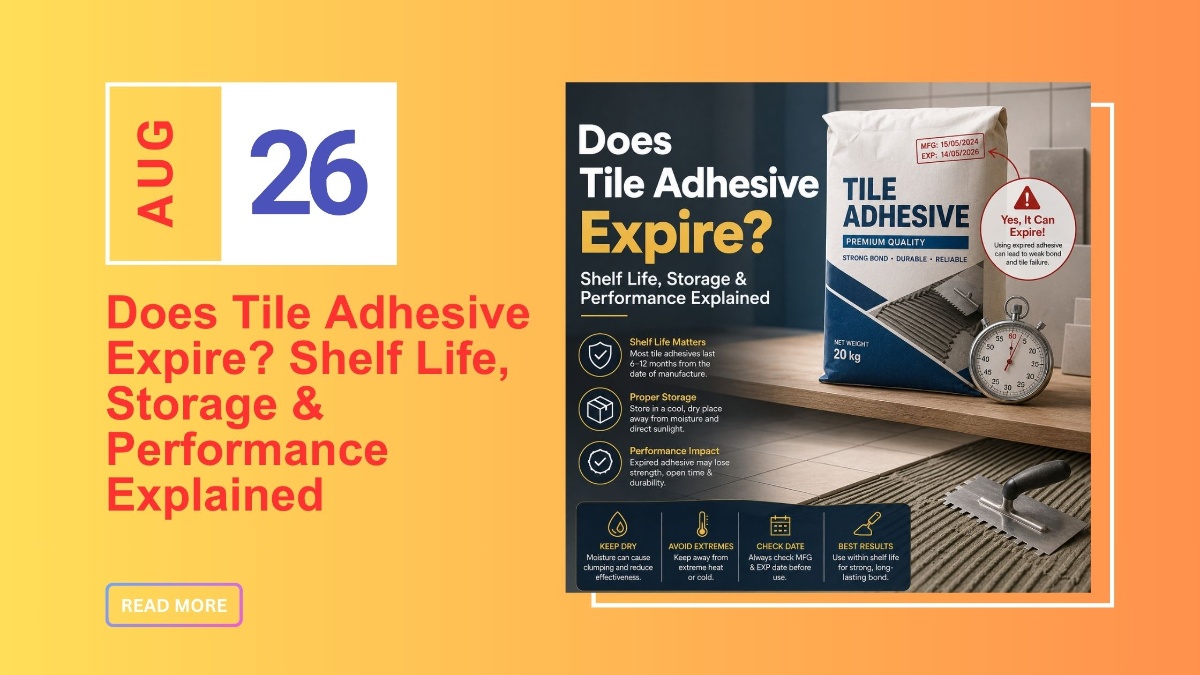
Many homeowners and contractors discover a few unopened bags of tile adhesive left over from a previous project and immediately ask the same question: Can I still use it? At first glance, a sealed bag may appear perfectly fine, but tile adhesives are carefully engineered construction materials with a defined shelf life. Over time, exposure to moisture, humidity, and unsuitable storage conditions can reduce their performance—even if the packaging has never been opened.
Using adhesive that has exceeded its recommended storage period may affect bond strength, workability, and long-term durability. While the product may still look usable, its internal chemical properties can change, increasing the risk of installation failures such as loose tiles, hollow spots, or poor adhesion. Understanding tile adhesive shelf life is therefore just as important as selecting the correct adhesive for the project.
Whether you're a homeowner planning a renovation, a contractor managing inventory, or a distributor storing construction materials, knowing how long tile adhesive remains usable helps reduce waste, improve installation quality, and protect your investment.
Yes. Most cement-based tile adhesives have a recommended shelf life provided by the manufacturer. Although the exact duration varies depending on the formulation and storage conditions, the product is designed to deliver its specified performance only within this period.
Tile adhesive contains cement, polymers, graded fillers, and performance-enhancing additives that work together to create a strong and durable bond. These ingredients remain stable only when protected from moisture and stored under appropriate environmental conditions.
Even unopened bags gradually age. Over time, exposure to humidity or improper storage may trigger slow chemical reactions inside the packaging, reducing the adhesive's ability to hydrate and develop full bonding strength once mixed with water.
For this reason, professional installers generally avoid using adhesive beyond the manufacturer's recommended shelf life unless its condition has been carefully assessed and approved.
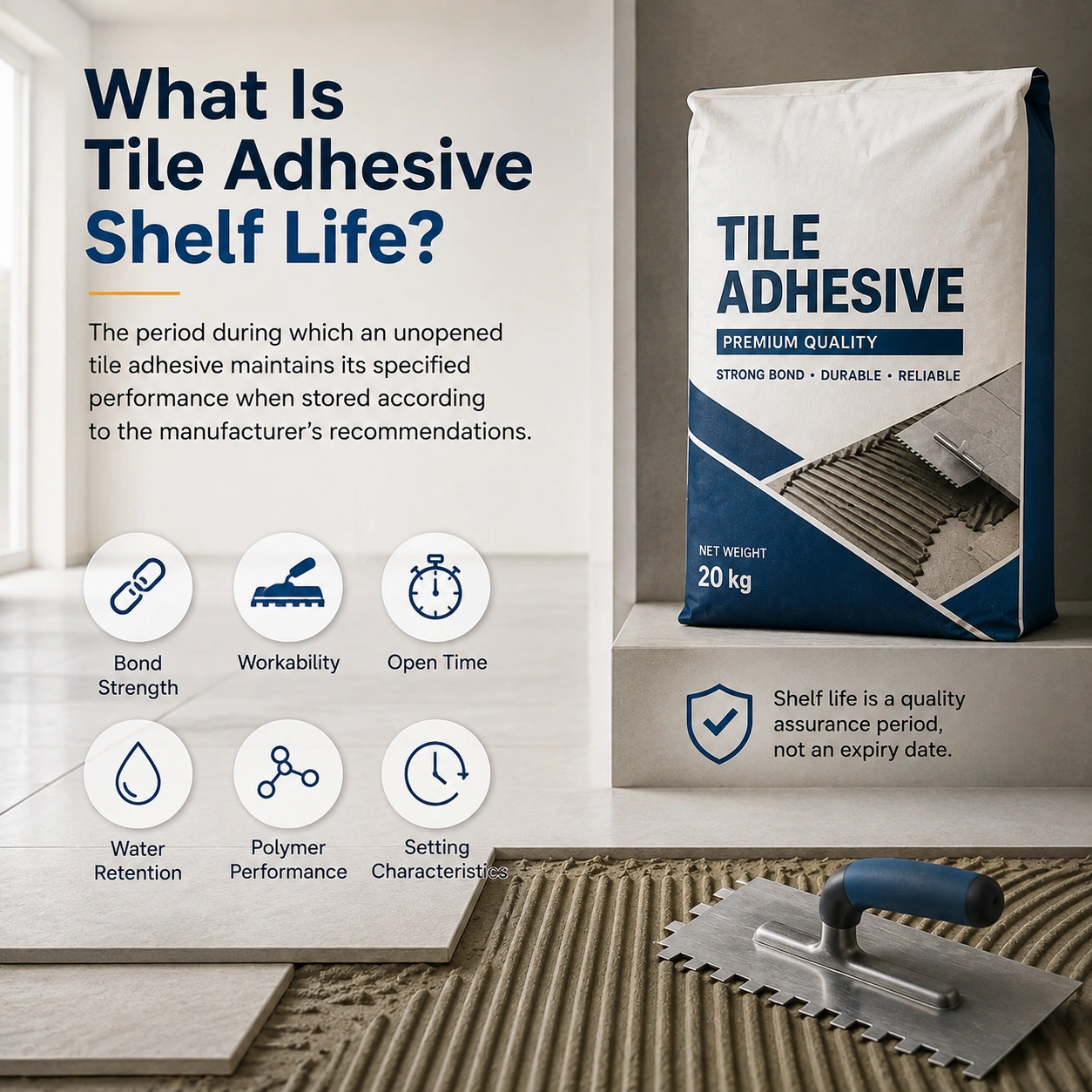
Tile adhesive shelf life refers to the period during which an unopened product is expected to maintain its specified performance when stored according to the manufacturer's recommendations.
It is important to understand that shelf life does not simply represent a marketing guideline. It reflects extensive laboratory testing carried out by manufacturers to determine how long the adhesive retains its designed properties under controlled storage conditions.
These properties include:
Bond strength
Workability
Open time
Water retention
Polymer performance
Setting characteristics
Once the recommended storage period has passed, manufacturers can no longer guarantee that these performance characteristics will remain unchanged.
Shelf life should therefore be viewed as a quality assurance period rather than an arbitrary expiry date.
Some construction materials remain usable for many years, but cement-based products behave differently because they react chemically with moisture.
Even tiny amounts of humidity entering the packaging can begin activating portions of the cement before the product is mixed. Although this reaction may not be immediately visible, it gradually reduces the adhesive's ability to develop full strength during installation.
Using fresh adhesive within its recommended tile adhesive shelf life helps ensure predictable workability, consistent bonding, and long-term durability.
For professional contractors, this also reduces the likelihood of costly callbacks resulting from installation failures linked to aged materials.
As tile adhesive gets older, several physical and chemical changes may occur depending on storage conditions.
The cement particles can slowly absorb atmospheric moisture, reducing their reactivity during mixing. Polymer additives may also lose effectiveness over time, affecting flexibility and adhesion.
These changes can make the adhesive more difficult to mix, reduce its working time, and lower its final bond strength after curing.
Although the product may still resemble fresh adhesive visually, its performance may no longer meet the standards originally specified by the manufacturer.
This is why experienced installers pay close attention not only to manufacturing dates but also to storage conditions before deciding whether a product remains suitable for use.
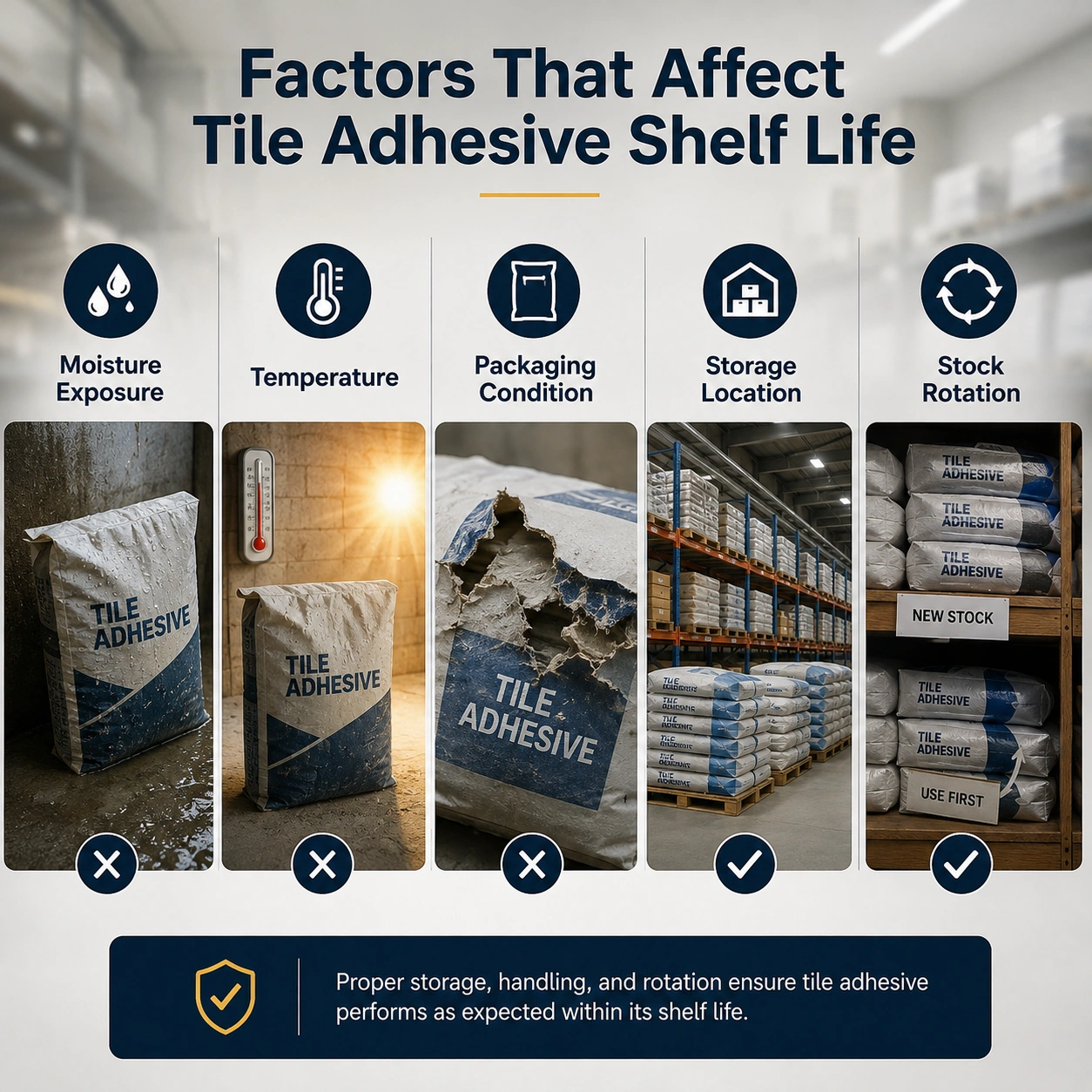
Shelf life is influenced by much more than the manufacturing date. Storage environment plays an equally important role in preserving product quality.
Moisture is the single greatest threat to cement-based tile adhesive.
Even unopened bags can gradually absorb humidity if packaging is damaged or stored in damp conditions. Once moisture begins reacting with the cement, the adhesive loses part of its ability to develop proper bonding strength.
For this reason, tile adhesive should always be stored in dry, covered locations protected from rain, condensation, and groundwater.
Extreme temperatures can also affect long-term product stability.
Very high temperatures may accelerate ageing of polymer additives, while repeated temperature fluctuations increase the likelihood of condensation forming inside storage areas.
Maintaining moderate, stable storage temperatures helps preserve adhesive quality throughout its recommended shelf life.
The packaging itself provides the primary protection against environmental exposure.
Torn bags, punctures, damaged seals, or packaging that has absorbed moisture significantly increase the risk of premature deterioration.
Before using any adhesive, carefully inspect the bag for visible signs of damage or water exposure.
If packaging integrity has been compromised, the product should be evaluated carefully before installation.
Where adhesive is stored often has a greater influence on product life than many people realize.
Professional warehouses typically keep bags elevated on pallets, away from walls and direct contact with concrete floors where moisture may accumulate.
Good ventilation also helps maintain stable humidity levels while protecting packaged materials from condensation.
Proper adhesive storage significantly extends the likelihood that the product will remain within specification throughout its recommended shelf life.
Professional contractors and distributors commonly use the First-In, First-Out (FIFO) inventory method.
This simple practice ensures older stock is used before newly delivered material, reducing the risk of products remaining in storage beyond their recommended shelf life.
Proper inventory management not only improves product reliability but also reduces waste and unnecessary replacement costs.
A high-quality adhesive is designed to deliver excellent bond strength only if its chemical properties remain intact before mixing. Once moisture, excessive heat, or poor storage conditions begin affecting the product, even premium formulations may no longer perform as intended.
Understanding both tile adhesive shelf life and proper adhesive storage allows contractors, retailers, and homeowners to make informed decisions about material handling, project planning, and inventory management.
For projects requiring complete installation systems, including tile grout and finishing products, you can also explore Lapifix Tile Grouts
Proper cementitious adhesive storage is one of the easiest ways to maintain product quality throughout its recommended shelf life. Even premium tile adhesives can lose performance if they are exposed to unsuitable storage conditions before use.
Manufacturers typically recommend storing adhesive bags indoors in a dry, well-ventilated location where they are protected from rain, direct sunlight, and excessive humidity. The storage area should remain clean and free from standing water or condensation that could damage the packaging.
Another important practice is keeping bags elevated above the floor using wooden or plastic pallets. This prevents moisture from concrete floors from reaching the packaging while allowing air to circulate beneath the stacked materials.
Professional warehouses also avoid stacking bags excessively high because excessive weight can damage lower bags and weaken the packaging over time.
Checking the manufacturing date is the first step, but it is not the only indicator of product condition. A bag that is still within its recommended tile adhesive shelf life may have deteriorated if it has been stored improperly.
Before opening the package, inspect it carefully for tears, punctures, moisture stains, or hardened sections. Damaged packaging often allows humidity to enter, accelerating deterioration.
Once the bag is opened, examine the powder closely. Fresh adhesive should appear free-flowing and consistent in texture. Large hardened lumps, excessive clumping, or unusual discoloration may indicate that moisture has already reacted with the cement.
During mixing, aged adhesive may require more effort to blend evenly, develop poor workability, or fail to achieve the smooth consistency expected from fresh material.
Although these observations cannot replace laboratory testing, they provide useful practical indicators that the product may no longer perform as intended.
This is one of the most frequently asked questions among homeowners and contractors.
Technically, an expired tile adhesive may still appear usable, but manufacturers generally cannot guarantee its specified performance once the recommended tile adhesive shelf life has been exceeded.
Cement hydration, polymer stability, bond strength, and workability all depend on the chemical condition of the product. As these properties change with age or poor storage, the risk of installation failure increases.
For low-risk temporary applications, some contractors may choose to evaluate the material carefully before use. However, for permanent residential, commercial, or industrial tile installations, professional practice is to use fresh adhesive that remains within the manufacturer's recommended shelf life.
The potential cost of replacing failed tiles usually far exceeds the cost of purchasing new adhesive.
The effects of aging are not always immediately visible during installation. In many cases, problems appear only after weeks or months of service.
Reduced bond strength is one of the most significant concerns. Tiles installed with deteriorated adhesive may gradually loosen or produce hollow sounds when tapped.
Open time may also decrease, giving installers less time to position tiles accurately before the adhesive begins to skin over.
Some aged products develop reduced flexibility, increasing the likelihood of cracking where thermal movement or minor structural movement occurs.
Poor hydration may also affect adhesive setting time, resulting in inconsistent curing and lower long-term durability.
These performance changes explain why proper adhesive storage and inventory management are critical to successful tile installations.
The following comparison highlights the practical differences between properly stored adhesive and material that has exceeded its recommended shelf life.
|
Characteristic |
Fresh Tile Adhesive |
Expired Tile Adhesive |
|
Powder Condition |
Free-flowing and uniform |
Clumps or hardened particles may be present |
|
Mixing |
Smooth and consistent |
Difficult to mix evenly |
|
Workability |
Excellent |
Reduced |
|
Bond Strength |
Manufacturer-specified performance |
Performance cannot be guaranteed |
|
Adhesive Setting Time |
Predictable |
May vary |
|
Long-Term Reliability |
High |
Increased risk of failure |
This comparison demonstrates why the condition of the adhesive is just as important as the installation technique.
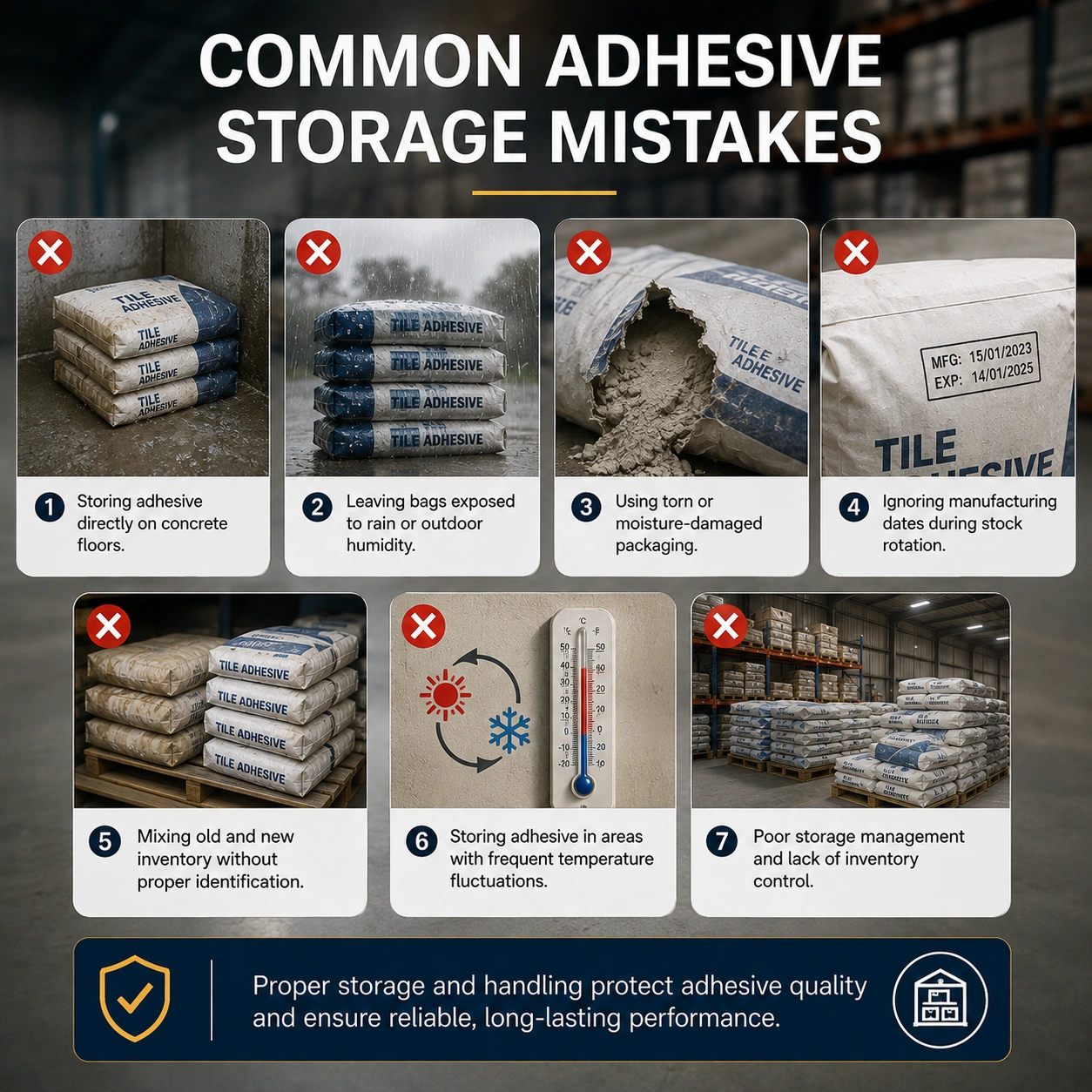
Many storage problems can be avoided by following a few simple handling practices. Unfortunately, some of the most common mistakes occur long before installation begins.
Storing adhesive directly on concrete floors.
Leaving bags exposed to rain or outdoor humidity.
Using torn or moisture-damaged packaging.
Ignoring manufacturing dates during stock rotation.
Mixing old and new inventory without proper identification.
Storing adhesive in areas with frequent temperature fluctuations.
Professional contractors minimize these risks by implementing consistent inventory control procedures and maintaining suitable storage environments.
Experienced installers understand that product quality begins long before adhesive is mixed.
Always purchase materials from reliable suppliers with good inventory turnover. Fresh stock is less likely to have experienced prolonged warehouse storage before delivery.
Inspect packaging during delivery and reject bags showing signs of water damage or significant physical deterioration.
Use the First-In, First-Out (FIFO) method to ensure older stock is consumed before newly delivered materials. This simple practice greatly reduces the likelihood of products exceeding their recommended tile adhesive shelf life.
Whenever possible, store adhesive indoors on pallets, away from direct sunlight, exterior walls, and damp surfaces.
Maintaining these conditions helps preserve adhesive performance and reduces unnecessary material waste.
Large construction projects often involve hundreds or even thousands of bags of tile adhesive.
Without proper inventory management, some materials may remain unused long enough to exceed their recommended storage period. This not only increases waste but also creates uncertainty regarding product performance.
Digital inventory systems, barcode tracking, and scheduled warehouse inspections are becoming increasingly common on commercial projects because they improve stock rotation and reduce material losses.
Even small residential contractors benefit from basic inventory management by clearly labeling delivery dates and organizing materials for easy rotation.
For projects requiring complete tile installation systems, including structural fixing and finishing materials, you can also explore Lapifix Structural Fixing Solutions
Maintaining tile adhesive quality begins the moment the product arrives on site or at the warehouse. Professional contractors know that proper handling is just as important as proper installation because even the best adhesive cannot perform as intended if it has deteriorated before mixing.
Always store adhesive indoors in a clean, dry, and well-ventilated area. Bags should remain sealed in their original packaging until they are ready to be used. Opening a bag too early exposes the adhesive to moisture in the air, which can gradually reduce its performance.
Place bags on wooden or plastic pallets rather than directly on concrete floors. This simple practice protects the packaging from rising dampness while improving air circulation beneath the stacked materials.
Avoid stacking bags against exterior walls where condensation can form during temperature changes. If the storage area experiences significant humidity fluctuations, consider improving ventilation or using moisture-control measures to maintain a stable environment.
Most importantly, always follow the manufacturer's storage instructions because different adhesive formulations may have slightly different environmental requirements.
As construction projects become larger and more efficient, material storage practices continue to improve.
Digital inventory management systems are now widely used on commercial construction sites. Barcode tracking, QR code labeling, and automated stock monitoring help contractors identify product age quickly and rotate inventory more effectively.
Many manufacturers also provide clearer packaging with visible manufacturing dates, batch numbers, and recommended storage conditions, making stock management easier for distributors and contractors.
Climate-controlled warehouses are becoming increasingly common in regions with high humidity or extreme temperatures. Maintaining stable environmental conditions helps preserve cementitious adhesive storage quality while reducing material losses caused by premature ageing.
Sustainability is another growing trend. Better inventory management reduces unnecessary disposal of expired construction materials, helping projects minimize waste while improving cost efficiency.
Proper storage recommendations are based on years of laboratory testing and field experience. Manufacturers evaluate how temperature, humidity, packaging integrity, and storage duration affect adhesive performance before determining the recommended tile adhesive shelf life.
Industry best practices generally include storing products in dry indoor environments, protecting packaging from moisture, rotating stock using the First-In, First-Out (FIFO) method, and inspecting bags before use.
Professional installers also verify that adhesive remains free-flowing and free from hardened lumps before mixing. If there is any doubt about product condition, replacing the adhesive is usually the safest option.
Following both manufacturer instructions and recognized industry guidelines helps ensure consistent installation quality and long-term durability.
Tile installations are expected to perform reliably for many years, often under demanding conditions such as heavy foot traffic, moisture exposure, and thermal movement.
Fresh adhesive provides predictable workability, proper adhesive setting characteristics, and the bond strength required to support these conditions. Using material beyond its recommended tile adhesive shelf life introduces unnecessary uncertainty into the installation.
Replacing damaged tiles, removing old adhesive, preparing the substrate again, and reinstalling new tiles usually costs significantly more than replacing a questionable bag of adhesive before installation begins.
For homeowners, contractors, and project managers alike, choosing fresh materials is one of the simplest ways to reduce long-term maintenance costs.
Although storage recommendations vary slightly between manufacturers, most cement-based tile adhesives are tested according to internationally recognized performance standards.
The Tile Council of North America (TCNA) publishes installation guidelines covering substrate preparation, adhesive selection, storage considerations, and best installation practices for ceramic and porcelain tile systems.
Manufacturers also publish Technical Data Sheets (TDS) that specify recommended storage conditions, expected tile adhesive shelf life, application procedures, and environmental limitations. These documents should always be consulted before installation because they provide product-specific guidance that takes precedence over general recommendations.
Understanding tile adhesive shelf life is essential for achieving reliable, long-lasting tile installations. Even high-quality adhesives can lose performance if they are stored improperly or used beyond their recommended storage period. By following proper cementitious adhesive storage practices, inspecting packaging carefully, and using materials within the manufacturer's recommended shelf life, homeowners and professionals can reduce installation risks, improve bond strength, and avoid costly repairs in the future.
If you're planning a residential, commercial, or industrial tiling project, choosing fresh, professionally manufactured installation materials is just as important as selecting the right adhesive type. Explore the complete range of tile installation products from Lapifix, including tile adhesives, grouts, and finishing solutions. Proper storage and quality materials today help deliver stronger, more dependable tile installations for years to come.
The tile adhesive shelf life depends on the manufacturer and product formulation. Most cement-based adhesives have a recommended storage period when kept unopened in dry, properly ventilated conditions. Always refer to the product packaging or technical data sheet for the specific shelf life.
Although an expired tile adhesive may still appear usable, its bond strength, workability, and performance can no longer be guaranteed. For permanent installations, using fresh adhesive within the recommended shelf life is the safest approach.
Adhesive should be stored indoors in a cool, dry location on pallets and protected from rain, moisture, direct sunlight, and damaged packaging. Proper adhesive storage helps preserve product quality throughout its recommended shelf life.
Common signs include hardened lumps, moisture-damaged packaging, poor mixing consistency, unusual discoloration, and reduced workability. If the adhesive does not mix smoothly or shows evidence of moisture exposure, it should not be used for critical installations.
Yes. Even unopened bags gradually age over time. While sealed packaging slows deterioration, manufacturers specify a recommended tile adhesive shelf life because long-term storage and environmental conditions eventually affect product performance.