

Walk onto any modern construction site today and you’ll notice one thing immediately — tiles are getting larger, heavier, and far more demanding than they were a decade ago. From polished porcelain slabs in luxury apartments to exterior vitrified tiles on commercial buildings, modern tile installations now require adhesives that can handle movement, moisture, temperature shifts, and long-term structural stress without failing halfway through their job. That’s exactly where EN 12004 Tile Adhesive Standards become important.
For contractors, builders, architects, and manufacturers, these standards act like a universal language for adhesive performance. They help professionals understand whether an adhesive is suitable for ceramic tiles, porcelain slabs, swimming pools, commercial floors, or exterior facades.
A properly classified adhesive doesn’t just hold tiles in place — it improves installation durability, reduces maintenance issues, and protects the entire surface system over time. If you already understand concepts discussed in our guide on Tile Adhesive Guide: Types, Uses, and Benefits , you’ll know how adhesive selection directly impacts tile performance in real-world construction environments.
Modern construction projects increasingly rely on internationally recognised adhesive classifications because buyers and installers want consistency, safety, and professional-grade reliability. In this complete 2026 guide, we’ll break down everything you need to know about EN 12004 Tile Adhesive Standards, including classifications like C1, C2, S1, and S2, testing procedures, flexibility requirements, and how to choose the right adhesive for different applications.
EN 12004 is a European standard developed to classify and evaluate tile adhesives based on their performance characteristics. It defines technical requirements, testing procedures, and adhesive classifications used for fixing ceramic, porcelain, vitrified, and natural stone tiles on floors and walls.
In simple terms, EN 12004 helps professionals understand whether a tile adhesive is suitable for a specific installation condition. Instead of relying on vague marketing claims like “strong adhesive” or “premium quality,” the standard provides measurable performance categories backed by laboratory testing.
The standard primarily focuses on:
Adhesion strength
Water resistance
Heat resistance
Flexibility
Open time
Slip resistance
Deformation capability
These classifications help reduce tile installation failures caused by poor adhesive selection. In modern construction, especially with large-format porcelain tiles becoming increasingly common, the wrong adhesive can lead to cracking, hollow sounds, debonding, or tile lifting over time.
EN 12004 classifications are often discussed alongside ISO 13007 standards because both systems help define adhesive performance requirements, bonding performance, and durability expectations for modern tile installations across residential, commercial, and industrial construction projects.
EN 12004 Tile Adhesive Standards are now widely recognised not only in Europe but also across Asia, the Middle East, Africa, Australia, and international export markets because they provide a reliable benchmark for adhesive quality and performance.
A tile installation is only as strong as the adhesive underneath it. You can install the world’s most beautiful porcelain tile, but if the adhesive lacks flexibility or bonding strength, the surface may fail long before the building itself shows signs of ageing.
That’s why EN 12004 Tile Adhesive Standards are so valuable. They create a standardised system that allows manufacturers, contractors, and buyers to compare products based on tested performance instead of assumptions.
Imagine trying to buy tyres without knowing their grip rating or weather performance. Choosing adhesives without classifications works the same way — risky, expensive, and occasionally disastrous.
In real construction environments, adhesive failure rarely happens immediately after installation. Most problems appear months later when tiles begin sounding hollow, edges start lifting, or grout lines crack due to movement stress, moisture exposure, or poor bonding performance. This is one reason professional contractors increasingly rely on EN 12004 classifications before selecting adhesives for modern tile installations, especially for porcelain slabs, exterior walls, and high-traffic commercial flooring.
These standards improve:
Installation reliability
Surface durability
Moisture resistance
Contractor confidence
Export credibility
Long-term structural performance
They are particularly important for modern tile installations involving:
Large-format slabs
Exterior cladding
Heated flooring systems
Swimming pools
High-traffic commercial areas
EN 12004 classifies adhesives into three main categories based on composition and curing behaviour.
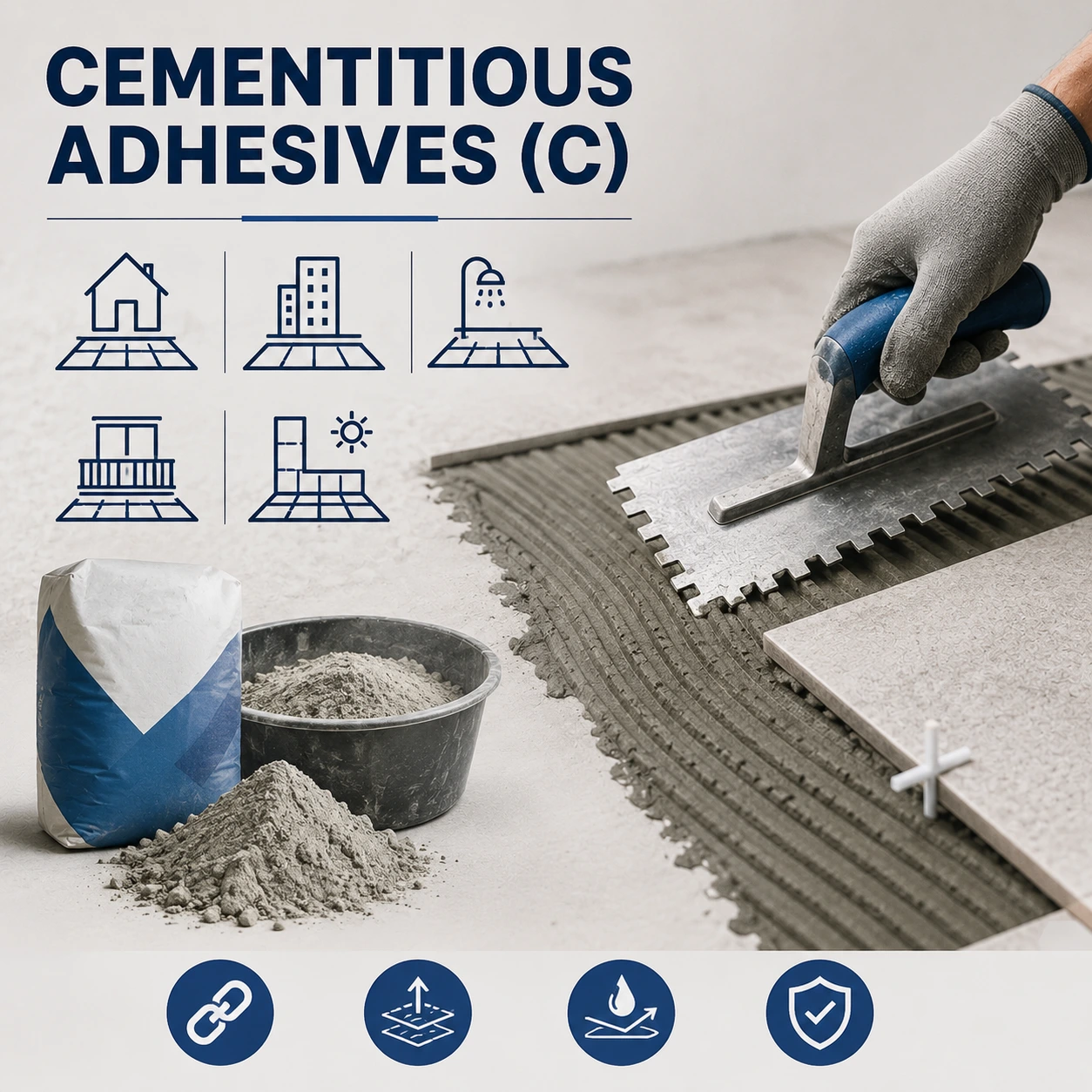
Cementitious adhesives are the most widely used tile adhesives in the construction industry. These powder-based adhesives are mixed with water before application and are suitable for ceramic, vitrified, porcelain, and natural stone tiles.
They are commonly used in:
Residential flooring
Commercial spaces
Bathrooms
Balconies
Exterior wall installations
Modern cementitious adhesives often include polymers and additives that improve flexibility, adhesion strength, and water resistance. Many products discussed in professional guides like Choosing the Right Adhesive for Different Types of Tiles are designed specifically for demanding building environments where durability matters.
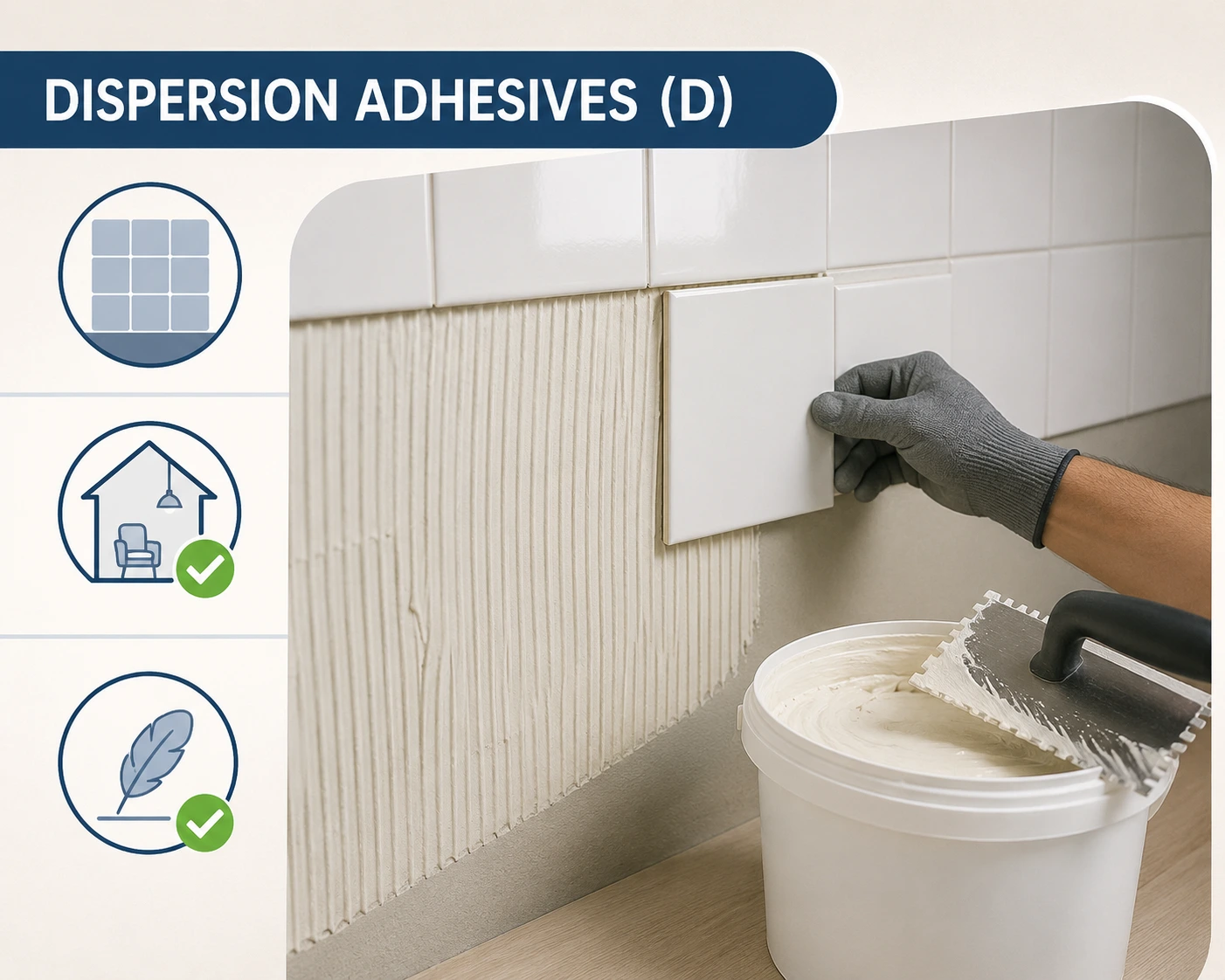
Dispersion adhesives are ready-mixed paste adhesives generally used for interior wall applications. They are easier to apply but are typically limited to lighter-duty environments.
These adhesives are suitable for:
Interior ceramic wall tiles
Dry areas
Lightweight applications
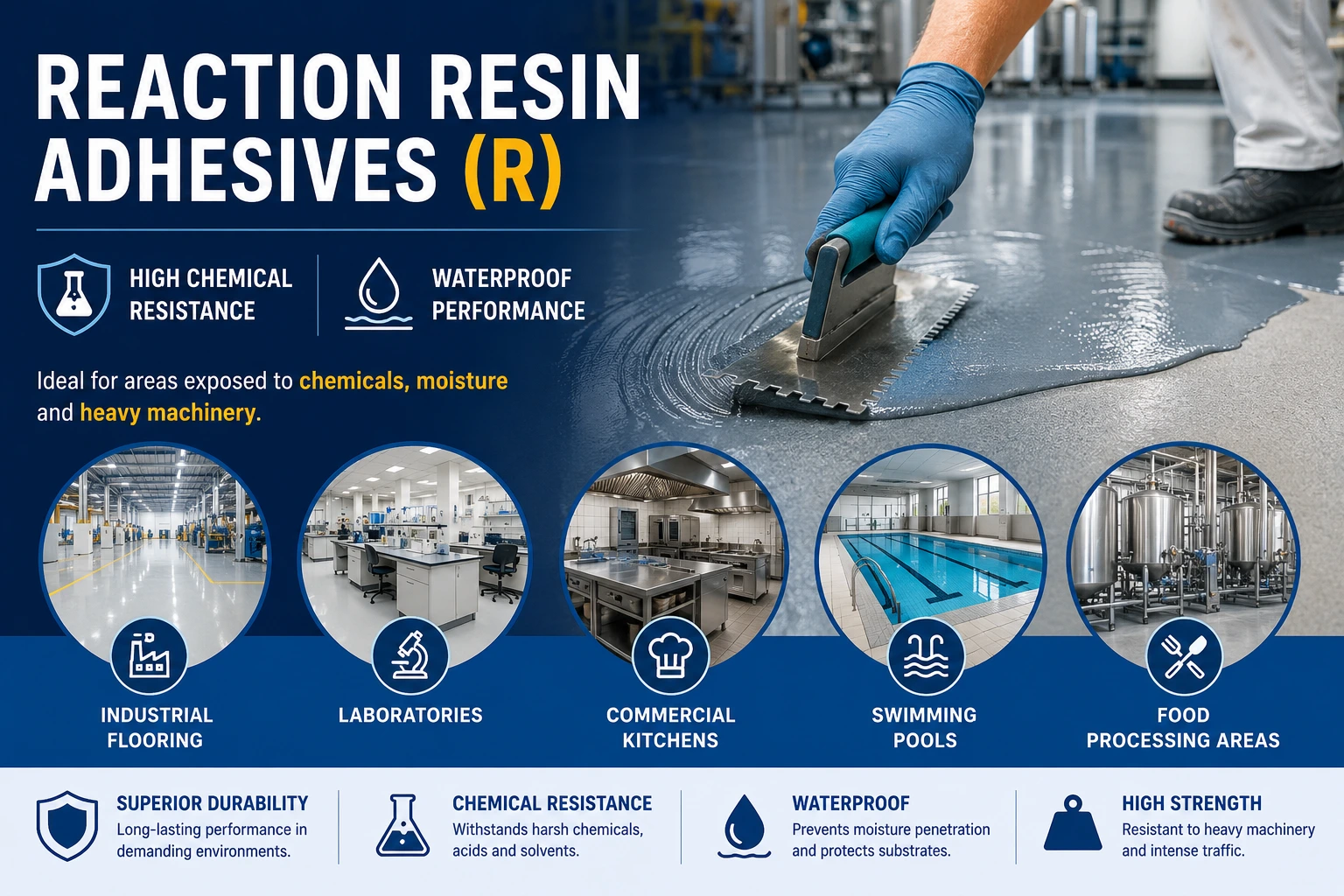
Reaction resin adhesives include epoxy-based systems designed for specialised installations requiring high chemical resistance and waterproof performance.
These adhesives are often used in:
Industrial flooring
Laboratories
Commercial kitchens
Swimming pools
Food processing areas
In facilities exposed to chemicals, moisture, or heavy machinery, professionals working in environments similar to Epoxy Grouts: A Complete Guide to Types, Uses & Benefits often prefer reaction resin systems because of their superior durability and resistance performance.
One of the most important aspects of EN 12004 Tile Adhesive Standards is the classification system itself. These combinations of letters and numbers provide detailed information about adhesive performance.
The most common classifications include:
C1
C2
C2T
C2TE
C2TES1
C2TES2
At first glance, these codes might look like Wi-Fi passwords from a frustrated engineer, but they actually communicate very useful technical information.
C1 refers to a standard cementitious adhesive with normal adhesion performance.
These adhesives are generally suitable for:
Small ceramic tiles
Interior wall applications
Low-stress environments
Dry indoor spaces
C1 adhesives offer basic bonding strength and are often used in simpler residential projects where flexibility and heavy-duty performance are not major concerns.
C2 represents improved cementitious tile adhesives with higher bonding performance compared to C1 products.
Many modern C2 adhesives are polymer-modified formulations designed to improve flexibility, adhesion strength, moisture resistance, and long-term durability under demanding installation conditions. These advanced formulations are widely preferred for porcelain tiles, vitrified tiles, exterior surfaces, and large-format tile installations where stronger bonding performance is essential.
These adhesives provide stronger adhesion, better flexibility, improved moisture resistance, and enhanced durability compared to standard cementitious adhesives.
C2 adhesives are commonly recommended for:
Porcelain tiles
Vitrified tiles
Exterior walls
Large-format tiles
Commercial flooring
As modern tile sizes continue increasing, many professional installers now prefer C2 adhesives even for residential projects because they provide greater long-term reliability.
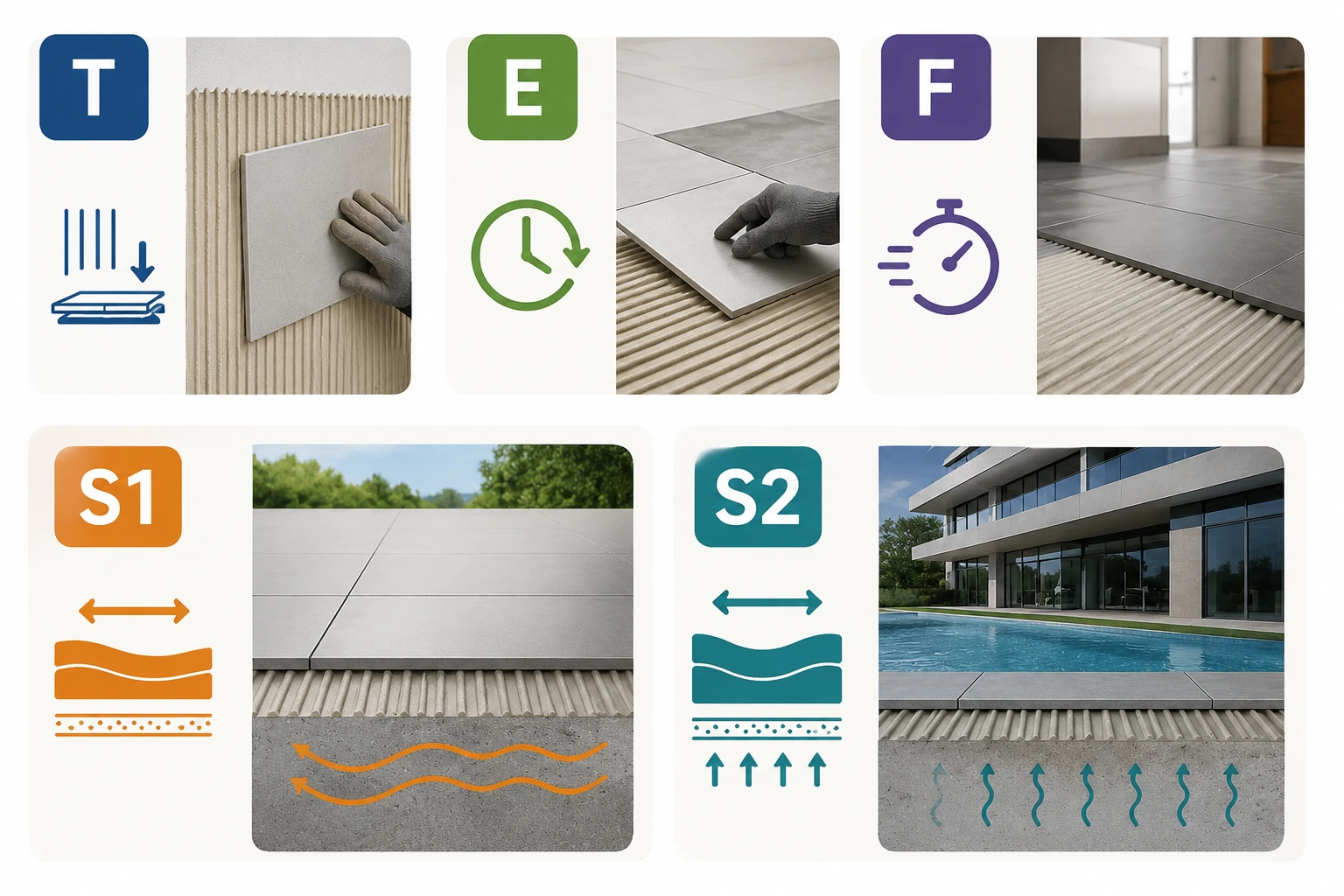
Besides C1 and C2, EN 12004 Tile Adhesive Standards use additional symbols to describe specific adhesive properties.
The “T” classification indicates reduced slip properties. This is particularly useful for wall tile installations where heavy tiles may slide downward before the adhesive cures.
The “E” classification means the adhesive remains workable for a longer period after application. This provides installers with additional time for tile placement and adjustment.
Extended open time becomes especially useful during:
Hot weather
Large-format installations
Complex layouts
Fast-setting adhesives cure more quickly than standard adhesives and are commonly used in renovation projects where faster completion is required.
S1 adhesives provide flexibility and can absorb moderate substrate movement without cracking.
They are commonly recommended for:
Heated floors
Exterior applications
Large-format tiles
Areas with slight structural movement
S2 adhesives offer even greater flexibility and deformation capability. These high-performance adhesives are typically used for demanding installations involving:
Large porcelain slabs
Commercial buildings
Heavy traffic zones
Swimming pools
Facade installations
According to the official European standards guidance available through CEN European Standards Information, adhesive classifications play an important role in ensuring consistent construction material performance across international markets.
To qualify under EN 12004 Tile Adhesive Standards, adhesives must pass multiple laboratory tests designed to measure real-world performance characteristics.
This test measures the bonding strength between the tile adhesive and substrate surface. Higher adhesion strength improves tile durability and reduces the risk of debonding.
Adhesives are exposed to water immersion conditions to evaluate bonding performance after moisture exposure.
This is critical for:
Bathrooms
Swimming pools
Kitchens
Exterior walls
This test measures adhesive performance after exposure to high temperatures.
Heat resistance becomes important in:
Outdoor environments
Heated flooring systems
High-temperature climates
Freeze-thaw testing evaluates adhesive durability under repeated temperature fluctuations. Although more relevant in colder regions, it demonstrates overall adhesive stability under stress conditions.
S1 and S2 adhesives undergo deformation testing to measure flexibility and movement absorption capacity.
Insert infographic explaining EN 12004 adhesive testing methods here.
|
Feature |
C1 Adhesive |
C2 Adhesive |
|
Bond Strength |
Standard |
Higher |
|
Flexibility |
Basic |
Improved |
|
Water Resistance |
Moderate |
Better |
|
Tile Compatibility |
Ceramic Tiles |
Porcelain & Vitrified |
|
Exterior Use |
Limited |
Recommended |
|
Large Tiles |
Less Suitable |
Highly Suitable |
|
Performance Level |
Standard Duty |
Professional Grade |
C2 adhesives are increasingly preferred in modern construction because they offer stronger performance across a wider range of installation conditions.
Selecting the right adhesive depends on several factors, including tile size, surface condition, moisture exposure, and environmental stress.
For ceramic wall tiles in dry indoor areas, a standard C1 adhesive may perform adequately. However, once you move into porcelain tiles, exterior walls, or commercial flooring, stronger C2 adhesives become far more suitable.
For high-performance installations, professionals working with modern construction projects similar to those handled by Understanding Different Classes of Tile Adhesives often prioritise flexible S1 or S2 adhesives because they help accommodate movement and temperature-related stress over time.
Recommended adhesive selection includes:
C1 for standard ceramic wall tiles
C2 for porcelain and vitrified tiles
C2TE for large-format tiles
C2TES1 for exterior applications
C2TES2 for demanding commercial environments
The growing demand for high-performance tile installation systems has encouraged many manufacturers to develop adhesives that comply with EN 12004 Tile Adhesive Standards. Today, contractors, architects, builders, and distributors often prefer brands that provide internationally recognised classifications because these products offer better reliability, stronger adhesion, and improved long-term durability.
Some tile adhesive brands focus primarily on residential applications, while others specialise in commercial flooring, industrial projects, swimming pools, and large-format porcelain installations. The best manufacturers usually offer a complete range of C1, C2, S1, and S2 adhesive solutions designed for different installation conditions.
When evaluating tile adhesive brands, professionals generally consider:
EN 12004 classification compliance
Bond strength performance
Flexibility
Water resistance
Open time
Workability
Export certifications
Technical support
Insert image of premium tile adhesive bags and installation tools here.
Several globally recognised brands manufacture EN 12004-compliant adhesives for modern construction applications. These include:
|
Brand |
Popular EN 12004 Classifications |
Common Applications |
|
Lapifix |
C1T, C2TE, C2TES1 |
Porcelain tiles, vitrified tiles, exterior walls, large-format tile installations |
|
Mapei |
C2TE S1, C2TES2 |
Large-format tiles, commercial flooring |
|
Ardex |
C2TE, S1 |
Exterior walls, porcelain tiles |
|
Weber |
C1T, C2TE |
Residential and commercial tiling |
|
Kerakoll |
C2TES1, S2 |
Flexible tile installations |
|
Laticrete |
C2TES2 |
Swimming pools and heavy-duty applications |
|
Roff |
C2TE |
Interior and exterior tile installations |
Among emerging brands, Lapifix is gaining strong recognition for offering modern tile adhesive solutions developed for evolving construction requirements. With increasing demand for large porcelain slabs, exterior cladding systems, and high-performance tile installations, many contractors and distributors now prefer adhesives that combine strong bonding performance with flexibility and durability.
Many Indian manufacturers are also increasingly producing EN 12004-compliant adhesives to meet international export demand across the Middle East, Africa, Australia, and Southeast Asia. This growth reflects the rising importance of globally accepted tile adhesive standards in modern construction and infrastructure development.
Choosing a trusted brand does not simply improve installation quality — it also reduces long-term maintenance risks, especially in demanding environments involving moisture, movement, heavy traffic, or large-format tiles.
International construction markets increasingly demand adhesives that meet recognised performance standards. Buyers, importers, and distributors prefer EN 12004-compliant products because they offer:
Quality consistency
Reliable performance
Global acceptance
Reduced installation risk
Professional credibility
For exporters, compliance with EN 12004 Tile Adhesive Standards also improves trust in overseas markets where technical specifications heavily influence purchasing decisions.
Modern buyers are no longer simply asking, “How much does this adhesive cost?” They’re asking:
Is it flexible?
Is it suitable for porcelain?
Does it meet international standards?
Can it handle exterior conditions?
Those questions directly impact purchasing behaviour in today’s construction industry.
One of the biggest mistakes installers make is selecting adhesives purely based on price instead of application requirements. Cheap adhesives may reduce upfront costs, but they often increase long-term repair expenses.
Another common issue is using standard C1 adhesives for large-format porcelain tiles. Porcelain has very low water absorption, which means it requires stronger bonding performance typically found in C2 adhesives.
Ignoring flexibility requirements is another major problem. Exterior surfaces, balconies, terraces, and heated flooring systems experience movement due to temperature changes. Without flexible S1 or S2 adhesives, cracking and debonding become much more likely.
Using interior-grade adhesive outdoors is equally risky. Exposure to rain, UV radiation, and thermal expansion places additional stress on adhesive systems that basic products simply cannot handle.
Large-format porcelain tiles should never be installed using low-flexibility adhesives on unstable or movement-prone surfaces. In real-world construction projects, slab installations are exposed to thermal expansion, structural movement, vibration, and moisture-related stress over time. Using standard low-performance adhesives in these conditions can significantly increase the risk of hollow tiles, edge lifting, cracking, or complete bonding failure.
For modern porcelain slabs and large-format vitrified tiles, professional installers typically recommend high-performance C2TES1 or C2TES2 adhesives because they provide stronger bonding strength, improved flexibility, and better long-term deformation resistance. Selecting the correct adhesive classification at the beginning of the installation process often prevents expensive repairs and maintenance problems later.
The tile installation industry is evolving rapidly as modern construction projects demand stronger, more flexible, and longer-lasting adhesive solutions. In 2026, one of the biggest trends shaping the market is the growing use of large-format porcelain slabs and gauged porcelain panels. These larger tiles place significantly more stress on bonding systems, increasing demand for high-performance C2TES1 and C2TES2 adhesives with advanced flexibility and deformation resistance.
Another major trend is the rise of polymer-modified and lightweight tile adhesives designed to improve workability while maintaining strong bonding performance. Contractors are increasingly looking for adhesives that provide extended open time, reduced slip, and better crack resistance, especially for exterior applications and high-traffic commercial flooring.
Sustainability is also becoming a stronger focus across the global construction industry. Many manufacturers are now developing low-VOC and environmentally responsible adhesive formulations to support green building practices and modern environmental standards. At the same time, international buyers are paying closer attention to EN 12004 classifications because globally recognised standards help ensure consistent product quality and installation reliability.
As tile technology continues advancing, adhesives are no longer viewed as basic construction materials. They are now considered critical performance components that directly influence tile durability, structural stability, and long-term installation success.
EN 12004 Tile Adhesive Standards have become an essential benchmark in modern construction because they provide a clear and reliable system for evaluating adhesive performance. From basic ceramic installations to demanding large-format porcelain projects, these classifications help contractors, architects, builders, and buyers choose adhesives based on real technical performance instead of guesswork. Understanding classifications such as C1, C2, S1, and S2 improves installation quality, reduces long-term failures, and supports safer, more durable tile systems across residential, commercial, and industrial environments.
As global construction standards continue evolving, choosing the right adhesive is no longer optional — it’s part of building smarter, stronger, and more reliable spaces. If you want expert guidance on selecting high-performance tile adhesive solutions for your projects, contact Lapifix today and contact our team to discuss the right products and specifications for your installation requirements.
EN 12004 is a European standard that classifies tile adhesives based on performance characteristics such as adhesion strength, flexibility, water resistance, and durability. It helps professionals choose the correct adhesive for different tile installation conditions.
C1 adhesives provide standard bonding performance suitable for basic ceramic tile installations, while C2 adhesives offer improved bond strength, flexibility, and moisture resistance for porcelain, vitrified, and large-format tiles.
Yes, S1 adhesives are classified as deformable adhesives. They provide flexibility that helps absorb movement and reduce cracking in areas exposed to structural or temperature-related stress.
Porcelain tiles typically require C2 or higher-performance adhesives because porcelain has low water absorption and requires stronger bonding strength for reliable installation.
These standards ensure consistent adhesive quality, improve installation durability, reduce tile failures, and help contractors and buyers select suitable adhesives for different construction environments.