

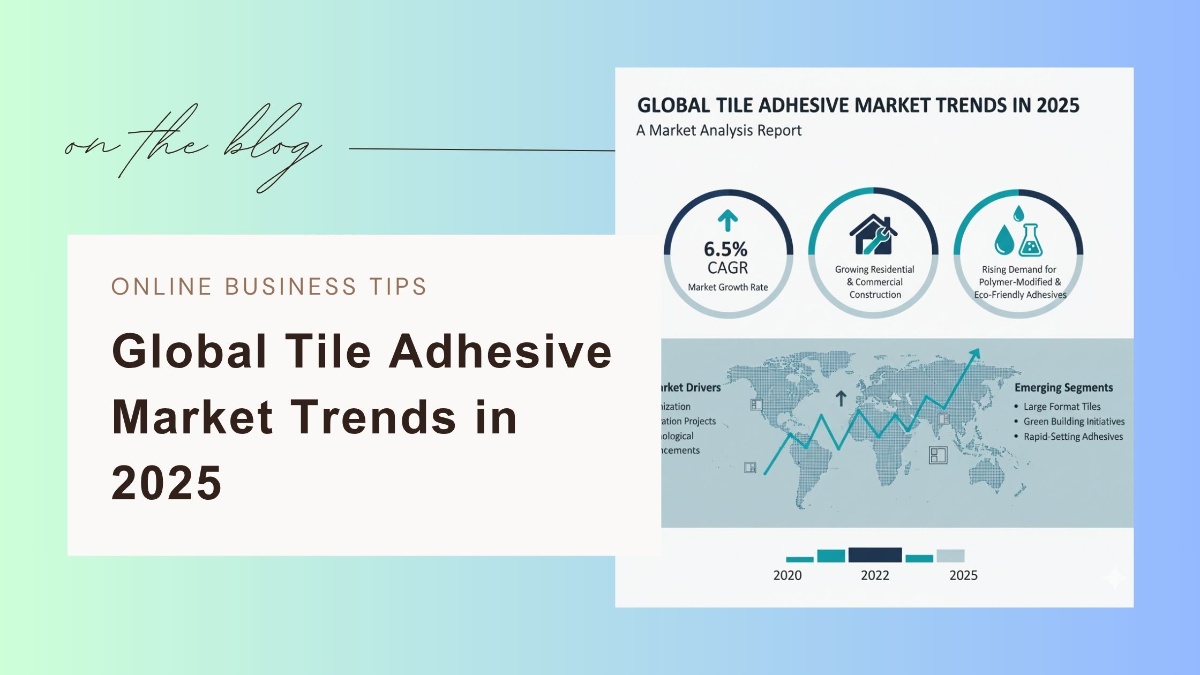
The industry of tile adhesive has developed as a niche product to a mainstream requirement in the contemporary construction industry. Previously, cement and sand mixes were utilized extensively by contractors because they were cheap but had limitations such as uneven leveling, poor adhesion, and shrinkage cracks and also handling bulky or heavy tiles.
Adhesives have now substituted these old processes, as they provide superior bonding, thinner coatings, quicker application, and more durable effects. This has especially been observed in areas where massive porcelain slabs and vitrified tiles are now the norms among house owners and architects.
Industry forecasts reveal that the global tile adhesive market will grow to USD 8 billion and above by 2025 with a steady growth due to urbanization, infrastructure development, and the demand to renovate. Adhesives are no longer optional but a technical necessity in order to attain superior finishes in residential, commercial and industrial construction.
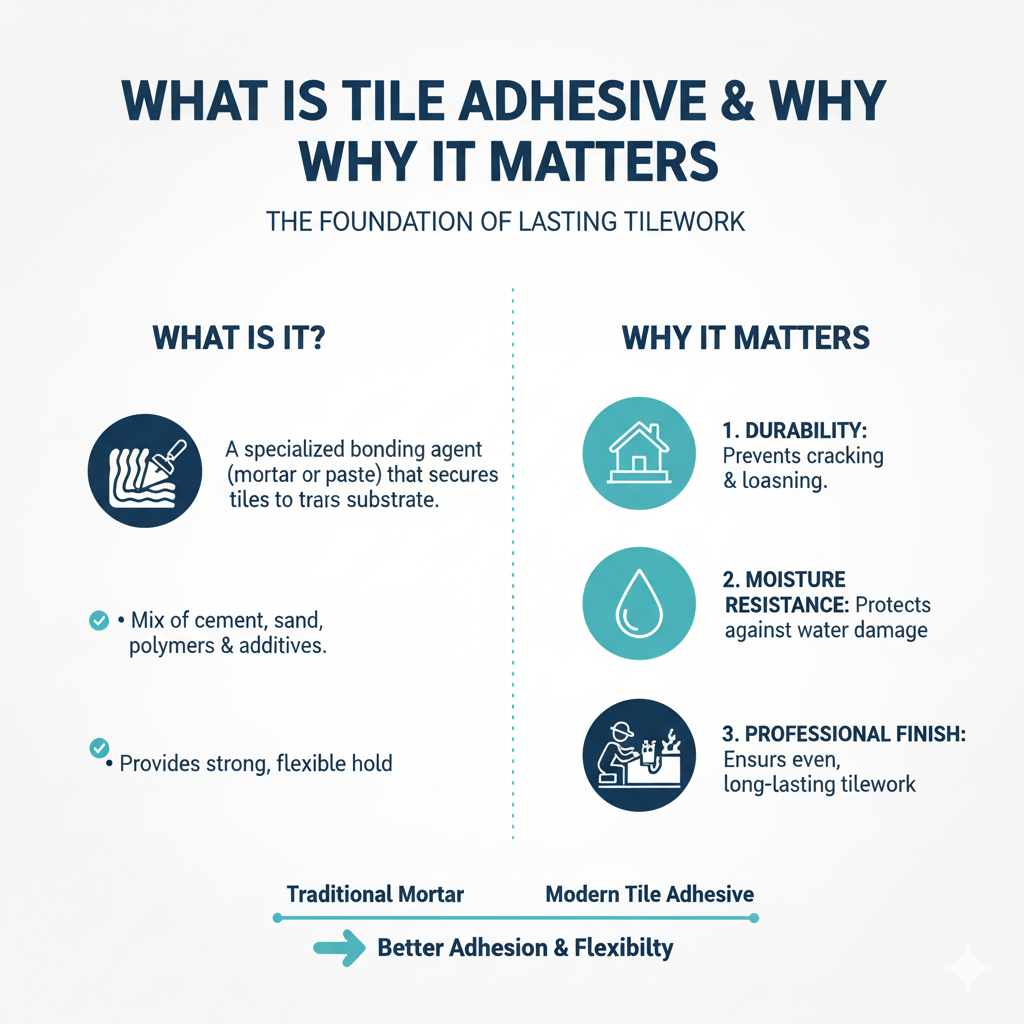
Tile adhesive is a special mixture consisting of cement, polymers, fillers, and chemical additives that increase bonding strength and flexibility. Adhesives are used on thin-bed technology, typically at only 3 to 6 mm in thickness, which saves material and labor, unlike cement mortar where thick layers are required and this uses less material and less labor.
Superior bonding strength:
Unlike traditional cement-sand mortar, which often suffers from shrinkage, cracks and lack of proper adhesion, tile adhesive presents a scientifically designed solution. The adhesive has polymers that make it flexible, and can absorb structural movement and vibrations without debouncing the tiles. Additives enhance workability, and the contractors can spread a uniform layer and get accurate alignment. It not only increases efficiency in installation, but also provides long-term performance in residential and commercial projects. This is why tile adhesive can be regarded as another essential component of the modern construction toolkit.
Flexibility and elasticity:
The presence of air pockets under tiles and the weakening of the bond is one of the greatest disadvantages of traditional mortar and ultimately results in the cracks, popping, or loosening of tiles. This risk is removed by tile adhesive which provides a uniform and even base that sticks firmly to the tile and the substrate. This homogenous bonding improves sound transmission, longevity of the tile, and avoids the expensive maintenance expenses in the future. In high volume places like malls, airports, or even office floors, this dependability is a game changer, as it ensures aesthetics and structural integrity.
Water and heat resistance:
One of the characteristics of tile adhesives is its versatility. New formulations are made to be compatible with a variety of substrates such as cement plaster, concrete, gypsum boards and even old tiled surfaces. This makes them suitable not only in the new construction, but also the renovation projects. There are special adhesives to apply to glass mosaics used in swimming pools, granite slabs that are heavy on the facade, and thin porcelain panels on the countertops in the kitchen. This flexibility has expanded the usage of adhesives in all industries, whether in residential use or in high-end hospitality and healthcare centers where accuracy and longevity are the most important factors.
Time efficiency:
Time saving is essential in the current construction setting where the time limits on any construction project have never been as short as it is today. The adhesives enable the tiles to be installed in thinner layers with no loss to bonding strength and this saves the cost of material as well as lessening the structural load. The speed of installation enables the contractors to finish the project on time, and this increases the satisfaction of the clients. In addition, flexibility of adhesives allows them to meet architectural trends like curved surfaces, cladding, and ventilated facade. It is this quality of speed, economy as well as adaptability that results in adhesives being used in preference over cement mortar in practically all building projects today.
The tile adhesive market 2025 globally has been experiencing a high growth rate, which is attributed to the global surge in infrastructure construction, residential housing, and commercial real estate construction. As more consumers and businesses move off of traditional cement-sand mixes, the use of adhesives is going mainstream.
The market is projected to record a strong CAGR of 8-10% in the period between 2022 and 2025 as per the industry estimates. It is also significant to note that the popularity of large-format tiles has increased due to this development, in addition to the growing emphasis on durability, sustainability, and efficiency in the contemporary construction industry.
Projections indicate the use of consistent trends of tile adhesive 2025, especially in the emerging economies where the rate of urbanization is therefore increasing at alarming rates. The semi-urban and rural markets are also starting to appreciate the advantages of using adhesives as a result of increasing awareness and better accessibility of the product through the retail networks.
As construction professionals and homeowners become more educated about the disadvantages of cement mortar such as weak adhesion and poor performance with large tiles, adhesive adoption is expected to rise further.
In fact, government housing initiatives and smart city projects are accelerating this transition by specifying adhesives in technical guidelines for tile installations.
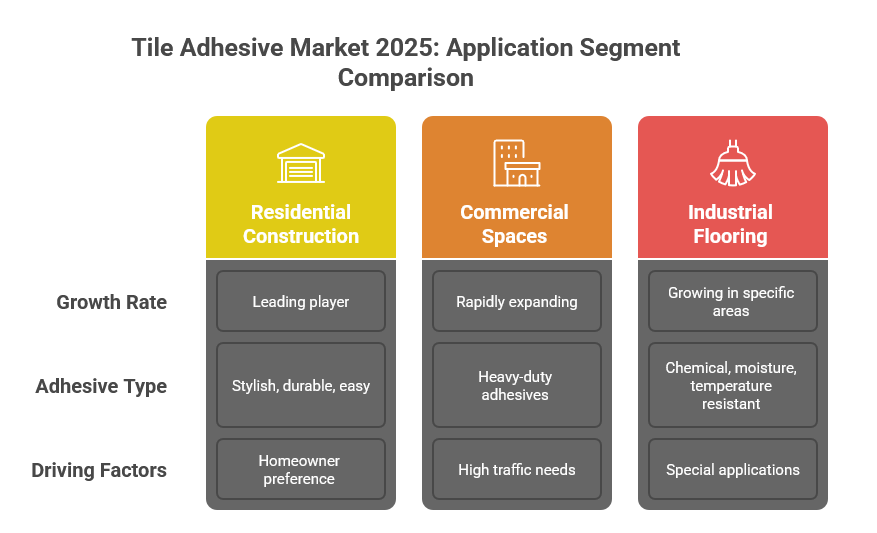
Residential construction – End-user segmentation shows that residential construction is the leading player in the tile adhesive market in the world 2025 with the increasing preference of homeowners towards stylish, durable and easy to maintain surfaces.
Commercial spaces –Commercials, including office spaces, shopping malls, hotels, and hospitals, are another rapidly expanding market since they require heavy-duty adhesives that can support high traffic as well as high large format tile adhesive installations.
Industrial flooring –Industrial applications, although with a small percentage share, are growing in special applications in the chemical industries and in food processing plants and clean rooms where tile adhesive vs cement becomes a point of heated argument adhesives is the best option due to chemical, moisture, and extreme temperature resistance.
The international market of tile adhesives 2025 is being influenced by a few strong forces that are driving the demand in both the developed and emerging economies. Such forces are manifest not only of macroeconomic tendencies, but also of changes in consumer preferences, technological advances, and the sustainability agenda. Manufacturers, builders and homeowners have to understand these drivers so as to keep up with the emerging landscape of the industry.
One of the greatest driving forces of tile adhesive adoption is urbanization. With millions of citizens moving into cities annually, governments and private developers are spending billions on new residential towers, office spaces, metro lines and business centers. In contrast to conventional construction techniques, these massive projects need high-performance water-resistant and strong materials that could endure extensive use and correspond to international quality standards. Adhesives provide consistent bonding, quicker assembly and increased durability which are major needs of mass housing projects and infrastructure megaprojects. Urban growth is not decelerating in such countries as India and China, and they are a significant target in adhesive consumption.
The other significant growth factor is the rising popularity of large format tile adhesive in modern-day architecture. Designers and homeowners are abandoning small ceramic tiles in favor of oversized porcelain and vitrified slabs, occasionally in sizes up to 1600x3200 mm. These tiles give the smooth, elegant appearance yet demand special glues so as to bond together well and not to crack. Cement-sand mortar is incapable of providing the flexibility and strength required in such use, and adhesives must be used instead. With the growing popularity of luxury housing, high quality offices and hospitality projects, the need to use adhesives that help to support large and heavy tiles keeps on increasing.
The DIY culture is having a significant role in North America, Europe, and to a greater extent, Asian pacific. Homeowners are spending more money and time on upgrading their living spaces and products such as the ready-mix and polymer modified tile adhesive fits well into this market. Simple to apply adhesives will enable even novice users to perform on a professional level, whether they are tiling the wall of his bathroom or re-tiling the back of his kitchen. Adhesives are becoming easier to find on online tutorials, influencer marketing, and the availability of e-commerce, creating a chance to gain more users in the DIY category. This is likely to be trending even higher as people seek cheaper, practical means of improving their houses.
Sustainability is becoming a staple of a contemporary construction, and eco-friendly tile adhesive is becoming increasingly popular due to it. Most adhesives are currently being developed with low VOC (volatile organic compound) rates, lower carbon footprint, and recyclable packaging. Environmental legislation in Europe in particular is fuelling the need to use sustainable adhesives that fulfill the requirements of green building systems like LEED and BREEAM. Constructors and architects are also facing pressure to use materials that are consistent with sustainable requirements. With the world becoming net-zero construction, the demand for environmentally responsible adhesives will continue to take center stage in the future of tile adhesive trends 2025 and beyond.
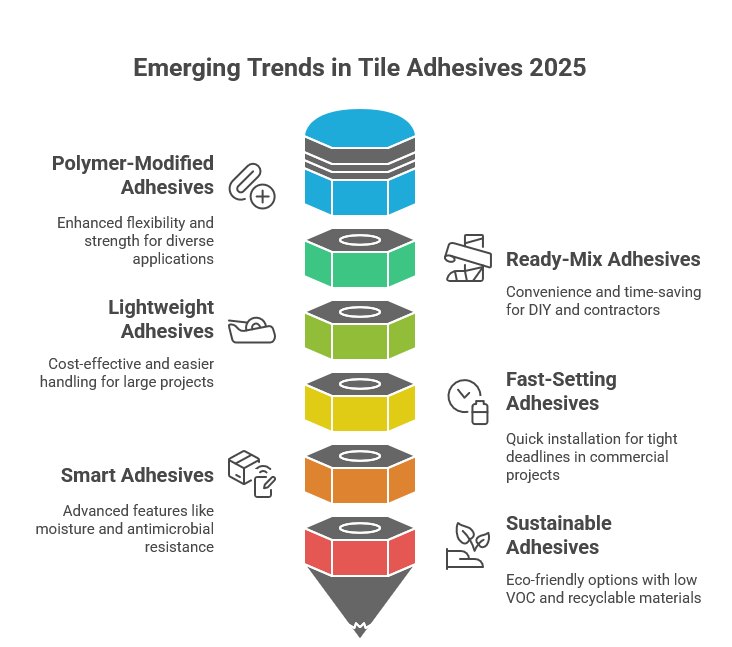
The global tile adhesive market 2025 is not only growing in terms of size, but also growing in terms of product innovation and performance expectations. New formulations and technologies are being proposed by manufacturers as the end-users seek greater quality, quicker outcomes and long-term solutions. These are the tile adhesive trends 2025 most important that will define the industry.
The most notable of these innovations is the introduction of polymer modified tile adhesive that was widely used. These adhesives are made of special polymers which increase flexibility, tensile strength and adhesion to different substrates. This has made them applicable in contemporary issues such as large porcelain tiles, natural stone and in places subject to structural movement. Compared to older-style mortars, the polymer-modified products are capable of standing thermal expansion, vibrations and moisture without affecting its performance. They are particularly severe where structural changes are frequent like in high-rise construction, and where weather welcoming is required as in outdoor use.
Demand for ready-mix tile adhesives has also increased with the emergence of DIY home improvement culture. Ready-mix variants are also pre-mixed and ready to use unlike powder adhesive which has to be mixed on site, which saves time and minimizes error. They are also used by contractors in smaller projects where accuracy and speed is needed. Ready-mix adhesives provide homeowners looking to do bathroom remodeling or assemble their kitchen with the best mix of professional work and ease of use. Their popularity is likely to explode in 2025 as these products become widely available through the e-commerce channels.
With the increase of the size and complexity of construction projects, the efficiency of managing materials gains more and more importance. Lightweight adhesives are also coming up as a solution, which possess similar properties of strength and durability to traditional adhesives but are light. This does not only render transport of tiles cost efficient but it also reduces the workload of installers of tiles. Contractors enjoy quicker applications, less fatigue and higher rates of coverage. Lightweight adhesives are especially efficient in massive commercial and industrial projects where the logistics and speed become a decisive factor.
The factor of time efficiency is important in today construction, particularly in commercial construction where time loss could lead to a huge loss of money. The use of fast-setting tile adhesives is becoming a significant trend as it allows one to grout the tiles in a few hours after installation. This saves a lot of time during project schedules and allows the contractors to work with the tight deadlines. Among the main areas that are implementing solutions that operate fast-setting is in airports, metro stations, and shopping malls since these adhesives can be utilized continuously with minimal downtime.
The market is also experiencing the introduction of smart adhesives capable of doing more than simple bonding with the advent of technology. These products come with characteristics like moisture resistance, heat resistance and even antimicrobial qualities. Antimicrobial adhesives are used in healthcare centers, such as in maintaining hygiene levels in these centers by preventing bacterial and mold growth beneath tiles. In manufacturing kitchens and spas, resistance to heat and moisture is an important aspect in the long life installations. These intelligent adhesives are the new heights of performance and innovation in the tile adhesive trends 2025.
Sustainability is no longer an option but a necessity in world building. Eco-friendly tile adhesives are taking off, due to the low VOC formulations, recyclable packaging, and less dependence on non-renewable raw materials. Bio-based polymers are now in use in some adhesives in line with the concepts of green chemistry. Governments and certification agencies are pressurizing the use of sustainable materials in constructions and adhesives are not an exception. Manufacturers who focus on environmentally friendly solutions will gain a competitive advantage by 2025, particularly in such areas as Europe and North America where environmental laws are very stringent.
The tile adhesive market 2025 has a lot of regional diversification with each geography subject to different economic factors, construction methods, and consumer tastes. Although Asia-Pacific takes the lead in market share, other regions, including Europe, North America, and the Middle East are also performing well with their own unique drivers influencing the demand of adhesive products.
The Asia-Pacific market is the biggest and fastest developing tile adhesive market due to high urbanization, growth in their economies, and initiatives by governments that promote infrastructure development. China and India are also the leading growth contributors because of the growing demand in housing and the growth in disposable incomes of the middle-class households. In India, programs such as Housing for All, and the growth of smart cities are spawning a residential construction boom, increasing residential construction demand on both large format tile adhesive and economical solutions to affordable housing. On the same note, the massive real estate industry in China and the infrastructure megaprojects such as metro networks and commercial complexes are highly dependent on polymer modified tile adhesive to ensure durability and performance. Southeast Asia, such as Vietnam, Indonesia, and Thailand is also experiencing the purchase of more with consumers shifting to modern tiling solutions.
Europe is a highly developed adhesive market that is highly concerned with sustainability and renovation. The area is specifically motivated by the need to have eco-friendly tiles adhesive of low VOC emissions, which are consistent with the stringent EU regulations on green construction. The market is dominated by renovation projects since most European countries have aging stocks of houses that need modernization. Advanced adhesives are used by homeowners and contractors as they are more efficient, stronger, and meet the requirements of green building certifications such as LEED and BREEAM. As well, large porcelain slabs are increasing in popularity within luxury homes and commercial interiors, which is also driving the demand of large format tile adhesive.
The tile adhesive market in North Americas is highly DIY home improvement culture. It is common that homeowners undertake minor renovation projects, which results in the sale of pre-mixed tile adhesive and fast-setting products that can be purchased at retail and online stores. The U.S and Canada are also keen on high quality adhesives that are highly advanced in features like antimicrobial characteristics, waterproof and even flexibility in heavy-duty set ups. Polymer modified tile adhesive has been used more due to the preference of luxury tiles such as natural stone and large sized panel tiles of porcelain. Both contractors and homeowners appreciate the fact that adhesives are easy to use, reliable and able to produce professional finishes on residential and commercial works.
The Middle East and Africa are fast becoming significant players in the global tile adhesive market 2025 with the tremendous infrastructure and real estate projects. Other countries like Saudi Arabia and UAE are spending a lot of money on mega-investments like smart cities, luxury hotels, shopping malls, and stadiums. The developments of such high profile require adhesives that are very strong in bonding, longevity, and capable of supporting large format tiles as applied in modern designs. Africa, on the other hand, is experiencing increasing urbanization and industrialization, which is presenting openings to adhesive manufacturers. As the governments concentrate on housing projects and economic development, the trend of using tile adhesive over cement is changing at a rapid rate towards adhesives owing to their high performance.
The global tile adhesive market 2025 is highly competitive, with both multinational corporations and regional players striving to capture market share. The industry is defined by continuous innovation, brand positioning, and strategic expansions. As demand for advanced adhesives grows worldwide, competition is intensifying across product development, distribution networks, and sustainability initiatives.
The global market is controlled by several multinational companies who have a high level of R&D, product portfolio, and brand recognition. The industry players like Lapifix, MAPEI, Sika, Ardex, Laticrete, Asian Paints and Fosroc are reputed to provide high performance products to serve residential and commercial markets. These companies are placing a lot of money in polymer modified tile adhesive, fast-setting solutions, eco-friendly innovations which match with the new trends. They also have large distribution channels that enable them to access not only the mature markets such as Europe and North America but also the fast-developing markets such as Asia-Pacific and Middle East.
The top manufacturers are engaged in mergers, acquisitions, and partnerships in order to gain a competitive advantage. The strategies assist them to increase their market presence and to reach new technologies. Another characteristic of industry leaders is heavy investment in research and development with special concentration on developing eco-friendly tile adhesive solutions that satisfy global sustainability requirements. Corporations are also segmenting their products which include provision of specialized adhesive products in large format tile adhesive applications, swimming pools, industrial flooring, and facade installations. This form of diversification will help them target niche markets and yet serve the mass-market demand.
The dynamic performance of the ceramics and construction industry has seen India become a force in the world tile adhesive market 2025. Gujarat, known as the ceramic capital of India, now has a few fast-growing tile adhesive companies in India in the Morbi cluster. They are using low-cost production, raw materials availability, and increased domestic demand to grow fast by these companies. A large number of Indian manufacturers are also going global, exporting adhesives to Africa, Middle East and Southeast Asia. They are good competitors to multinational brands; they offer their products at competitive prices and they can tailor them to suit local markets.
Competition is high, but in many cases, differentiation is reduced to the quality of the product, its sustainability, and after sales services. Firms that make adhesives with special characteristics, including antimicrobial adhesives, heat-resistant adhesives, or fast-cure adhesives are becoming popular among contractors and architects. Besides, sustainability has turned into the field of competition, and brands have started to showcase their tile adhesive innovations as being eco-friendly as a means to attract customers interested in using their products. Customer education and awareness campaigns are also important because most end-users of tile adhesive in developing regions continue to compare tile adhesive vs cement and the manufacturers are expected to emphasize the cost and durability benefits of adhesives in the long run.
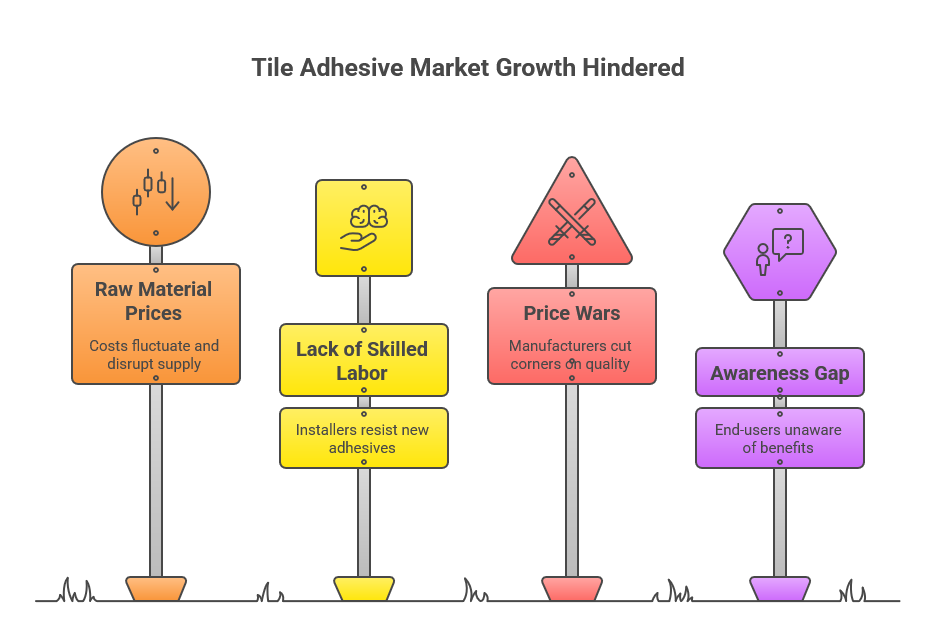
Despite strong growth opportunities, the global tile adhesive market 2025 faces several challenges that could slow down adoption, particularly in developing regions. These challenges span across raw material pricing, workforce skills, competition, and awareness. Understanding them is essential for manufacturers and stakeholders to develop strategies that ensure sustained growth.
Volatility of the costs of raw materials is one of the most urgent problems of the manufacturers of adhesives. The tile adhesives are based on cement, polymers, fillers and chemical additives, most of which are subject to global supply chain disruptions and fluctuations in prices. The increased cost of energy also becomes an issue, with manufacturing adhesives using a lot of energy. These price variations have a direct effect on profitability in companies that are in a very competitive environment. The small manufacturers, particularly the tile adhesive manufacturers India, are the most vulnerable as they are on low margins. In order to keep up with the competition, the companies have to concentrate on the supply chain resilience, substitute raw materials, and cost optimization.
Although advanced adhesives have better performance, they may need technical skills and suitable training in their application. In most developing areas the installers are used to using cement-sand mortar and would be reluctant to embrace new adhesives. Its misuse like the wrong application of thickness or improper mixing may result in shoddy performance which subsequently ruins consumer trust. This skill gap is one of the largest impediments towards a greater adoption of adhesives, particularly beyond urban centres. They need training programs, awareness and direct demonstrations to make sure that the advantages of the polymer modified tile adhesive and other innovative formulations are achieved.
The fast growth of the adhesive market has created intense competition, which has caused intensive price wars between the local and international brands. This is good in the short term of the end-users, but may push the companies to reduce corners or product innovation. In the long run, these practices may decrease the quality of the market on the whole and discourage the use of high-quality adhesives such as eco-friendly tile adhesive or fast-setting adhesives. Branding, innovation and education will be important in differentiating the manufacturers to remain profitable but not engage in devastating pricing strategies.
In most rural and semi-urban markets, the cement-sand mortar remains the most popular to date due to its familiarity and cheaper initial investment. Most domestic owners and small contractors do not know benefits of adhesive in the long term like durability, decreased maintenance and its compatibility with large format tile adhesive. The tile adhesive vs cement controversy is highly marked in these regions where cement is perceived to be cheaper. Nevertheless, the indirect expenses of repairing the tiles regularly, breaking, and water leakages are mostly overlooked. It will take regular marketing, demonstration projects and recommendations of trusted local distributors and contractors to bridge this gap of awareness.
Not only is the global tile adhesive market 2025 concerned with the current growth but also making the way towards innovativeness and sustainability as well as high-end performance in the next few years. With changes in construction trends, design trends and environmental regulations, manufacturers are focusing on the new generation adhesives which will fulfill future needs.
The future of tile adhesives is moving towards smart adhesives which incorporate technology of improved monitoring and performance. Other innovations such as adhesives with sensors to measure levels of moisture, structural changes, or changes in temperature under tiles are some innovations. Nanotechnology is also being used to enhance bonding at the molecular level, which provides a higher adhesion and high longevity when used in large format tile adhesive. These intelligent solutions could transform the business and industrial areas where it is essential to monitor the structural health and avoidance of early tile failures.
Trends in architecture have put an increased preference on ultra-large porcelain and vitrified slabs with sizes such as 1200x2400 mm or 1600x3200 mm. These tiles produce smooth, comfortable surfaces and they need special adhesives that can withstand excessive weight loads and thin joints. To satisfy these requirements, sophisticated polymer modified tile adhesive formulations are being designed to provide flexibility, uniform bonding and quick curing. These adhesives will help architects and builders to be more creative in their designs and still achieve the same structural integrity and aesthetic quality.
Governments around the world are enforcing tougher environmental policies on construction and are demanding lower VOC levels, raw materials that are sustainable, and green-certified products. This is driving the product of eco-friendly tile adhesive which meets the environment standards without losing product performance. Sustainable construction rewards and certifications are also pushing constructors to substitute cement-based mortars with hi-tech adhesives, which means environmentally-friendly products will constitute an important segment of the market in the future.
India is also becoming a big force in the global tile adhesive market 2025 not only in the domestic market but also internationally. The manufactures of Gujarat, Maharashtra and other industrial centers are exporting adhesives to the Middle East, Africa, Europe and southeast Asia. The high-quality production and competitive pricing and the customization options make Indian adhesives competitive in international markets. As the numbers of tile adhesive manufacturers India grow, the exports will increase consistently, providing a large contribution to the economical development of the regions and adding to the India's role in the global construction supply network.
According to the future outlook, it is evident that adhesives are no longer considered as a simple utility but high-performance and design-critical products. The contemporary construction works have become more demanding in terms of adhesives which are durable, flexible, sustainable and of smartness. Homeowners and commercial contractors alike are becoming aware that investing in the appropriate adhesive solution at the beginning of the project will save on long-term maintenance costs and improve esthetics, as well as help to eco-friendly construction objectives.
The global tile adhesive market 2025 is entering a new era where performance, design, and sustainability converge. What was once considered a basic utility in construction has transformed into a sophisticated, high-performance product that meets the demands of modern architecture, infrastructure projects, and eco-conscious building practices.
Several factors have contributed to the continued growth of tile adhesive trends 2025, and they include increased urbanization, escalation of popularity of large format tile adhesive, DIY home improvement boom, and the use of eco-friendly materials. There is a growth in residential, commercial, and industrial sectors contributing to the growth, as well as innovations such as polymer modified tile adhesive, fast-setting formulas, and smart adhesives are establishing new standards in the industry.
There are also good regional dynamics in the market. Asia-Pacific has the largest scale building work and the growing middle-class population, Europe focuses on the use of eco-friendly tile adhesive in its renovations, North America is motivated by DIY adoption and high-quality products, and the Middle East and Africa are conditioned by mega-projects in infrastructure development. In the meantime, tile adhesive manufacturers India are becoming known all over the world, taking advantage of their cost advantages, innovation, and export capabilities to compete with global brands.
Although the company faces some challenges like the volatility of raw materials prices, unskilled labor, and insufficient awareness in rural areas, the future of the company is bright in the long term. Smart adhesives using nanotechnology, ultra-large slabs adhesives and sustainable formulations will characterize the future of the industry. The competition by the manufacturers who owe their success to environmentally friendly, high performance and special adhesives will have an upper hand and the market will keep on rising steadily after 2025.
It is important to keep abreast with the current trends in tile adhesive 2025 to architects, builders and home owners. The appropriate adhesive can both provide durability and performance but can also lead to sustainability and efficiency in construction. The future of adhesives lies in products that are strong, flexible, convenient and environmentally friendly, and thus cannot be left out of any contemporary tiling projects.
The global tile adhesive market 2025 is projected to grow at a CAGR of 7–9%, driven by urbanization, rising demand for large-format tiles, and infrastructure development in regions like Asia-Pacific, Europe, and North America.
Polymer modified tile adhesive offers superior flexibility, bonding strength, and durability compared to traditional cement mortar. It is especially suitable for large format tile adhesive applications and modern construction projects requiring precision and long-lasting performance.
Eco-friendly tile adhesive has low VOC emissions, reduced carbon footprint, and sustainable formulations. It supports green building certifications like LEED and BREEAM, making it ideal for environmentally conscious construction.
Tile adhesive vs cement highlights that adhesives offer better bonding, faster installation, moisture resistance, and flexibility. Cement-sand mortar lacks these benefits, especially for large or heavy tiles.
Asia-Pacific leads due to rapid urbanization, infrastructure projects, and rising middle-class housing demand. Europe, North America, and the Middle East are also significant markets, driven by sustainability, DIY trends, and mega-projects.
Leading tile adhesive manufacturers India include companies based in the Morbi cluster (Gujarat) and other industrial hubs, producing polymer-modified, ready-mix, and eco-friendly adhesives for domestic and international markets.
Key tile adhesive trends 2025 include smart adhesives with antimicrobial properties, fast-setting and lightweight formulations, sustainable eco-friendly options, and specialized products for ultra-large slabs.
Yes. Ready-mix tile adhesive is user-friendly, easy to apply, and eliminates the need for on-site mixing, making it ideal for homeowners undertaking DIY renovations or small-scale commercial projects.
The rising use of large format tile adhesive is driven by modern architecture and luxury interior designs. Adhesives provide the necessary bonding strength and flexibility to support oversized porcelain, vitrified, and natural stone tiles.
Challenges include fluctuating raw material costs, lack of skilled labor in developing regions, price competition among manufacturers, and low awareness in rural areas where cement is still preferred