

Modern construction has changed dramatically over the past decade. Large-format porcelain slabs, vitrified tiles, exterior cladding systems, and high-traffic commercial flooring now demand installation materials that deliver stronger bonding performance, flexibility, and long-term durability.
Traditional cement mortar alone is no longer sufficient for many modern tile applications, which is why cementitious tile adhesives have become a critical part of contemporary construction systems.
Today, contractors, architects, builders, and distributors increasingly rely on factory-manufactured adhesive formulations because consistency matters more than ever. A properly manufactured tile adhesive not only improves bonding strength but also reduces tile failures, hollow sounds, cracking, and moisture-related installation issues over time. If you already understand concepts discussed in our guide on Tile Adhesive Guide: Types, Uses, and Benefits, you’ll know how adhesive quality directly influences installation performance in real construction environments.
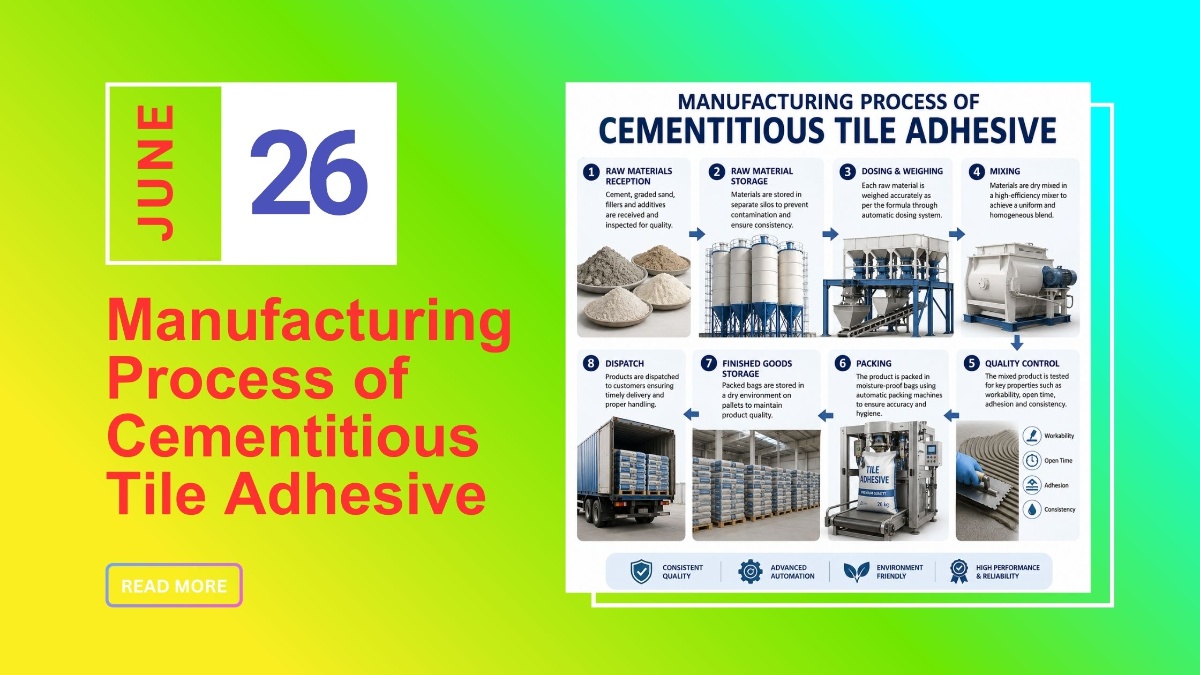
The Manufacturing Process of Cementitious Tile Adhesive involves far more than simply mixing cement and sand together. Modern adhesive production includes carefully selected raw materials, polymer modification technology, automated dry-mix manufacturing systems, quality control testing, and performance-based formulation engineering designed to meet international construction standards.
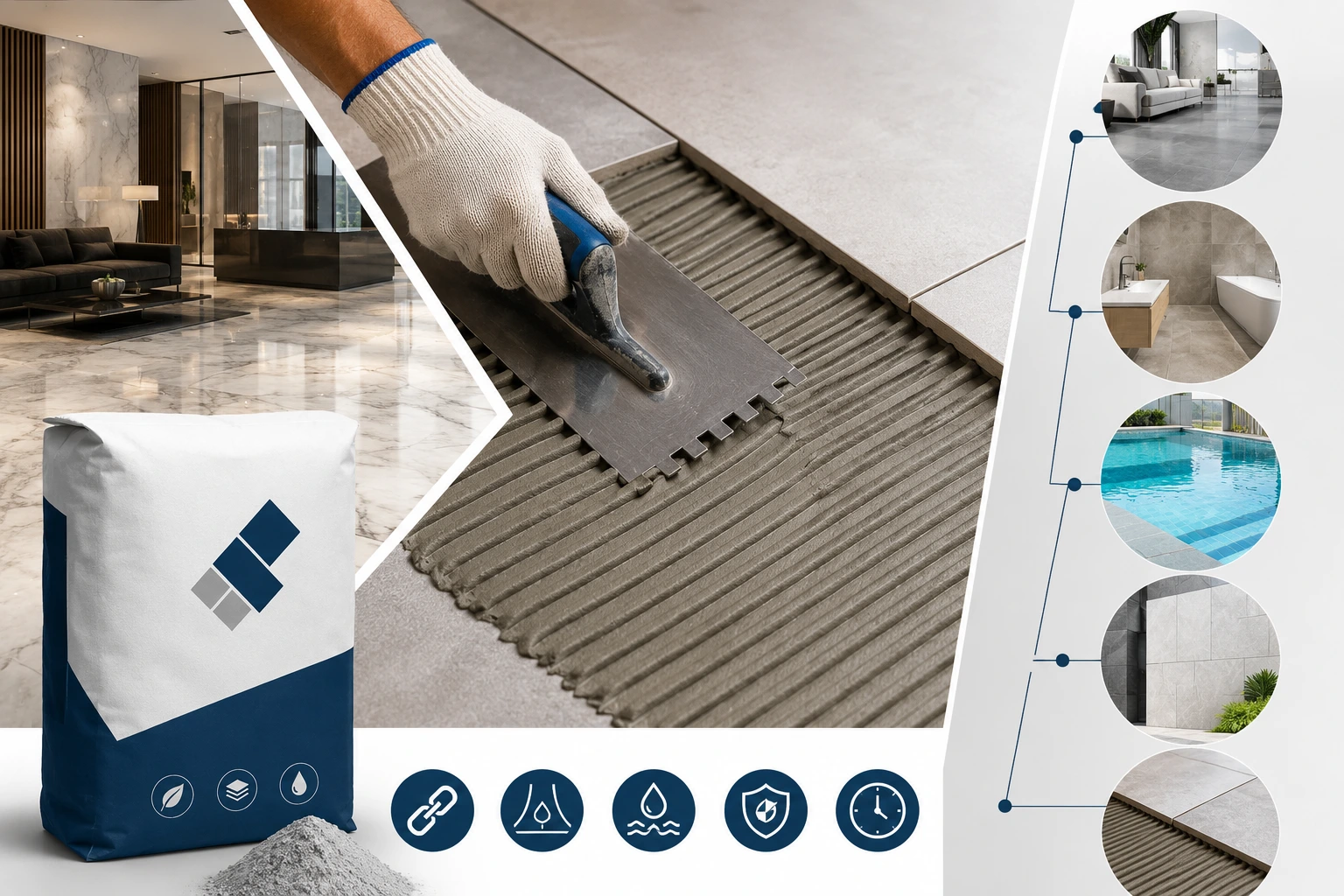
Cementitious tile adhesive is a dry-mix construction material primarily made from cement, graded silica sand, polymers, fillers, and chemical additives. When mixed with water, it forms a high-performance bonding material used for fixing ceramic, porcelain, vitrified, and natural stone tiles on walls and floors.
Unlike traditional cement mortar, modern cementitious tile adhesives are engineered to provide:
Better adhesion strength
Improved flexibility
Reduced shrinkage
Enhanced workability
Moisture resistance
Longer durability
These adhesives are widely used in:
Residential construction
Commercial flooring
Bathrooms
Swimming pools
Exterior cladding systems
Large-format tile installations
Modern tile installation systems increasingly depend on polymer-modified adhesive formulations because larger and heavier tiles create higher stress on bonding surfaces. As a result, adhesive manufacturing quality now plays a major role in long-term tile performance.
A tile adhesive may look similar from the outside, but manufacturing quality determines whether the product performs reliably after installation. In real construction environments, many tile failures occur not because of tile quality but because of poor adhesive formulation, inconsistent mixing, or low-grade raw materials.
A professionally manufactured cementitious tile adhesive improves:
Bonding strength
Flexibility
Water resistance
Open time
Slip resistance
Long-term durability
Poor-quality manufacturing can lead to:
Hollow tiles
Debonding
Cracking
Edge lifting
Water penetration issues
In modern construction projects involving porcelain slabs, exterior walls, heated flooring systems, and commercial installations, adhesive performance becomes even more critical because these applications experience movement stress, thermal expansion, moisture exposure, and heavy traffic over time.
The Manufacturing Process of Cementitious Tile Adhesive depends heavily on the quality and proportion of raw materials used during production. Every ingredient plays a specific role in adhesive performance.
Cement acts as the primary binding agent in tile adhesive formulations. It provides compressive strength and forms the core bonding structure after hydration.
Graded silica sand improves workability, reduces shrinkage, and helps control adhesive consistency. Particle size distribution is extremely important because it directly affects application smoothness and bonding performance.
RDP is one of the most important components in polymer-modified tile adhesive formulations. It improves:
Flexibility
Adhesion strength
Water resistance
Deformation resistance
Modern large-format tile installations often require higher polymer content to handle movement stress effectively.
HPMC improves water retention and workability. It helps prevent rapid moisture loss during installation, allowing proper cement hydration and stronger bonding development.
Various fillers and specialty additives are used to improve:
Open time
Slip resistance
Setting characteristics
Application smoothness
Sag resistance
These materials help manufacturers develop adhesives suitable for specific installation requirements.
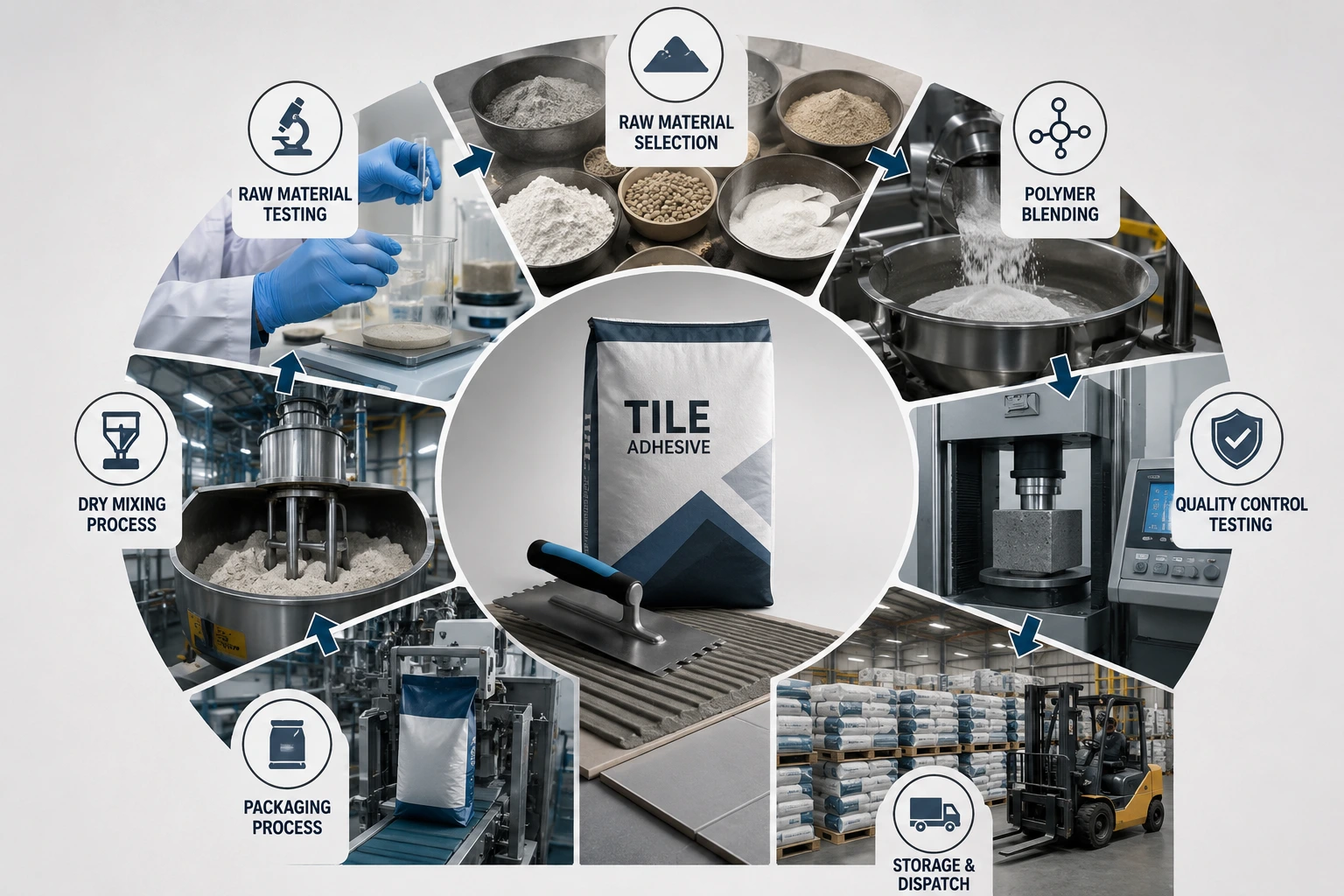
The Manufacturing Process of Cementitious Tile Adhesive follows a carefully controlled industrial production system designed to ensure consistent quality and reliable adhesive performance.
The process begins with selecting high-quality raw materials from approved suppliers. Manufacturers carefully evaluate:
Cement quality
Sand grading
Polymer purity
Moisture levels
Chemical additive compatibility
Raw material inconsistency can significantly affect adhesive performance, which is why quality inspection begins before manufacturing even starts.
Before production, manufacturers test raw materials for:
Moisture content
Particle size
Chemical composition
Bulk density
Flow characteristics
This step helps maintain consistent formulation performance across production batches.
After testing, raw materials are transferred into automated mixing systems where precise proportions are blended using high-speed industrial mixers.
The dry mixing process is one of the most critical stages because uneven mixing can create:
Poor polymer distribution
Inconsistent bonding performance
Reduced flexibility
Uneven curing behaviour
Modern dry-mix mortar plants use computer-controlled batching systems to maintain formulation accuracy during large-scale production.
Polymer-modified adhesive production requires precise blending of redispersible polymer powder with cement and aggregates.
The polymer content directly influences:
Adhesion strength
Flexibility
Water resistance
Crack resistance
Deformation performance
Many products discussed in Choosing the Right Adhesive for Different Types of Tiles rely heavily on polymer modification technology to meet modern tile installation requirements.
After mixing, manufacturers conduct multiple quality control tests to verify adhesive performance. These tests typically evaluate:
Tensile adhesion strength
Slip resistance
Open time
Water retention
Flexibility
Deformation resistance
Professional manufacturers often test formulations according to international standards such as EN 12004 and ISO 13007 to ensure reliable product performance.
According to official European construction standards guidance available through CEN European Standards Information, adhesive classification systems play an important role in ensuring construction material consistency and installation reliability across global markets.
Once approved, the finished adhesive is transferred into automated packaging systems where it is filled into moisture-resistant bags.
Proper packaging is essential because moisture contamination can damage cementitious adhesive formulations before use.
Finished products are stored in controlled warehouse conditions before dispatch. Proper storage protects adhesive quality and helps maintain shelf life during transportation and distribution.
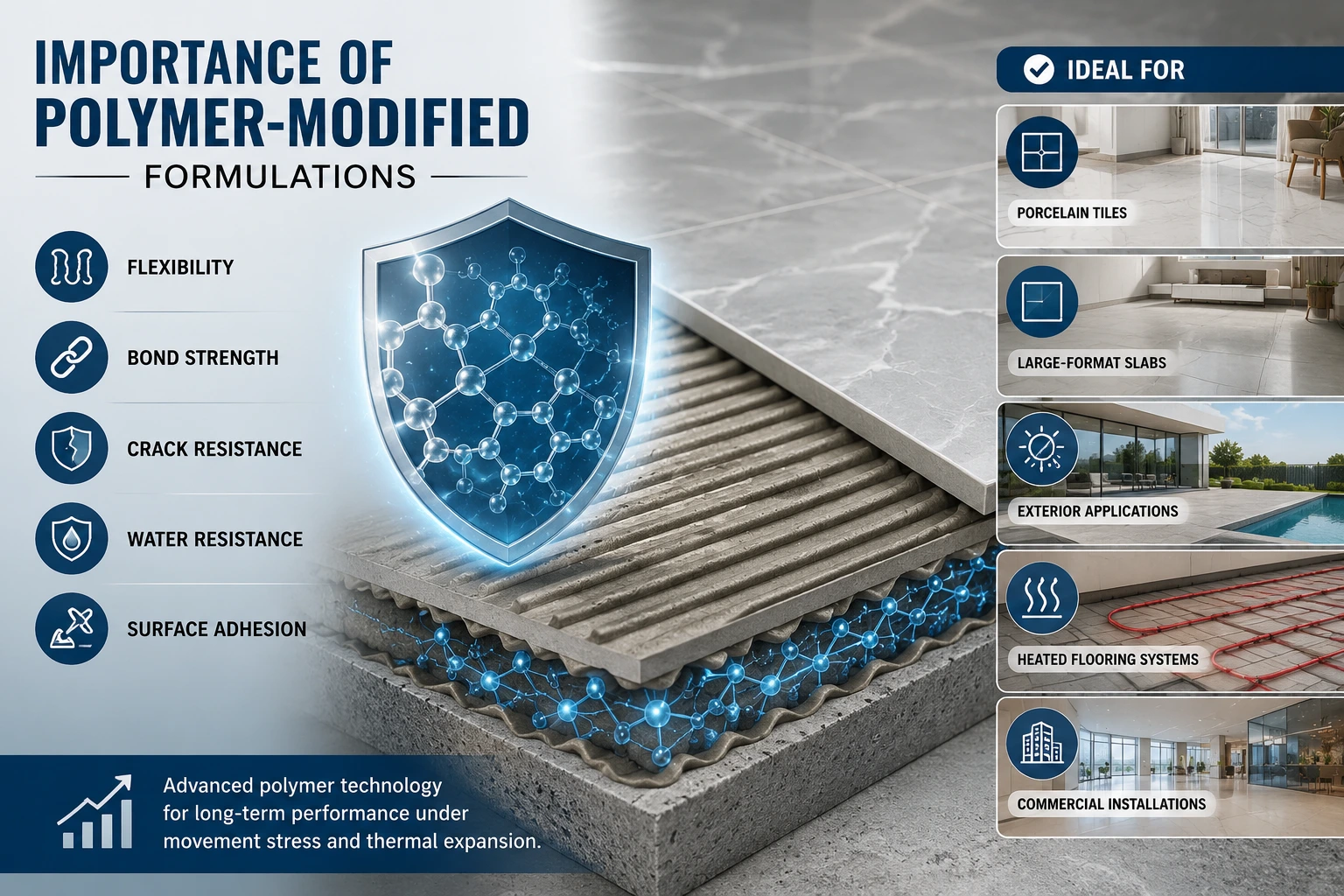
Modern tile installation systems increasingly depend on polymer-modified adhesive technology because traditional cement mortar cannot handle many modern installation demands effectively.
Polymer-modified adhesives improve:
Flexibility
Bond strength
Crack resistance
Water resistance
Surface adhesion
These properties become especially important for:
Porcelain tiles
Large-format slabs
Exterior applications
Heated flooring systems
Commercial installations
As tile sizes continue increasing, manufacturers are investing heavily in advanced polymer technologies designed to improve long-term adhesive performance under movement stress and thermal expansion conditions.
Quality control is one of the most important stages in the Manufacturing Process of Cementitious Tile Adhesive because even minor formulation inconsistencies can affect installation reliability.
Professional manufacturers test:
Bond strength
Tensile adhesion
Open time
Slip resistance
Water retention
Flexibility
Deformation performance
EN 12004 and ISO 13007 standards are commonly used to classify and evaluate adhesive performance characteristics for different installation environments.
In real-world construction projects, poor quality control often results in:
Hollow tile sounds
Cracking
Adhesive failure
Water penetration
Reduced durability
This is why contractors increasingly prefer factory-manufactured adhesives over site-mixed mortar systems.
Modern manufacturers produce several classes of cementitious tile adhesives depending on installation requirements.
These commonly include:
C1 Adhesives
C2 Adhesives
C2TE Adhesives
C2TES1 Adhesives
C2TES2 Adhesives
Each classification offers different levels of:
Bond strength
Flexibility
Open time
Deformation resistance
Water resistance
If you want a deeper understanding of adhesive classifications, our guide on Understanding Different Classes of Tile Adhesives explains how different formulations are designed for specific tile installation conditions.
The tile adhesive manufacturing industry is evolving rapidly as construction technology continues advancing.
In 2026, major manufacturing trends include:
Lightweight adhesive formulations
Low-VOC products
Sustainable manufacturing systems
Automated dry-mix plants
Advanced polymer modification
Export-grade quality control systems
Manufacturers are also increasingly developing adhesives for:
Large porcelain slabs
Thin gauged porcelain panels
Exterior insulation systems
High-performance commercial flooring
As global construction standards continue improving, adhesive manufacturers are focusing more heavily on performance consistency, environmental responsibility, and long-term durability.
Professional contractors increasingly prefer factory-manufactured tile adhesives because controlled production systems provide more reliable performance than traditional site-mixed cement mortar.
Factory-made adhesives offer:
Consistent formulation quality
Better workability
Stronger bonding
Improved flexibility
Reduced installation risk
Compared to traditional mortar, modern cementitious adhesives also improve installation speed and reduce material wastage.
Many contractors comparing modern construction materials in guides like AAC Block Adhesive vs Traditional Cement: Cost & Performance Comparison now prefer factory-engineered adhesive systems because they deliver more predictable long-term performance.
The Manufacturing Process of Cementitious Tile Adhesive also involves several technical challenges that manufacturers must carefully manage.
One major issue is moisture contamination during storage or production. Even small moisture exposure can affect cement hydration behaviour and reduce adhesive shelf life.
Another challenge involves maintaining consistent polymer distribution during dry mixing. Poor blending can create uneven flexibility and inconsistent bonding performance across production batches.
Manufacturers must also control:
Raw material quality variation
Sand grading consistency
Polymer dosage accuracy
Packaging moisture protection
Storage temperature conditions
Modern automated manufacturing systems help reduce many of these risks by improving production consistency and process control.
The Manufacturing Process of Cementitious Tile Adhesive involves far more than simple cement mixing. Modern adhesive production depends on carefully selected raw materials, advanced polymer-modified formulations, automated dry-mix manufacturing systems, and strict quality control procedures designed to ensure reliable installation performance.
As construction projects continue demanding larger tiles, stronger bonding systems, and greater durability, manufacturing quality has become one of the most important factors influencing long-term tile installation success.
At Lapifix, we understand how critical adhesive performance is for modern construction applications. From polymer-modified formulations to advanced quality control systems, every stage of adhesive manufacturing directly impacts durability, flexibility, and installation reliability.
If you want expert guidance on high-performance tile adhesive solutions for residential, commercial, or industrial projects, contact our team today and discover the right adhesive systems for your next project.
Cementitious tile adhesive is typically made from cement, silica sand, polymers, fillers, and specialty chemical additives designed to improve bonding performance, flexibility, workability, and water resistance.
Tile adhesive is manufactured through a controlled dry-mix process involving raw material selection, testing, automated blending, polymer modification, quality control testing, packaging, and storage.
Polymer-modified tile adhesive contains redispersible polymer powder or similar additives designed to improve flexibility, adhesion strength, crack resistance, and moisture resistance.
Quality control helps ensure consistent adhesive performance, bonding reliability, flexibility, and durability across different tile installation conditions.
EN 12004 and ISO 13007 are among the most widely recognised standards used to classify and evaluate cementitious tile adhesive performance.