

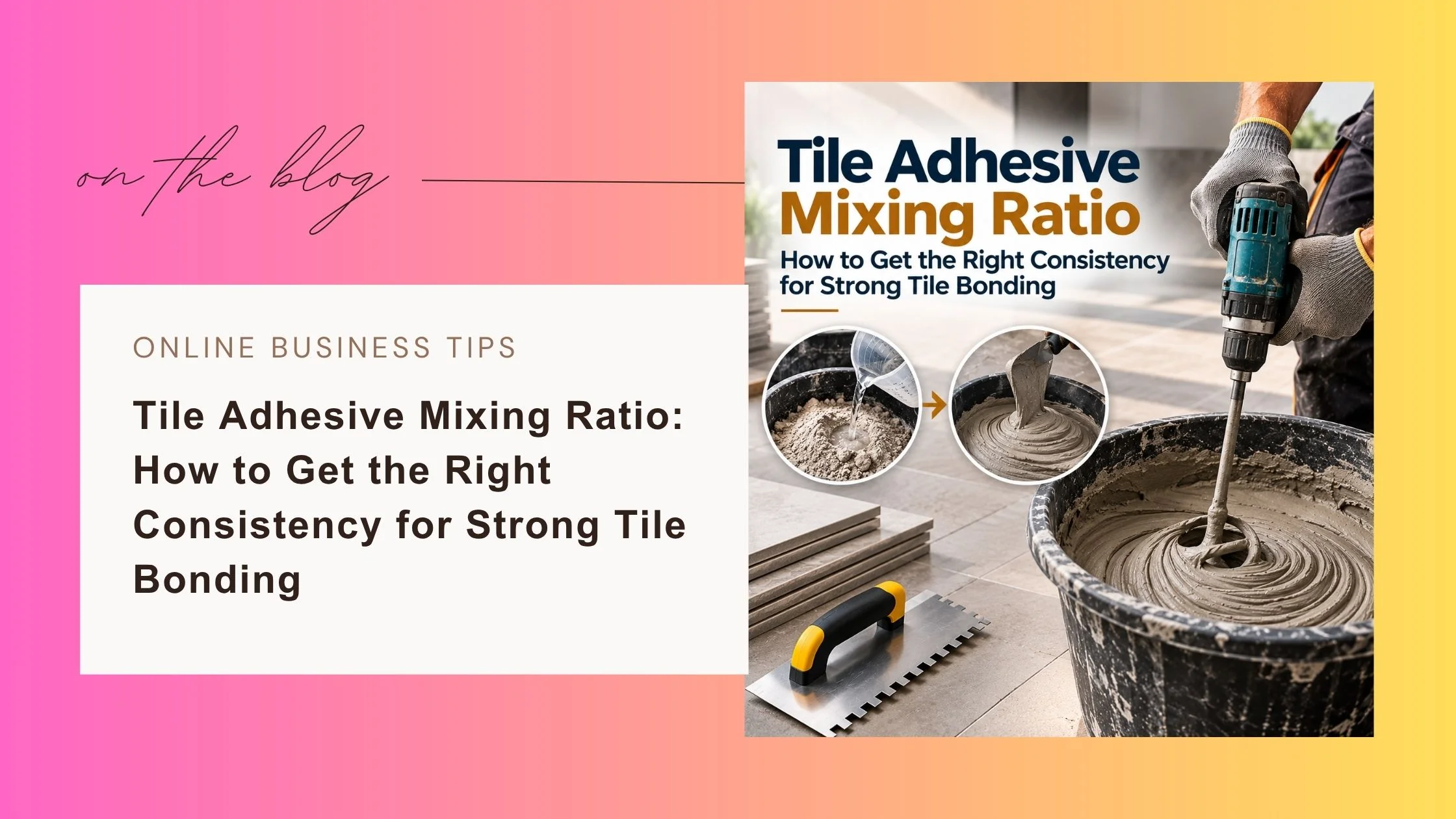
A tile adhesive can be a brilliant product, but there is one surprisingly easy way to make a good adhesive perform badly: mix it incorrectly. Too much water can turn a workable powder into a loose, weak mixture. Too little can leave you wrestling with a stiff mass that refuses to spread properly. Somewhere between those two extremes is the consistency your installation actually needs.
Understanding the Tile Adhesive Mixing Ratio is therefore just as important as selecting the right adhesive for the tile, substrate and application. Lapifix's tile adhesive guidance emphasises following the manufacturer's specified mixing ratio and achieving a smooth, workable consistency before application.
This guide explains how to mix tile adhesive correctly, why water quantity matters, how to recognise the right consistency, what pot life means and which common mixing mistakes can quietly compromise a tile installation. Whether you're working on a residential floor, a bathroom wall or a demanding large-format project, getting the mixture right is where a reliable bond starts.
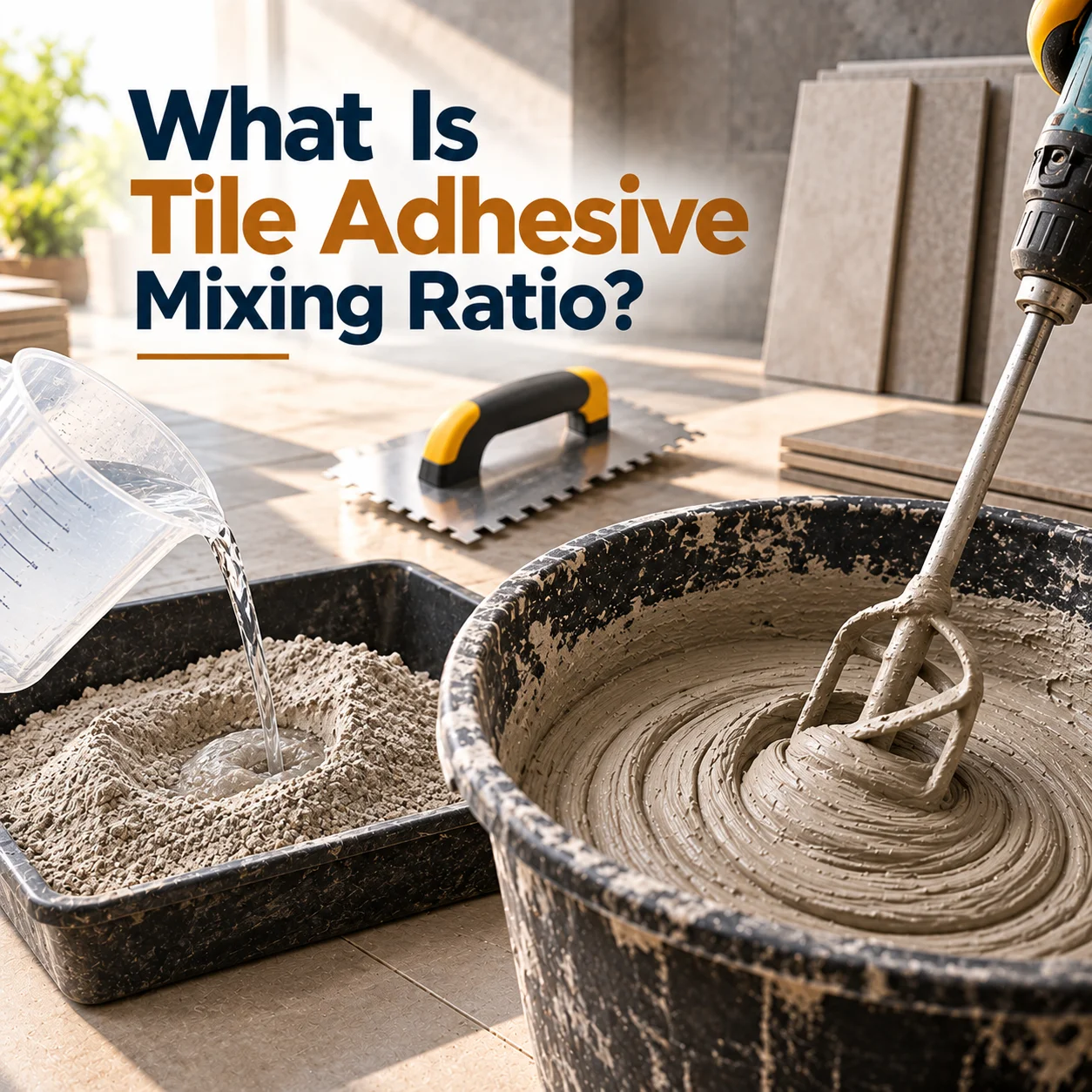
The Tile Adhesive Mixing Ratio is the recommended proportion of water to dry adhesive powder needed to produce a workable mixture with the intended performance characteristics. It is normally provided by the adhesive manufacturer and can vary between products.
That last point matters. There is no single water quantity that is correct for every cement-based tile adhesive. Different formulations contain different combinations of cement, graded fillers, polymers and performance additives. A standard internal-floor adhesive may have different mixing requirements from a flexible adhesive intended for large-format tiles or demanding external applications.
The ratio also needs to be understood by weight or volume according to the manufacturer's instructions. Guessing with an old bucket or adding water until the mixture “looks about right” might feel efficient, but construction chemistry is not particularly impressed by eyeballing.
A properly mixed adhesive should be smooth, homogeneous and workable without becoming watery or excessively stiff. The exact appearance will depend on the product, but the mixture should remain capable of forming a consistent adhesive bed when applied with the appropriate trowel.
Water is not simply there to make tile adhesive easier to spread. In cementitious adhesives, water participates in the hydration process and influences the workability of the mixture. The formulation is designed around a particular amount of water, which is why changing the ratio can change the material's behaviour.
If you add significantly more water than recommended, the mixture can become overly fluid. That may make spreading seem easier initially, but excessive water can alter the adhesive's intended properties and potentially reduce installation performance.
If you use too little water, the opposite problem appears. The adhesive may become difficult to mix, difficult to comb and harder to spread evenly. Lumps can remain, and the installer may struggle to achieve consistent contact with the tile.
The Tile Adhesive Mixing Ratio is therefore part of the product's performance system. It should not be treated as a flexible suggestion that can be changed simply because the weather, tile or installer “feels” different on the day.
The correct amount depends on the specific adhesive. For that reason, the safest answer to “how much water do I mix with tile adhesive?” is: use the quantity stated in the product's current technical documentation or packaging instructions.
Published general guidance can sometimes provide a rough range, but using a generic number across different products can create problems. Lapifix's own published guidance notes that manufacturers provide exact mixing ratios and gives approximately 4.5–5 litres per 20 kg bag as a typical range for some cement-based adhesives, while also stressing that the manufacturer's instructions should be followed.
That distinction is important. A “typical” range is not a substitute for the technical data sheet of the product sitting in front of you.
For a professional installation, measure the required water first, add the powder according to the stated procedure and mix mechanically where recommended. If you are using a different Lapifix product, do not automatically transfer the water quantity from another adhesive grade. Product formulations and intended applications can differ.
The basic Tile Adhesive Mixing Ratio becomes much easier to control when the mixing process itself is consistent.
Start with a clean mixing bucket and clean water. Measure the required water accurately rather than filling the bucket approximately. Add the adhesive powder according to the manufacturer's recommended sequence, then mix using a suitable mechanical paddle mixer where the product instructions call for mechanical mixing.
The objective is a uniform mixture without dry pockets or visible lumps. Avoid whipping the adhesive aggressively because unnecessarily high-speed mixing can introduce excess air into the material.
After the initial mix, some cementitious adhesives require a short resting or slaking period before a brief remix. Lapifix's published installation guidance, for example, describes allowing the mixed adhesive to stand for around five minutes and then remixing before application.
However, the product instructions should always take priority because resting times and procedures can vary.
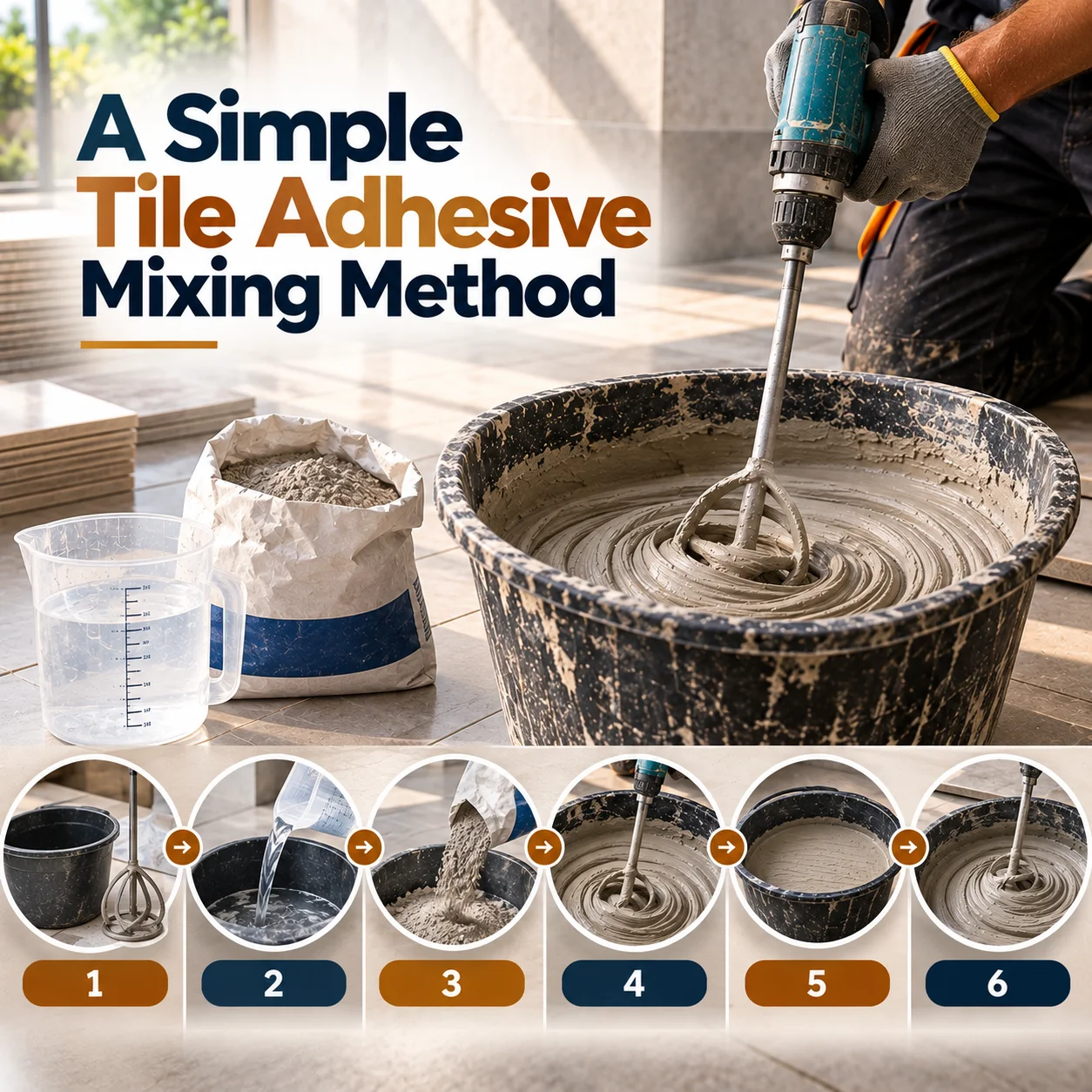
For most powder-based cementitious adhesives, the process can be thought of as a controlled sequence rather than a quick stir-and-go exercise.
Prepare the equipment. Use a clean bucket, clean water and a suitable mixing paddle. Contamination from old adhesive or grout can affect the new mixture.
Measure the water. Follow the product's specified Tile Adhesive Mixing Ratio rather than estimating the quantity.
Add the powder. Introduce the adhesive powder according to the manufacturer's recommended procedure while mixing steadily.
Mix thoroughly. Continue until the material becomes smooth and homogeneous, with no obvious dry powder or lumps.
Allow the specified resting time. If the product requires slaking, let it rest for the stated period.
Remix before use. Give the adhesive the recommended final mix before beginning application.
The process sounds simple because it is. The trick is consistency. If one batch receives a measured amount of water and the next receives an extra half-litre because it “looks thick”, you no longer have a controlled installation process.
The correct tile adhesive consistency should be smooth, cohesive and workable. It needs to spread under the notched trowel without flowing excessively, while still being soft enough to form consistent ridges.
A useful practical check is to look at how the adhesive behaves when combed. The ridges should hold their shape rather than immediately collapsing into a watery layer. At the same time, the adhesive should not be so stiff that the trowel struggles to create continuous, even ridges.
This balance is one reason experienced installers pay attention to consistency rather than focusing only on the number of litres of water used.
Remember that temperature can also affect workability. A mixture may behave differently in hot, dry conditions compared with a cool indoor environment. That does not mean you should randomly change the Tile Adhesive Mixing Ratio. Instead, follow the product instructions and manage the working conditions appropriately.
Adding excessive water is one of the most common mixing mistakes.
The first warning sign may actually be that the adhesive feels wonderfully easy to spread. That can be deceptive. A very fluid mixture can be harder to control and may not provide the intended properties once cured.
Excess water can also make the adhesive slump more readily on vertical surfaces. Instead of maintaining a stable adhesive bed, the material may move under gravity before the tile has been properly positioned.
For this reason, do not add water simply because the mixture feels slightly difficult to spread. First check whether the adhesive has been mixed correctly, whether the substrate is prepared properly and whether the product is still within its usable working time.
The Tile Adhesive Mixing Ratio is designed around the formulation. More water is not a shortcut to better workability.
Too little water creates a different set of problems.
The mixture may become extremely stiff, making it difficult to achieve a uniform layer. The trowel can drag through the adhesive rather than producing clean, continuous ridges, and the installer may find it difficult to properly bed the tile.
An excessively dry mixture can also encourage installers to keep adding small amounts of water during the application. This is where consistency between batches can quickly disappear.
If a batch is too stiff, do not automatically pour in extra water without checking the manufacturer's instructions. Consider whether the adhesive was mixed correctly, whether enough mixing time was allowed and whether the material has already exceeded its usable working period.
Construction sites are full of practical improvisation. Sometimes that is useful. Mixing adhesive by guesswork is not one of those moments.
A product's Tile Adhesive Mixing Ratio is developed alongside its formulation and performance requirements. Changing that ratio can affect workability and installation behaviour.
Lapifix's published guidance specifically warns against guessing the ratio and recommends using the manufacturer's stated quantity.
This is particularly important when different adhesive grades are being used on the same project. A contractor may have one product for standard internal tiling and another for more demanding applications. Assuming they all require the same amount of water can create inconsistent batches.
Measure first. Mix consistently. Then judge the material against the product's intended working characteristics.
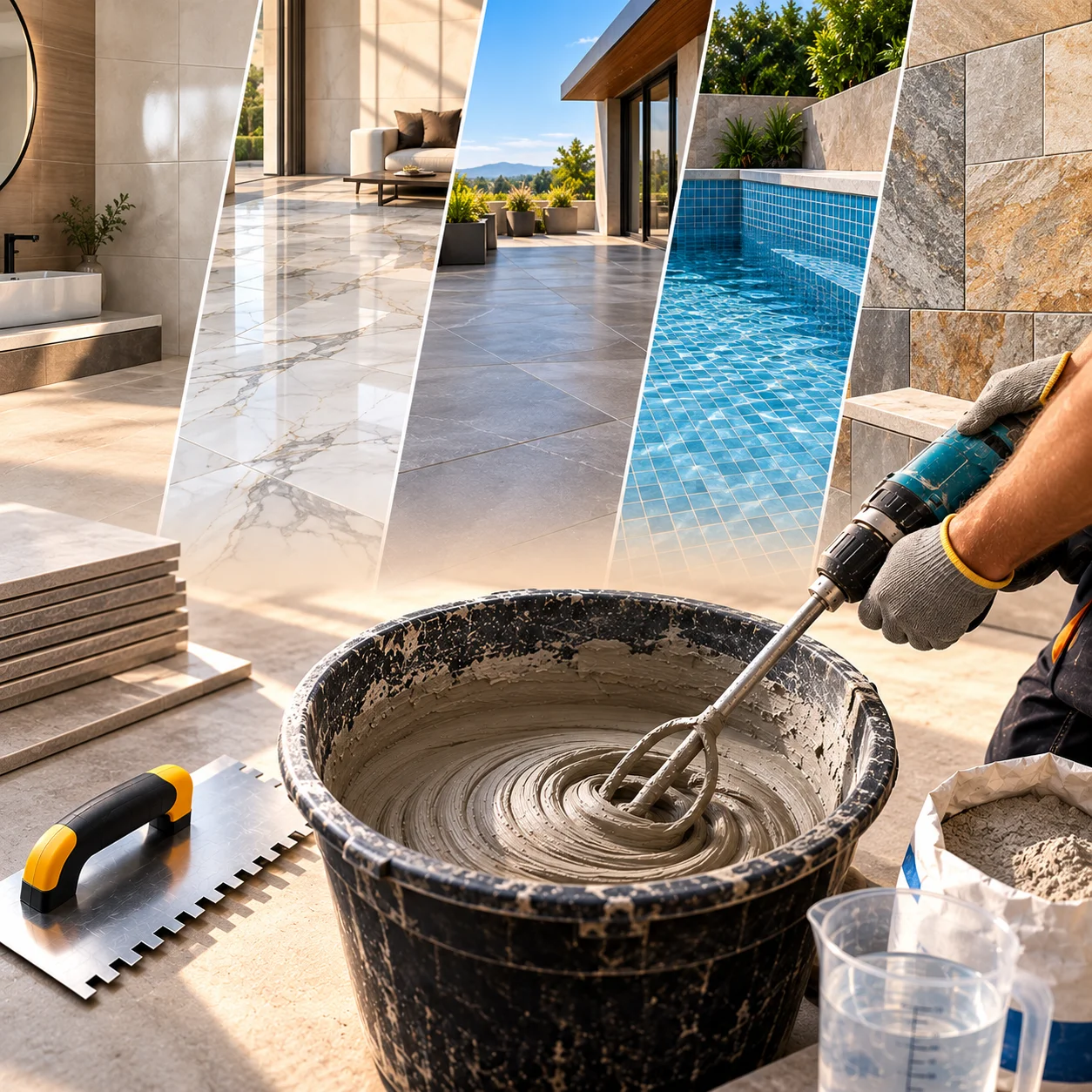
The mixing process should always begin with the product's technical requirements, but the application itself can influence what you need to consider.
A standard ceramic tile on an internal wall may be a relatively straightforward installation. Large-format porcelain, natural stone, external tiles or tile-on-tile applications can demand a different adhesive classification and installation method.
Lapifix currently offers several adhesive grades, including LX Standard, LX Super, LX Platinum, LX Premium and LX PU Superior. Its product range is positioned for different tile and application requirements rather than treating one adhesive as a universal solution.
That means the correct Tile Adhesive Mixing Ratio should be considered alongside tile type, substrate, location and product classification.
The ratio gets the mixture into the correct working state; the right product gets the overall installation system into the right performance category.
Large-format tiles are increasingly popular because they create a clean, contemporary appearance with fewer grout joints. They also demand more discipline during installation.
The adhesive still needs to be mixed according to its specified ratio. However, large-format tile installation can require additional attention to substrate flatness, trowel selection, adhesive coverage and back-buttering.
Lapifix's current product information positions LX Premium for demanding applications including large-format vitrified tiles, natural stone, marble, terrazzo and swimming pools, with a C2TE S1 classification listed by the manufacturer.
The important lesson is that you should not simply add extra water because a large tile seems difficult to handle. Large-format installations need the correct adhesive system and application technique, not a looser mixture.
Mixing and application are closely connected.
A correctly prepared adhesive needs to work with the chosen trowel. If the mixture is too wet, the ridges may collapse too quickly. If it is too stiff, the trowel may not form consistent ridges.
The goal is an adhesive consistency that allows the installer to spread the product evenly and create the appropriate adhesive bed for the tile.
Lapifix's installation guidance recommends using a notched trowel to create an even adhesive layer and highlights the importance of proper application technique.
This is why mixing should not be viewed as a separate stage that ends when the drill stops. The real test is how the adhesive behaves during application and whether the installed tile achieves the required contact.
Pot life refers to the period during which mixed adhesive remains suitable for use after preparation. It is not the same thing as curing time or open time.
This distinction matters because an adhesive can remain physically soft while becoming less suitable for installation as its working period progresses.
Lapifix LX Standard, for example, lists a pot life of approximately 2 hours and 30 minutes, along with an open time of 40 minutes and an adjustment time of 25 minutes. These are product-specific figures, not universal values for every adhesive.
Temperature, humidity, substrate absorption and other site conditions can influence practical working behaviour. Always follow the specific product documentation rather than assuming one pot-life figure applies across the entire range.
Do not attempt to revive adhesive that has exceeded its usable working period by simply adding water. That changes the mixture rather than restoring the original formulation.
Mixing a huge quantity of adhesive may appear efficient, especially when a large floor is waiting to be tiled. But if the installer cannot use the entire batch within its usable working time, efficiency quickly turns into waste.
Smaller, controlled batches make it easier to maintain the Tile Adhesive Mixing Ratio and keep the adhesive within its working window.
The ideal batch size depends on the crew, tile size, installation speed, site conditions and product pot life. An experienced installer learns to balance these factors.
For a DIY project, smaller batches can also reduce the pressure of trying to spread and use a large bucket before the adhesive changes in consistency.
Yes, site conditions can affect how adhesive behaves, although they do not automatically justify changing the specified water ratio.
Hot and dry conditions can accelerate moisture loss and shorten practical working time. Very cold conditions can slow curing and affect installation progress. Strong airflow or direct sunlight can also influence how quickly the exposed adhesive surface changes.
The answer is controlled working conditions and adherence to the manufacturer's instructions, not improvising with additional water.
If you are working outdoors or in particularly demanding conditions, check the product's technical documentation for suitable application temperatures and environmental limitations before starting.
Before covering a large area, take a moment to assess the adhesive.
The mixture should appear uniform, without dry powder, lumps or obvious separation. When spread with the trowel, it should create consistent ridges appropriate to the selected application method.
If the adhesive is watery, investigate before continuing. If it is unusually stiff, investigate that too. Do not immediately compensate by changing the Tile Adhesive Mixing Ratio unless the product instructions specifically permit adjustment.
A small test area can be extremely useful. Apply the adhesive, place a tile and then lift it to inspect coverage. This provides a real-world check of the entire system rather than judging the mixture in the bucket alone.
Many adhesive problems can be traced to a handful of simple habits. The first is adding water without measuring. The second is mixing with dirty equipment. The third is using too much water because the adhesive initially feels easier to spread.
Another mistake is skipping the recommended resting period when the product requires one. Some cementitious adhesives benefit from this controlled pause before final remixing, allowing the formulation to develop the intended working characteristics.
Installers should also avoid mixing more material than they can reasonably use within the product's pot life. A large bucket is not a badge of productivity.
Finally, never assume that an adhesive from one manufacturer or product grade has the same Tile Adhesive Mixing Ratio as another. Always check the current packaging and technical documentation for the exact product being used.
For worldwide projects, recognised standards provide a useful framework for understanding adhesive performance.
ISO 13007-1:2014 covers ceramic tile adhesives for internal and external wall and floor installations and establishes terminology and performance requirements for cementitious, dispersion and reaction-resin adhesives. ISO states that this edition was reviewed and confirmed in 2025 and remains current.
However, an international standard does not replace the manufacturer's product instructions. A standard describes requirements and classifications; the product's technical documentation tells the installer how that specific formulation should be prepared and applied.
That distinction is particularly useful for contractors working across markets. The same basic principles of controlled mixing, correct substrate preparation and suitable application remain relevant, but local project requirements and product documentation still need to be checked.
Before starting the next batch, keep the process simple and repeatable:
Check the exact adhesive product and current technical instructions.
Measure clean water accurately.
Use a clean mixing container and suitable mixing equipment.
Add the powder and water in the recommended sequence.
Mix until the material is smooth and homogeneous.
Follow the specified resting or slaking period if required.
Remix according to the manufacturer's instructions.
Use the adhesive within its stated pot life.
Do not add extra water after the mixture has started to set.
Check the applied adhesive and tile coverage during installation.
A consistent process is far more reliable than relying on experience alone.
The most important rule is simple: do not assume every Lapifix product uses the same Tile Adhesive Mixing Ratio.
Lapifix publishes several adhesive products for different installation requirements. LX Standard, for example, is described as a polymer-modified cement-based adhesive for internal floor applications and lists a specific pot life and application characteristics. Other grades are positioned for broader or more demanding applications, including tile-on-tile, external surfaces, large-format tiles and natural stone.
For that reason, the exact water quantity should always be taken from the current technical data or packaging for the specific product being installed. This avoids one of the most common mistakes in tile work: treating different adhesive formulations as though they are all interchangeable.
A strong tile installation starts before the adhesive reaches the wall or floor. The correct Tile Adhesive Mixing Ratio gives the product the water level it was designed around, while correct mixing ensures the powder is properly dispersed and ready for application.
But mixing is only one part of the system. The tile, substrate, adhesive classification, trowel, coverage, working time and environmental conditions all matter. If one part is wrong, a perfect-looking mixture in the bucket cannot rescue the entire installation.
So, rather than asking for one universal number of litres per bag, ask a better question: what does the manufacturer specify for this exact adhesive, and does the resulting mixture behave correctly during application?
That approach is far more useful—and considerably less likely to leave you standing beside a bucket of expensive adhesive wondering what went wrong.
Getting the Tile Adhesive Mixing Ratio right is one of the simplest ways to make tile installation more predictable. Measure the water accurately, use clean equipment, mix thoroughly, follow any required resting period and work within the adhesive's pot life. Most importantly, do not assume one water ratio works for every adhesive. Product formulation, tile type, substrate and application conditions all influence the correct preparation method.
For projects where consistent bonding and reliable application matter, selecting the right adhesive is only the beginning. Lapifix offers a range of tile adhesive solutions for different tile types and installation requirements. Before mixing your next batch, check the product's current technical instructions and choose the appropriate solution for the job through the Lapifix tile adhesive range. A properly measured mix may seem like a small detail, but in tile installation, small details are often what keep a finished surface looking solid long after the tools have been packed away.
The correct Tile Adhesive Mixing Ratio depends on the specific adhesive formulation and must be taken from the manufacturer's current instructions. Different cement-based adhesives can require different amounts of water, so a generic ratio should not be applied automatically to every product.
There is no universal amount for every 20 kg bag. Some cement-based products may require roughly 4.5–5 litres per 20 kg, but this is only a general range cited in Lapifix guidance and should not replace the exact product specification. Always measure the quantity stated for the specific adhesive you are using.
Proper tile adhesive consistency should generally be smooth, homogeneous and workable without being runny. It should spread under the trowel and hold appropriate ridges without becoming excessively stiff. The manufacturer's instructions should remain the primary reference because different formulations can have different working characteristics.
You should not automatically add more water. If the mixture is too thick, first check whether the original Tile Adhesive Mixing Ratio was followed and whether the adhesive remains within its usable working period. Adding water later can change the formulation and may compromise the intended performance.
The usable period depends on the product and is generally described as pot life. For example, Lapifix LX Standard currently lists a pot life of approximately 2 hours and 30 minutes. Other products may differ, so always follow the specific manufacturer's technical documentation and do not attempt to extend expired adhesive by adding water.