

Epoxy coatings are widely used for creating durable, seamless, and long-lasting surfaces in residential, commercial, and industrial spaces. With rising demand for reliable epoxy flooring solutions, it’s important to understand the different Types of Epoxy Coatings before making a choice.
The three main Types of Epoxy Solvent-based, Water-based & 100% solids each offer unique benefits, performance levels, and applications. This guide will help you choose the right option based on your needs while ensuring better performance and long-term epoxy coating durability.
Epoxy coatings are protective surface layers made by combining resin and hardener, which chemically react to form a strong, rigid material. This process creates a durable and highly adhesive finish that bonds well to concrete and other surfaces, making it ideal for various epoxy coating applications.
There are different epoxy resin types, each designed to deliver specific performance characteristics such as chemical resistance, moisture protection, and surface strength. These properties make epoxy one of the most preferred materials across multiple epoxy flooring types, especially where durability and performance are critical.
Epoxy coatings are widely used in industries, commercial spaces, and homes due to their ability to withstand heavy loads, resist wear, and maintain a clean, polished look. Whether used in factories or garages, they play a key role in enhancing surface life and overall epoxy coating durability.
Choosing the right option from the various Types of Epoxy Coatings is not just about appearance it directly affects performance, cost, and long-term value. Each type is formulated differently, which means it behaves differently under specific conditions such as heavy traffic, moisture exposure, or chemical contact.
Understanding the different Types of Epoxy helps ensure that the coating you select matches your exact requirements. For example, some coatings are better suited for light residential use, while others are designed for demanding industrial epoxy coatings where strength and resistance are critical.
Selecting the correct coating also plays a major role in overall epoxy coating durability. The right choice can extend the life of your floor, reduce maintenance costs, and improve safety. On the other hand, using the wrong type may lead to peeling, cracking, or frequent repairs.
By following a proper epoxy floor coating guide, you can make an informed decision that balances performance, budget, and application needs ensuring long-lasting and efficient epoxy flooring solutions.
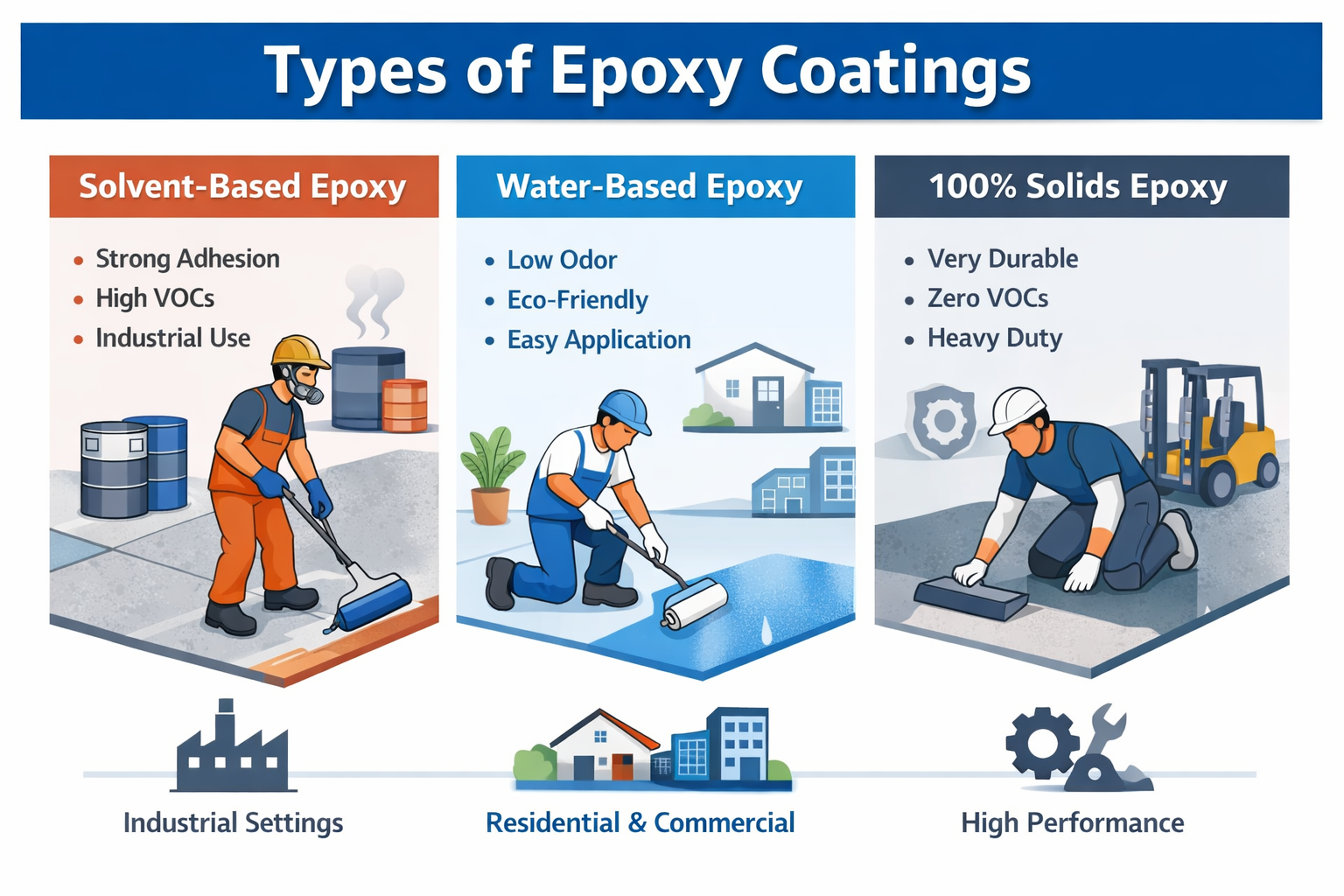
When exploring different Types of Epoxy Coatings, it’s important to understand that not all epoxy systems are the same. Each type is formulated with a different composition, which directly affects its performance, application method, and suitability for specific environments. The three most widely used Types of Epoxy are Solvent-based, Water-based & 100% solids epoxy coatings.
Let’s take a closer look at each type and how they fit into various epoxy flooring types and applications:
Solvent-based epoxy coatings are one of the most commonly used epoxy coating types, especially in demanding environments. These coatings are formulated by mixing epoxy resin with solvents, which help reduce viscosity and improve the coating’s ability to penetrate deep into concrete surfaces.
This deep penetration ensures a strong mechanical bond, making solvent-based systems highly reliable for heavy-duty epoxy coating applications where durability and performance are essential.
Solvent-based epoxy consists of epoxy resin, hardener, and chemical solvents. The solvents act as carriers that evaporate during the curing process, leaving behind a hard, protective surface. This composition enhances adhesion and allows the coating to perform well even on slightly porous or uneven substrates.
Strong Adhesion: The solvent content allows deeper penetration into concrete, resulting in excellent bonding strength.
High Penetration: Ideal for surfaces that require a firm grip, especially in older or rough concrete floors.
Suitable for Industrial Environments: Performs exceptionally well in factories and warehouses where floors are exposed to heavy loads, chemicals, and constant traffic.
Reliable Performance: Known for consistent results across various epoxy flooring types, particularly in high-demand settings.
High VOC Content: These coatings release volatile organic compounds, which can impact air quality during application.
Strong Odor: The presence of solvents leads to a noticeable smell, requiring proper ventilation and safety precautions.
Solvent-based epoxy is widely used in areas where strength and durability are critical, such as:
Factories and manufacturing units
Warehouses and storage facilities
Heavy-duty industrial floors
Mechanical workshops
These environments benefit from its ability to withstand wear and maintain long-term epoxy coating durability.
Solvent-based systems play a significant role in industrial epoxy coatings due to their superior bonding and resistance properties. They are often the preferred choice when surfaces are exposed to harsh conditions, including chemicals, abrasion, and heavy machinery.
For industries seeking dependable and long-lasting epoxy flooring solutions, solvent-based epoxy remains a practical and performance-driven option.
Water-based epoxy coatings are a popular choice among modern Types of Epoxy Coatings, especially where environmental safety and ease of application are important. Instead of solvents, these coatings use water as a carrier, making them a more eco-friendly option for various epoxy flooring types.
They are widely used in residential and commercial spaces where low odor and safe indoor application are priorities.
Water-based epoxy is made by combining epoxy resin, hardener, and water as the primary dispersing agent. During the curing process, water evaporates, leaving behind a protective coating. While thinner than other epoxy coating types, they still provide a smooth and durable finish.
Low VOC and Eco-Friendly: Produces minimal emissions, making it safer for indoor use and environmentally conscious projects.
Easy Application and Cleanup: Simple to apply with standard tools and can be cleaned using water, reducing overall effort.
Low Odor: Ideal for occupied spaces like homes, offices, and retail areas.
Cost-Effective Solution: Generally more affordable compared to other Types of Epoxy, making it suitable for budget-friendly projects.
Lower Durability: Compared to solvent-based and 100% solids epoxy, it may not perform as well in heavy-duty environments.
Thinner Coating Layer: Offers less thickness, which can impact long-term epoxy coating durability under high traffic.
Water-based epoxy is best suited for light to medium-duty epoxy coating applications, such as:
Residential floors and garages
Offices and commercial interiors
Retail stores and showrooms
Decorative flooring projects
These applications benefit from its ease of use and clean finish, making it a practical choice for modern epoxy flooring solutions.
Among different epoxy flooring types, water-based coatings are often chosen for projects that prioritize safety, sustainability, and convenience. They may not offer the same strength as heavy-duty options, but they provide a balanced solution for spaces with moderate usage.
For users following a practical epoxy floor coating guide, water-based epoxy is an excellent starting point for achieving reliable performance without complex installation requirements.
100% solids epoxy coatings are the purest form of epoxy, containing no solvents or water. This means that the entire applied material remains on the surface after curing, resulting in a thicker and more durable layer.
These coatings provide superior strength, chemical resistance, and long-term epoxy coating durability. They are widely used in high-performance epoxy flooring solutions where maximum protection is required. However, they require skilled application and are generally more expensive.
Maximum Durability: Offers superior epoxy coating durability, making it ideal for high-traffic and heavy-load areas.
Zero VOC Emissions: Contains no solvents, making it environmentally safer compared to solvent-based options.
Thick and Strong Coating: Builds a solid layer that provides excellent resistance to chemicals, abrasion, and impact.
Long-Term Performance: Requires less maintenance over time, making it a cost-effective choice in the long run.
Higher Cost: More expensive than other Types of Epoxy, both in material and application.
Complex Application: Requires skilled professionals for proper installation due to its thick consistency and fast curing time.
100% solids epoxy is ideal for heavy-duty and high-performance epoxy coating applications, such as:
Industrial plants and factories
Warehouses with heavy machinery
Commercial spaces with high foot traffic
Pharmaceutical and food processing units
These environments benefit from its strength and long-lasting epoxy flooring solutions.
Among all epoxy flooring types, 100% solids epoxy stands out as the premium choice for projects that demand maximum strength and durability. It is often selected when performance cannot be compromised, especially in critical industrial settings.
For those following a detailed epoxy floor coating guide, this type is the best option when durability, thickness, and long-term value are top priorities.
Understanding the differences between various Types of Epoxy Coatings is essential for selecting the right solution for your project. Each type offers unique advantages and limitations depending on factors like durability, cost, environmental impact, and application method.
Below is a simplified comparison of the three main Types of Epoxy Solvent-based, Water-based & 100% solids to help you make an informed decision.
|
Feature |
Solvent-Based Epoxy |
Water-Based Epoxy |
100% Solids Epoxy |
|
Durability |
High |
Moderate |
Very High |
|
VOC Level |
High |
Low |
Zero |
|
Odor |
Strong |
Minimal |
Low |
|
Coating Thickness |
Medium |
Thin |
Thick |
|
Application Difficulty |
Moderate |
Easy |
Complex |
|
Cost |
Moderate |
Low |
High |
|
Best Use Case |
Industrial areas |
Residential & light use |
Heavy-duty industrial use |
Solvent-based epoxy is ideal for tough environments and widely used in industrial epoxy coatings due to its strong adhesion and penetration.
Water-based epoxy is best suited for indoor and light-duty epoxy coating applications, offering an eco-friendly and easy-to-use solution.
100% solids epoxy delivers the highest level of epoxy coating durability, making it perfect for high-performance epoxy flooring solutions.
Each option among the different epoxy coating types serves a specific purpose. There is no one-size-fits-all solution your choice should depend on usage, environment, and budget.
By comparing these Types of Epoxy Coatings, you can confidently select the right system that ensures long-term performance and aligns with your flooring requirements.
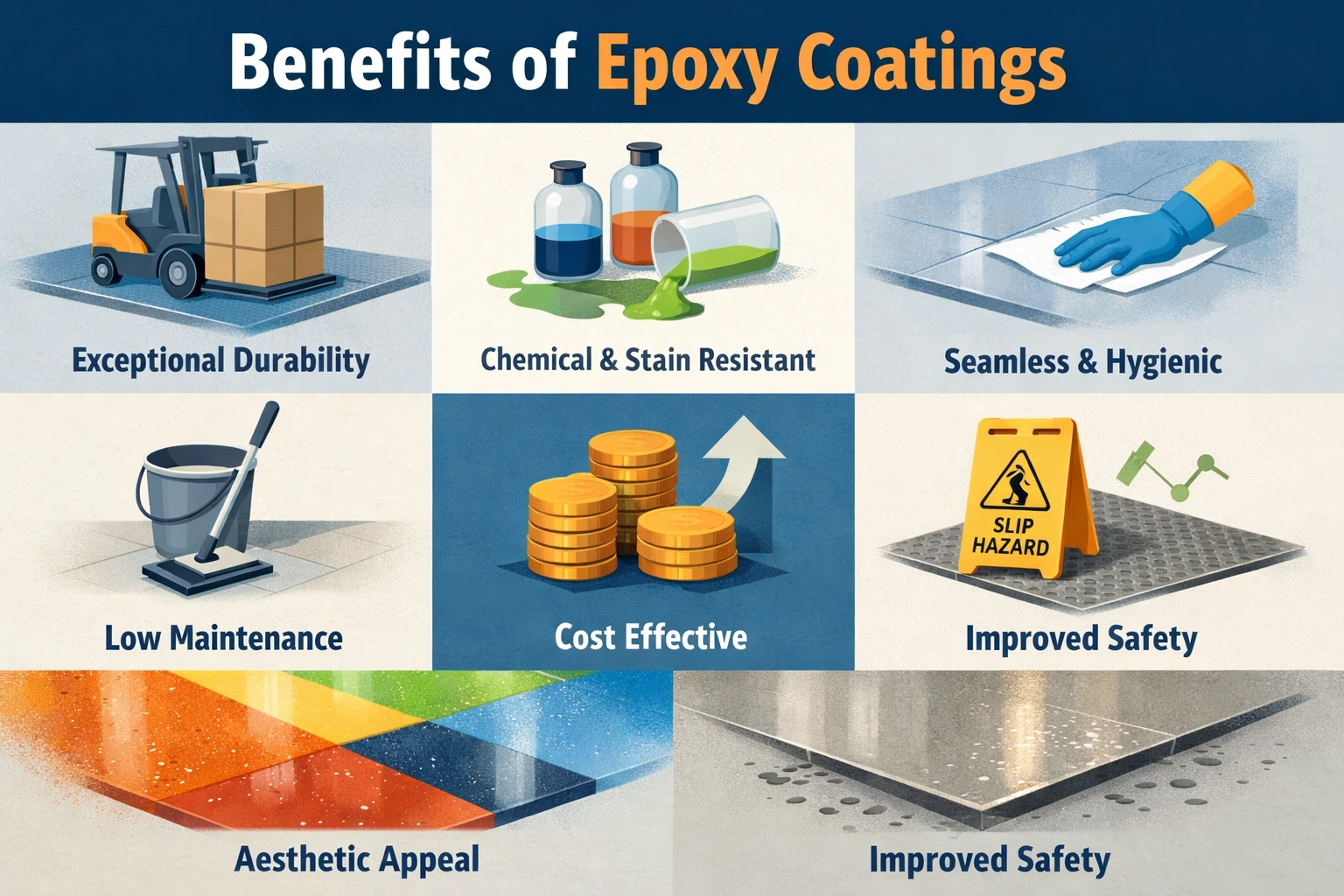
Epoxy coatings have become a preferred choice across various industries due to their strength, versatility, and long-term performance. Whether used in homes or industrial epoxy coatings, they offer a wide range of advantages that make them one of the most reliable epoxy flooring solutions available today.
One of the biggest advantages of epoxy is its superior epoxy coating durability. It creates a hard, impact-resistant surface that can withstand heavy loads, constant foot traffic, and machinery without cracking or peeling.
Epoxy coatings are highly resistant to chemicals, oils, and stains, making them ideal for industrial and commercial epoxy coating applications. This property helps maintain a clean and damage-free surface even in harsh environments.
Epoxy forms a smooth, seamless layer without joints or gaps. This makes cleaning easier and prevents dust, bacteria, and moisture buildup especially important for healthcare, food processing, and commercial spaces.
Compared to other epoxy flooring types, epoxy-coated surfaces require minimal maintenance. Regular cleaning is usually enough to maintain their appearance and performance, reducing long-term costs.
Although some Types of Epoxy may have higher upfront costs, their long lifespan and low maintenance make them a cost-effective investment over time. This makes epoxy a smart choice for both residential and industrial use.
Epoxy coatings are available in a variety of colors, textures, and finishes. They can enhance the visual appeal of floors while still delivering high performance, making them suitable for modern epoxy flooring solutions.
Epoxy coatings can be customized with anti-slip additives, improving safety in workplaces and high-traffic areas. This is especially beneficial in industrial settings where safety is a priority.
The wide range of epoxy coating benefits makes it a versatile solution for different needs. From durability and aesthetics to safety and cost efficiency, epoxy coatings deliver reliable performance across all types of applications.
Understanding these advantages helps in selecting the right option from various Types of Epoxy Coatings, ensuring long-lasting and efficient results.
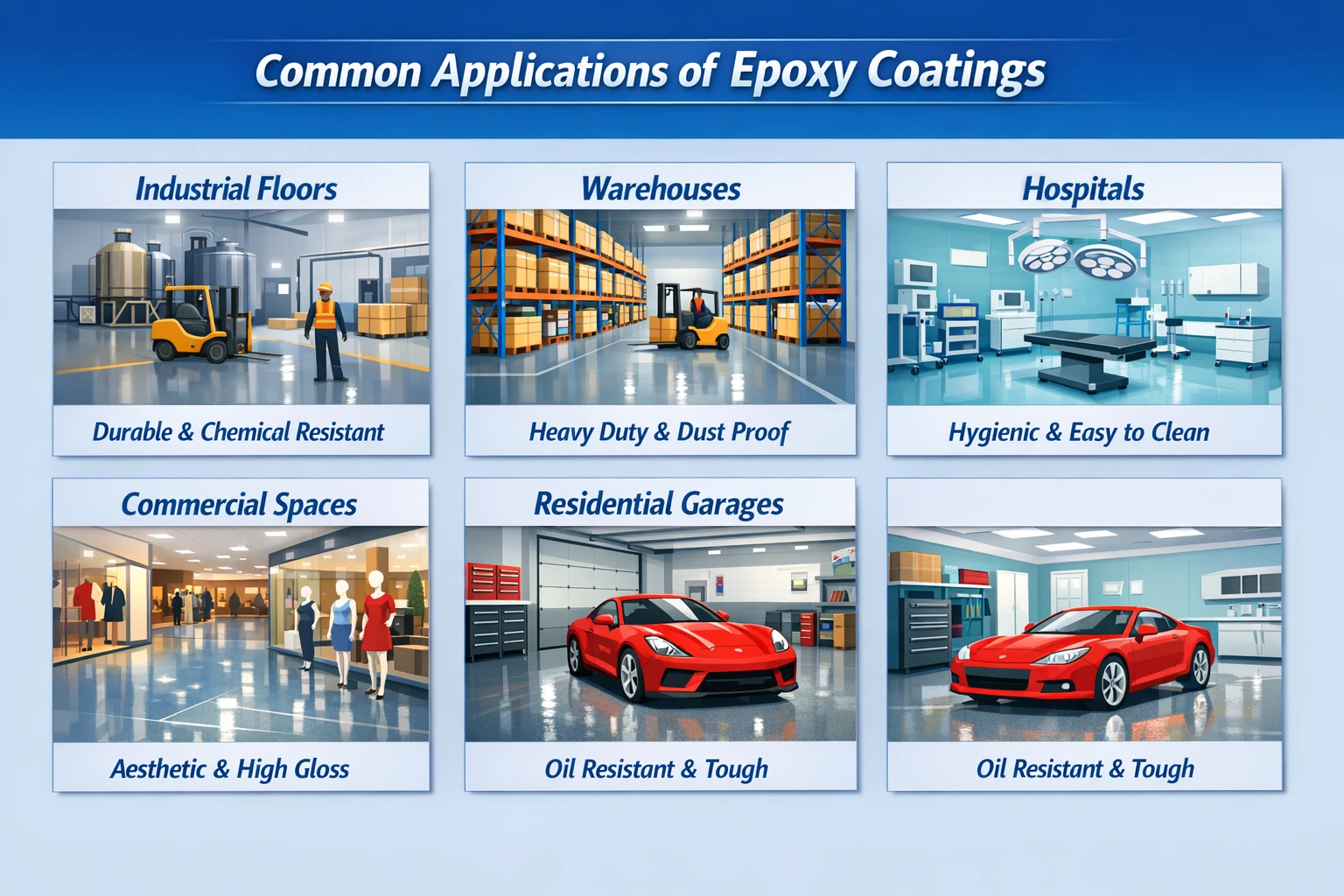
When it comes to versatility and performance, few materials match the wide-ranging epoxy coating applications seen across industries and residential spaces. Thanks to their strength, seamless finish, and long-lasting protection, different Types of Epoxy Coatings are used in environments that demand durability and hygiene.
Let’s explore where these coatings are most commonly applied and why they are preferred.
Industrial environments require flooring that can withstand heavy machinery, chemical exposure, and constant wear. This is where industrial epoxy coatings play a critical role.
These coatings create a tough, non-porous surface that resists oil spills, chemicals, and abrasion. Whether in manufacturing plants or processing units, choosing the right Types of Epoxy ensures long-term performance and safety.
Additionally, they improve visibility with glossy finishes and can include anti-slip properties for worker safety.
Warehouses experience continuous movement of forklifts, pallets, and heavy loads. Standard flooring often cracks or deteriorates under such pressure, but epoxy flooring solutions provide a reliable alternative.
Different epoxy flooring types are used depending on load requirements and traffic intensity. Epoxy coatings help reduce dust, improve cleanliness, and enhance operational efficiency.
Their seamless finish also makes maintenance easier, which is essential in large storage facilities.
In healthcare environments, hygiene is a top priority. Floors must be easy to clean, resistant to bacteria, and free from cracks where contaminants can accumulate.
This is where water-based & 100% solids epoxy coating types are commonly used. These options offer low VOC emissions and create a smooth, joint-free surface.
Among various epoxy resin types, medical-grade coatings are specially designed to meet strict hygiene standards. Their durability ensures long-term use without frequent repairs.
From shopping malls to offices and showrooms, commercial areas require flooring that is both durable and visually appealing.
Modern epoxy coating types provide customizable finishes, including decorative patterns and high-gloss surfaces. Businesses often choose epoxy for its aesthetic value along with its practical benefits.
The wide range of epoxy coating benefits includes resistance to foot traffic, ease of cleaning, and improved lighting due to reflective surfaces.
Homeowners are increasingly opting for epoxy coatings in garages due to their strength and polished look.
Among the different epoxy flooring types, garage coatings are designed to handle vehicle weight, oil spills, and temperature variations. They transform dull concrete into a durable and attractive surface.
A well-planned epoxy floor coating guide can help homeowners choose the right system based on usage and budget.
The growing demand for these surfaces comes down to one key factor epoxy coating durability. Whether it’s a factory or a home garage, epoxy coatings provide:
Long-lasting performance
Resistance to chemicals and stains
Seamless and hygienic surfaces
Low maintenance requirements
By understanding different Types of Epoxy Coatings, businesses and homeowners can select the most suitable option for their specific needs.
In conclusion, the adaptability of epoxy makes it a preferred choice across multiple sectors. From heavy-duty industrial setups to modern residential spaces, the right coating ensures both protection and performance.
The three main Types of Epoxy Coatings Solvent-based, Water-based & 100% solids each serve different needs, from eco-friendly indoor use to heavy-duty industrial performance.
Choosing the right Types of Epoxy is important for achieving maximum performance, safety, and long-term value. The right coating enhances surface strength, appearance, and overall epoxy coating durability.
If you're looking for reliable epoxy flooring solutions, trusted providers like Lapifix offer quality products suited for various epoxy coating applications.
The three main Types of Epoxy Coatings are Solvent-based, Water-based & 100% solids. Each type offers different levels of strength, chemical resistance, and application ease.
These epoxy coating types are selected based on the environment, surface condition, and performance requirements.
The best choice depends on usage. For heavy-duty areas, 100% solids coatings are ideal due to their strength and thickness. For indoor or residential use, water-based options are commonly preferred.
Among various epoxy flooring types, selecting the right one ensures better performance and long-term epoxy coating durability.
Water-based epoxy is eco-friendly, low in odor, and easy to apply, making it suitable for indoor environments.
Solvent-based epoxy, on the other hand, offers stronger adhesion and better resistance to chemicals and abrasion. It is often used in industrial epoxy coatings where durability is critical.
Yes, 100% solids epoxy is considered the most durable option among all Types of Epoxy. It provides a thick, high-performance layer with excellent resistance to wear and chemicals.
Although it may cost more initially, it offers long-term value due to reduced maintenance and superior protection.
The lifespan depends on usage, maintenance, and the selected coating. High-quality epoxy coating applications can last anywhere between 5 to 20 years.
With proper installation and care, epoxy coating durability ensures long-lasting performance in both residential and industrial environments.