

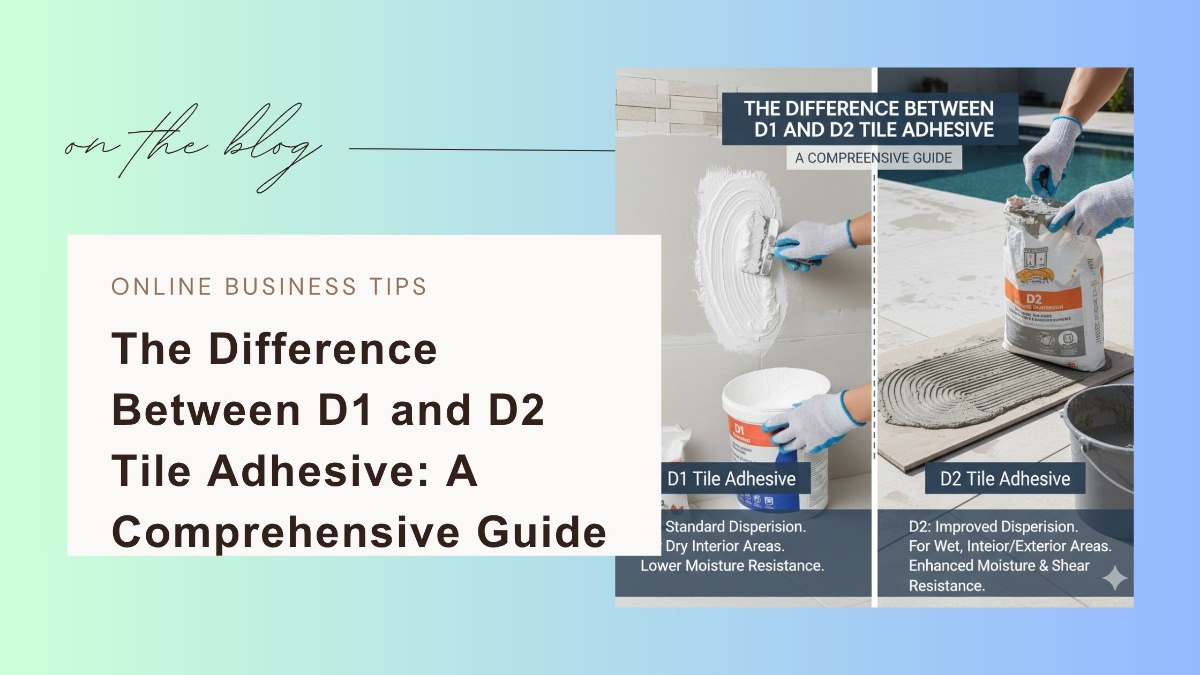
In tiling, the adhesive that you choose is very important in determining the longevity and durability of your tile installations. tile adhesives Tile adhesives are special compounds that are specially designed to bond tiles onto different surfaces and this bond is very strong and enduring. Regardless of whether you are a professional contractor or a DIY lover, knowing the various kinds of tile adhesives in the market can greatly determine how successful your project would be.
There are different types of tile adhesives and each type has a specific application and environment it is intended to be used. The nature of the tile, the surface to which it is being applied and even the environmental conditions are also some of the factors that will give the best adhesive to be used in the undertaking. D1 and D2 tile adhesives are among the many products in the market that are popular because of their versatility and performance.
This is a detailed guide as I will discuss the detail of D1 and D2 tile adhesives, their main differences, and give some information about how and when each type will be used. At the conclusion of this article, you will be able to make an informed decision about your tile installation project.
D1 tile adhesive is a dispersion based adhesive that has mainly interior applications. It is a non cementitious bonding agent, that is, it does not include cement as a bonding agent. This kind of adhesive is characterized by its ease of application and this is why it is very popular among the professionals as well as DIYers who are seeking simple application procedures.
Flexibility is one of the obvious characteristics of D1 tile adhesive. This is because it can be used on substrates that might slightly move like plasterboard and drywall due to this flexibility. It can also be used to fix tiles to surfaces which may either stretch or shrink with changes in temperature so that it can provide a safe fixation even in unstable conditions.
The D1 types of adhesives are generally used when it comes to light to medium-weight applications, which may include tiling of walls inside the bathroom and kitchen areas, among other interiors. It is necessary to mention that D1 adhesive has great characteristics of adhesion, but it might not be the best choice in terms of heavy-duty or outdoor use where stronger bonding is needed.
D2 tile adhesive is a dispersion-based adhesive as well, but it is designed to offer better performance than D1 adhesives. It is similar to D1 and is designed to be used in the interior, however, it has a higher strength and better water resistance, which means that it can be applied in places that have a greater moisture rate like shower areas and wet rooms.
The design of the D2 adhesive enables it to adhere firmly to a greater variety of surfaces such as cement-based surfaces and existing tiles. Its increased ability to resist water means that it can resist occasional water exposure without affecting its adhesive properties and is therefore a safe option in wet conditions.
Also, D2 tile adhesive is intended to hold heavy tiles and the more demanding applications. This is what makes it a flexible solution to the project where both strength and durability must be the key factors. Nevertheless, it remains mostly to be used indoors, because outdoor conditions may demand adhesives with other compositions to withstand extreme conditions.
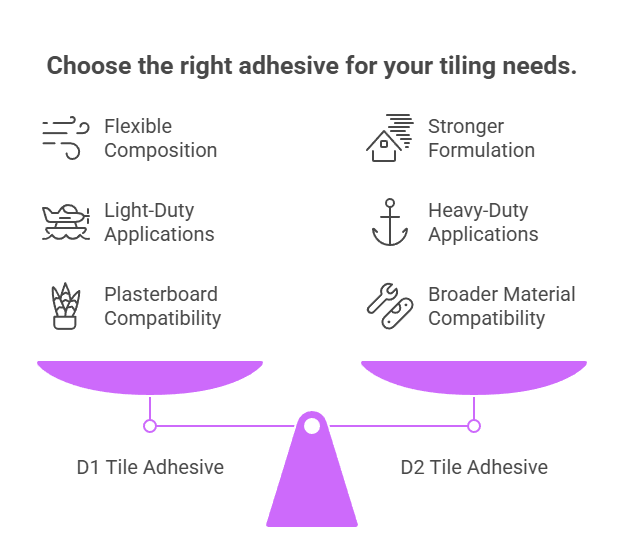
It is important to understand the most important distinctions between D1 and D2 tile adhesives so that you can select the appropriate product to suit your requirements. These are the significant differences.:
Composition: The Both adhesives D1 and D2 are both dispersion based but D2 is a stronger formulation, which has more water resistance and strength.
Flexibility vs. Strength:D1 adhesives are more flexible and hence are used in surfaces that have potential movement whereas D2 adhesives are stronger and have higher durability and are used in wetter areas.
Application Areas: D1 is best for light to medium-duty interior applications, whereas D2 can handle heavier tiles and areas with higher moisture exposure.
Substrate Compatibility: D1 can be used on substrates such as plasterboard and D2 can bond to a broader range of materials such as cement-based surfaces.
These variations show that, though both adhesives have certain similarities, they differ in terms of certain characteristics that make them fit in different applications. The choice of the type to use is dependent on the needs of your project such as the surroundings and the materials you are going to use.
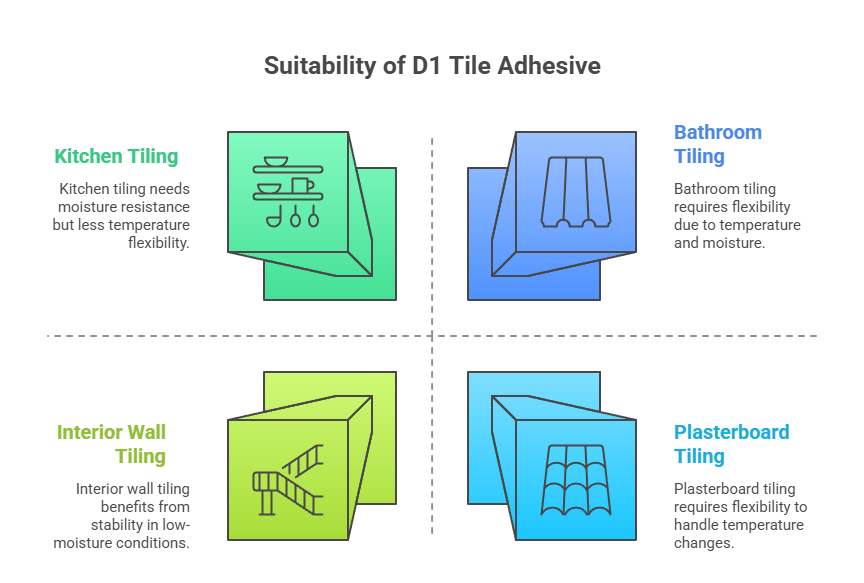
Choosing when to use D1 tile adhesive is essential for ensuring optimal results in your tiling projects. Here are some scenarios where D1 adhesive is the most suitable choice:
Interior Wall Tiling: D1 is suitable when used on interior wall where it is needed especially in places such as kitchens and bathrooms where tiles are used to beautify and improve the functionality of the room.
Plasterboard and Drywall: IThe plasterboard and drywall are quite flexible and thus D1 adhesive suits well in that type of substrate that is likely to settle like plasterboard and drywall to ensure a strong bond even when it moves a little.
Temperature Fluctuations: In places prone to temperature variations, the flexibility of D1 adhesive enables it to respond to the expansion and contraction ensuring the integrity of tiles.
Where applying D1 adhesive, it is essential to make the environment favorable to its characteristics. Do not use in high-moisture environments or where heavy duty is needed as it may not be as strong as it would be in such situations.
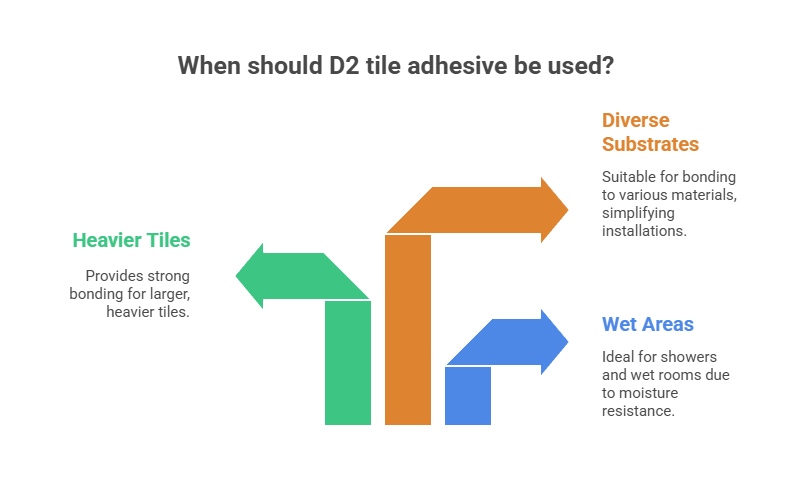
D2 tile adhesive is a versatile option, suitable for a variety of interior applications where enhanced strength and moisture resistance are needed. Here are the ideal scenarios for using D2 adhesive:
Wet Areas:D2 adhesive is ideal in places that are exposed to water, including showers, wet rooms and splash areas, where water protection is required.
Heavier Tiles: In the case of larger or heavier weighted tiles, D2 adhesive offers the support needed to be sure that the bonding will be strong and permanent.
Diverse Substrates: D2 adhesive has the properties of bonding to wide range of substrates and cement as well as available tiles and therefore makes it a good alternative to complicated installations.
To use D2 adhesive, the surface should be clean prior to application and the instructions of the manufacturer are to be adhered to although the best outcome might not be attained. Although it is better in performance in indoor use, it might not be applicable in outdoor conditions where weather resistance is needed.
Understanding the pros and cons of D1 and D2 tile adhesives can aid in making an informed decision for your project. Below is a comparative table to highlight their advantages and disadvantages:
| Feature | D1 Tile Adhesive | D2 Tile Adhesive |
|---|---|---|
| Flexibility | High flexibility, suitable for moving substrates | Moderate flexibility, prioritizes strength |
| Water Resistance | Limited water resistance | High water resistance, ideal for wet areas |
| Strength | Suitable for light to medium-duty applications | Supports heavier tiles, suitable for demanding tasks |
| Substrate Range | Limited to certain substrates | Bonds with a wide range of surfaces |
| Ease of Use | Easy application, user-friendly | Requires careful surface preparation |
D1 adhesive is flexible and easy to use, but does not have as good water resistance and strength of D2 adhesive. Alternatively, D2 adhesive is better in wet and demanding applications but might need more careful preparation.
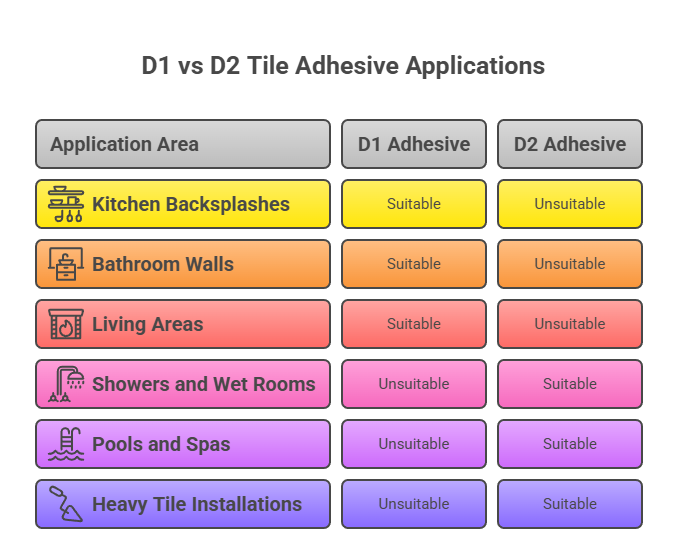
Both D1 and D2 tile adhesives have specific applications where they perform best. Here are some common scenarios for each:
Kitchen Backsplashes: These are useful in decorative tiling of kitchen walls where flexibility is an advantage.
Bathroom Walls: They can be used to decorate the walls without direct exposure to water, which supports the use of tiles.
Living Areas: Great for tiling accent walls and decorative features in living rooms and hallways.
Showers and Wet Rooms: Perfect for tiling in wet areas, ensuring a strong bond in moisture-rich environments.
Pools and Spas: Tiles have excellent water resistance when used in pools and spas and will not lose their adhesion when subjected to water all the time.
Heavy Tile Installations: These are used in large-format tiles or stone tiles that need extra support because of their weight.
It is possible to bring about a successful and long-lasting tile installation by comparing the type of the adhesive to the use, which improves both decorative and functional aspects of your space.
Selecting the appropriate tile adhesive involves considering several factors to ensure the best results for your project. Here are some tips to guide your decision:
Identify the Environment: dentify the location, either in doors or outdoors, and determine the amount of moisture to align the properties of adhesive with the environment.
Consider Tile Type and Size: Tiles heavier or larger in size might need stronger adhesives like D2, whereas lighter tiles can be bonded using D1 adhesive.
Evaluate Substrate Compatibility: Check that the adhesive should be used on the surface you are working on and it should be compatible with such substrates as cement, plasterboard or existing tiles.
Review Manufacturer Recommendations: It is always recommended to follow manufacturers instructions on application techniques, curing and on how to prepare the surface to achieve the best results.
Considering these factors, you are able to choose the appropriate adhesive that will fit the unique requirement of your tiling project, and which will result in the successful implementation of the tiling project.
In conclusion it is important to learn the difference between D1 and D2 tile adhesives to make an appropriate decision that could fit your project requirements. Flexibility, strength, or moisture resistance, each of the types of adhesives has its specific advantages, depending on the usage.
When starting your tiling project, make sure to consider the surrounding, the type of tile and substrate to find out which type of adhesive best fits your project. This way, you will have a long lasting and attractive tile installation which would be a lasting test of time.
In case you are willing to begin your next tiling project, you should talk to a professional and discuss the available options. Their experience can offer useful guidance and assist in understanding the issues of the choice of tile adhesive and making a solid decision.
No, D1 adhesive is not recommended for outdoor use due to its limited water resistance and durability in extreme weather conditions.
D2 adhesive is versatile and can bond with a wide range of tiles, including ceramic, porcelain, and natural stone, making it suitable for various applications.
Curing times for D1 adhesive vary based on environmental conditions, but it typically takes 24 to 48 hours for complete curing under normal circumstances.
Yes, D2 adhesive can bond effectively to existing tiles, making it a suitable choice for renovations and tile-over-tile installations.
Tile adhesives generally have a shelf life of 1 to 2 years when stored in a cool, dry place. Always check the manufacturer's label for specific information.