


Plywood looks solid, flat and perfectly innocent. Put a tile beside it and the temptation is obvious: spread adhesive, press the tile down and get on with the job. Unfortunately, tile installation is rarely that simple when wood-based surfaces are involved.
The real question is not simply whether Tile Adhesive for Plywood can stick to wood. The bigger question is whether the entire plywood-and-tile assembly can handle movement, moisture, loading and the stresses created when two very different materials are joined together. That distinction can be the difference between a floor that stays intact and one that eventually develops cracked grout, loose tiles or debonding.
In this guide, we’ll look at whether you can put tiles on plywood, what makes plywood challenging as a tile substrate, how to prepare it, when an uncoupling or tile backer system may be appropriate, and how to choose an adhesive based on actual substrate compatibility.
Yes, tile can be installed over some plywood-based assemblies, but direct bonding is not automatically suitable for every plywood surface or every tile project. The plywood must be structurally appropriate, adequately supported, properly fixed and compatible with the complete tile installation system.
Wood moves. It expands and contracts as moisture and humidity change, and a floor structure can also flex under load. Ceramic and porcelain tiles are comparatively rigid. If the substrate moves more than the tile assembly can tolerate, stresses can transfer into the tile and grout layer.
This is why professional tile systems often use an intermediate layer designed to manage movement between the wood-based substrate and the tile covering. For example, Schluter describes its DITRA system as an uncoupling layer designed for tile installations over plywood and OSB, helping accommodate differential movement between the substrate and tile.
So, while Tile Adhesive for Plywood can be part of a successful installation system, the adhesive should not be viewed as a magic bridge that makes every sheet of wood suitable for tiling.
Plywood is an engineered wood product, but it is still wood. Its behaviour is influenced by moisture, humidity, temperature and structural loading.
Tiles behave differently. Once properly installed, ceramic and porcelain coverings form a relatively rigid surface. The adhesive layer has some ability to accommodate movement depending on its formulation and classification, but it has limits.
This creates the central challenge of plywood tile installation: the substrate can move while the tile covering wants to remain rigid.
Plywood also varies considerably in quality and construction. Thickness, grade, number of layers, fastening, support spacing and exposure to moisture all matter. A thin or poorly supported panel may flex even if it looks perfectly flat before the tile is installed.
That is why choosing the best adhesive for plywood tiles should come after evaluating the substrate itself.
|
Plywood Tile Installation Factor |
What to Check |
Why It Matters |
|
Plywood stability |
Secure fixing, adequate support and minimal deflection |
Excessive movement can stress the tile and grout |
|
Plywood condition |
Clean, dry, sound and free from damage |
Contaminated or damaged surfaces can affect bonding |
|
Moisture exposure |
Bathroom, kitchen, exterior or dry interior |
Moisture can cause wood-based panels to expand or deform |
|
Tile type |
Ceramic, porcelain, natural stone or large-format tile |
Different tiles place different demands on the installation |
|
Adhesive compatibility |
Check the manufacturer's approved substrates |
Not every tile adhesive is suitable for plywood |
|
Underlayment |
Determine whether a membrane or tile backer is required |
Helps create a more suitable interface for tile |
|
Movement management |
Consider uncoupling and movement joints where required |
Helps manage differential movement between materials |
|
Adhesive application |
Follow mixing, trowelling and coverage requirements |
Consistent application supports reliable tile bonding |
|
Local requirements |
Check applicable building and installation standards |
Requirements can vary between countries and regions |
Tile adhesive needs to do more than simply stick two surfaces together. It must form part of an installation system capable of handling the conditions expected in service.
For plywood applications, flexibility and compatibility become especially important because the substrate can experience movement. However, “flexible” does not automatically mean “suitable for every plywood installation”.
The adhesive classification, tile type, plywood construction and any intermediate membrane or backer board all need to work together.
Schluter's technical guidance, for example, specifies different thin-set mortar requirements depending on the substrate and system. For installing its DITRA membrane over plywood or OSB, it specifies a modified thin-set mortar meeting ANSI A118.11.
That is a useful reminder: the correct adhesive depends on what you are bonding to and what system you are building, not simply what tile happens to be on top.
Direct bonding may be possible in specific, manufacturer-approved installations, but it should never be assumed to be the default solution.
The plywood needs to be sufficiently rigid, properly supported and suitable for the intended tile installation. The surface must also be clean and free from contaminants that could interfere with adhesion.
For some systems, an uncoupling membrane is used between the plywood and tile. This creates a designed interface that helps isolate movement in the wood substrate from the rigid tile covering.
Schluter's current documentation specifically lists plywood and OSB among substrates over which DITRA can be used for ceramic tile installations. It also explains that the membrane provides uncoupling and load distribution while addressing moisture-related concerns.
So when someone asks whether Tile Adhesive for Plywood can be used directly, the most useful answer is: sometimes, but only when the complete installation method permits it.
Imagine a timber floor expanding slightly in one direction while a rigid tile covering tries to stay put. Something has to absorb that difference.
If the installation has no suitable mechanism for managing the movement, stress can accumulate. The visible symptoms might appear later as cracked grout, hollow-sounding tiles, loose tiles or cracks through the tile itself.
This is one reason uncoupling systems exist. Rather than expecting the adhesive layer to absorb every movement generated below it, an uncoupling membrane creates a movement-management layer between the substrate and tile.
Schluter explains that its DITRA system provides an in-plane movement interface designed to neutralise differential stresses between the substrate and tile covering.
For plywood tile installation, that principle is particularly important.
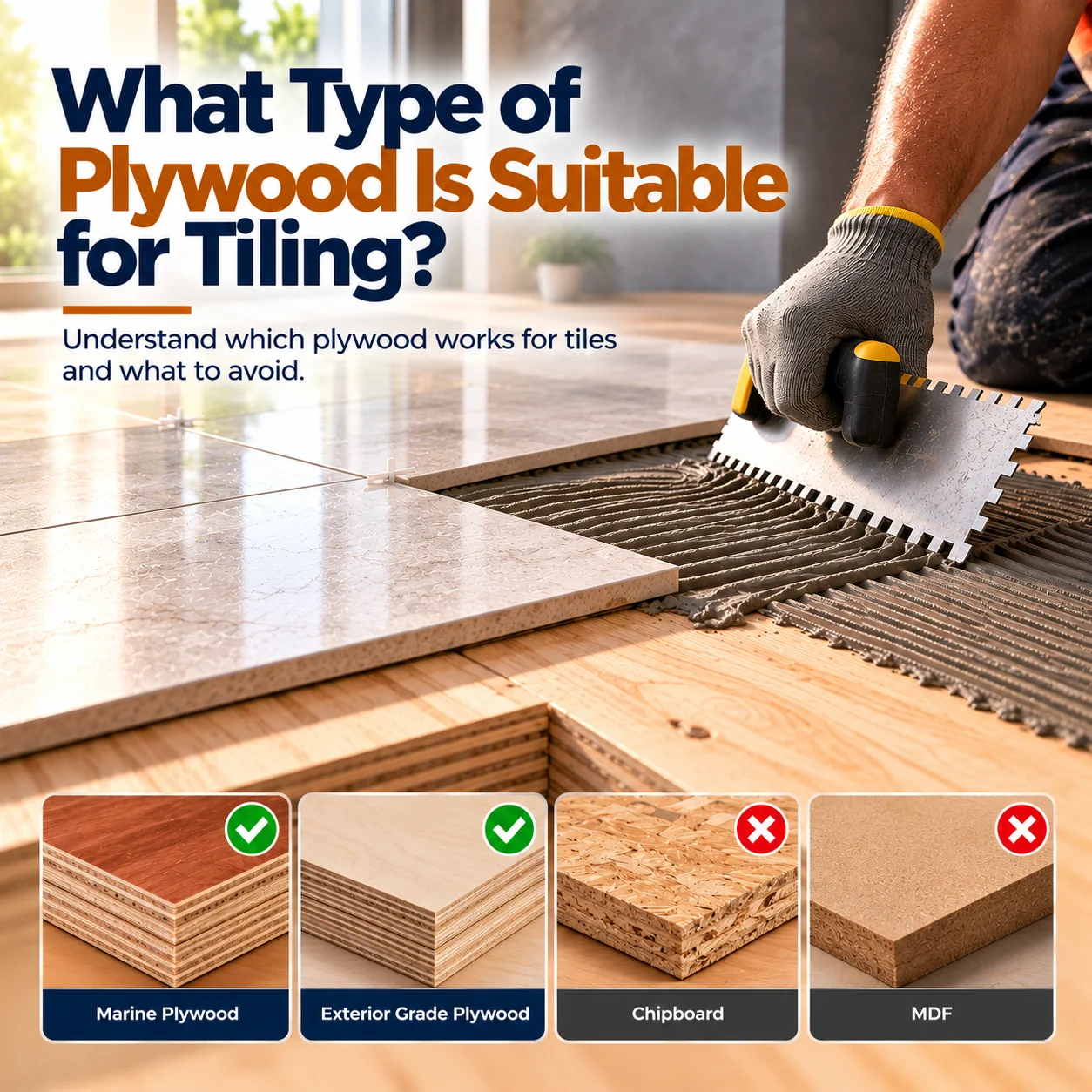
Not every wood panel should be treated as a ready-made tile substrate.
The plywood needs to be appropriate for the intended construction and installation environment. Structural stability comes first. If the floor flexes noticeably, adding a premium adhesive will not magically turn it into a rigid tile base.
Moisture resistance is another consideration, especially in bathrooms, kitchens and other areas where water exposure is possible. Wood-based panels can respond significantly to changes in moisture content.
Schluter's documentation for its DITRA-PS system notes that plywood, chipboard and compressed wood panels can experience significant deformation due to moisture or humidity fluctuations. It also stresses that the assembly needs to be sufficiently stable and properly fastened.
In other words, the substrate is part of the specification. You cannot judge suitability by looking only at the top surface.
Good plywood tile installation begins long before the first tile is placed.
Start by checking that the plywood is securely fastened and supported. The surface should be clean, dry and free from dust, oil, loose coatings and other contaminants. Any movement or structural deficiency needs to be addressed before tile installation begins.
The plywood should also be sufficiently flat for the selected tile format. Large-format porcelain is particularly unforgiving of uneven substrates because a larger tile spans a larger area and requires consistent support.
Do not use tile adhesive as a general-purpose levelling compound unless the specific product is expressly designed for that purpose. Correct substrate preparation should happen before the adhesive application stage.
Where a membrane or tile backer is specified, install it according to that system's instructions. For example, Schluter's DITRA guidance requires the substrate to be level and load-bearing before the membrane is installed.
In many plywood tile assemblies, an uncoupling membrane or suitable tile underlayment can provide a more controlled installation system than bonding tiles directly to wood.
The membrane sits between the plywood and tile covering and is designed to address movement and, depending on the product, moisture management and load distribution.
Schluter states that DITRA is specifically designed for ceramic and stone tile installations over substrates including plywood and OSB. The manufacturer describes its uncoupling function as a way of accommodating differential movement between the substrate and tile covering.
This does not mean every plywood project requires the same membrane. The appropriate system depends on local construction requirements, the plywood assembly, tile format, environment and manufacturer's instructions.
For high-moisture areas, the waterproofing requirements become even more important. A membrane may provide functions that a conventional adhesive layer alone cannot.
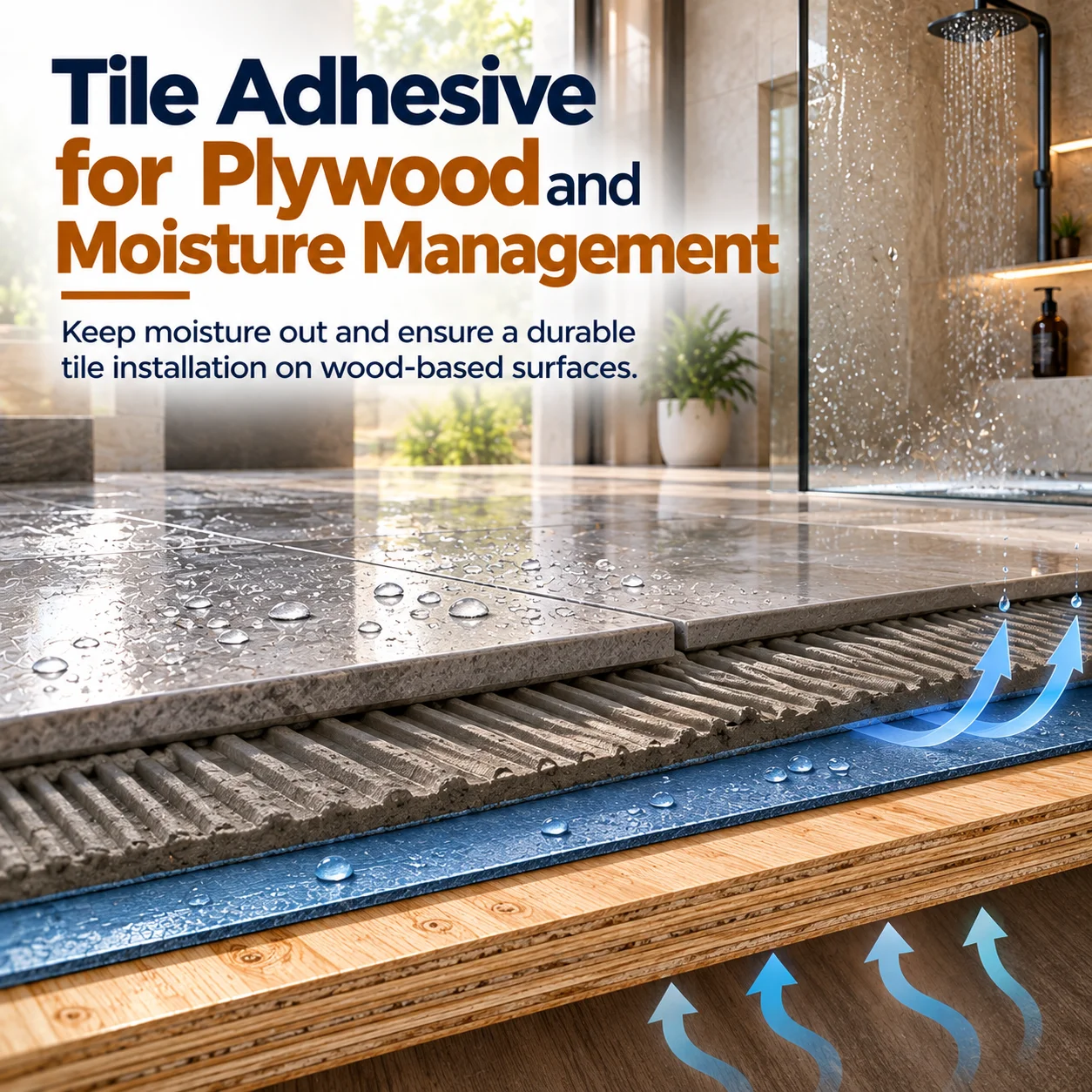
Water is one of the biggest concerns when wood-based substrates are involved.
A bathroom floor, wet room or kitchen may experience moisture that would be relatively harmless to a properly designed tile assembly but problematic for exposed wood components.
Plywood can absorb moisture and change dimension. If water repeatedly reaches the wood layer, movement and deterioration can become installation problems.
This is why waterproofing should not be confused with adhesive bonding. An adhesive can provide a bond while still being unsuitable as a waterproofing system.
For example, Schluter describes DITRA as providing waterproofing as well as uncoupling when installed as part of its specified system.
For any wet-area project, follow the complete waterproofing and substrate requirements applicable to the location and installation system rather than assuming that Tile Adhesive for Plywood alone provides moisture protection.
A flexible or deformable adhesive can be valuable in assemblies where movement needs to be accommodated, but flexibility should be evaluated through the adhesive's actual classification and technical documentation.
Marketing language such as “highly flexible” is not enough on its own. Look for the relevant performance classification and confirm that the manufacturer approves the adhesive for the substrate and tile combination you are using.
For ceramic tiles on plywood, the adhesive needs to be compatible with the actual installation layer. If a membrane or tile backer is being used, the adhesive may be selected according to the membrane manufacturer's requirements rather than simply the plywood underneath.
The same principle applies to porcelain tiles on plywood. Porcelain has low water absorption and can require an adhesive system designed for reliable bonding to the intended substrate or membrane.
A good adhesive is part of a system. It is not a substitute for one.
Ceramic and porcelain tiles may look similar, but they are not identical materials.
Porcelain tiles are generally denser and have very low water absorption. Their installation therefore requires careful attention to adhesive compatibility and coverage.
Ceramic tiles can also vary significantly in size, body composition and intended application. A small wall tile creates different demands from a large-format porcelain floor tile.
When selecting adhesive for ceramic tiles on plywood, start with the substrate system and then confirm the tile and adhesive compatibility.
For porcelain, the same approach applies, but pay particular attention to the manufacturer's requirements for large-format tiles, adhesive classification, coverage and substrate preparation.
The question is not simply “Which adhesive sticks to porcelain?” It is “Which complete installation system is approved for this porcelain tile over this particular substrate?”
Yes, plywood flooring can form part of a tile floor assembly, but the construction needs to be designed for tile rather than treating plywood as an ordinary finished floor.
The subfloor needs adequate structural support, fastening and stiffness. Tile installations are less tolerant of movement than many flexible floor coverings.
This becomes especially important in areas with long joist spans or closely spaced structural supports. The plywood may look flat while still moving under load.
A tile underlayment or uncoupling membrane can help create a suitable interface, but it does not eliminate the need for adequate structural support.
Schluter's DITRA and DITRA-XL systems illustrate how substrate configuration can influence an approved tile assembly. The manufacturer gives specific plywood/OSB and joist-spacing conditions for its systems rather than suggesting that every plywood floor is automatically suitable.
One of the most useful concepts in tile installation is substrate compatibility.
An adhesive may bond strongly to one surface and perform poorly on another. Concrete, cement board, gypsum-based substrates, plywood, OSB, existing tile and metal all present different bonding conditions.
That is why technical data sheets often contain specific substrate limitations.
For example, Schluter's PRIMER-U is specifically described as suitable for interior applications where increased adhesion is required over substrates including plywood and OSB.
A primer can sometimes form part of an approved system, but it should not be added simply because plywood “looks difficult”. The primer, adhesive and substrate need to be compatible according to the manufacturer's instructions.
Sometimes a primer is appropriate; sometimes it is not required; and sometimes the installation system specifically calls for one.
The key is to follow the system rather than adding products at random.
A primer can alter the surface characteristics and improve bonding where a compatible system requires it. Schluter, for example, describes PRIMER-U as suitable for enhancing adhesion to plywood and OSB in certain interior applications.
But primer does not solve structural movement. It cannot compensate for a flexible plywood floor, inadequate fastening or moisture problems.
If the substrate is moving, deal with the movement. If the surface is contaminated, clean it. If the installation requires a membrane, install the correct membrane. Think in systems, not shortcuts.
One of the biggest mistakes is assuming that because an adhesive bonds to wood, it automatically makes plywood a suitable tile substrate.
Another is installing tiles over plywood that flexes under foot traffic. A rigid tile covering cannot be expected to behave like carpet or vinyl.
Using ordinary interior plywood in a wet environment without considering moisture exposure is another potential problem. Wood-based panels and water are not natural best friends.
Installers can also run into trouble by skipping manufacturer instructions, ignoring movement joints or selecting an adhesive based only on price.
Finally, avoid assuming that one method works for every country. Building codes, structural requirements and recognised installation standards vary between jurisdictions.
The first step is to inspect the existing construction rather than reaching for the adhesive.
Confirm that the plywood is suitable, sufficiently supported and securely fastened. Check for deflection, damage, moisture exposure and uneven areas.
Next, determine whether the installation calls for direct bonding or an intermediate system such as an uncoupling membrane or tile backer. The decision should come from the applicable installation method and product instructions.
Then choose the adhesive based on the actual bonding surfaces. If the tile will be installed over a membrane, select the adhesive specified for that membrane and tile covering.
Finally, install the tile using the correct trowel, coverage method and movement-joint requirements. Large-format tiles may need additional installation techniques such as back-buttering depending on the system.
This approach may sound slower than simply spreading Tile Adhesive for Plywood directly onto the wood. In reality, it is much faster than repairing a failed tile installation.
Large-format tiles are particularly sensitive to substrate irregularities and movement.
A large tile can span a considerable distance across the substrate. If the plywood beneath it flexes or has uneven areas, the stresses can become concentrated across the tile.
Adhesive coverage also becomes increasingly important. Voids beneath a large tile can reduce support and make the installation more vulnerable to impact or loading.
For large-format porcelain over a wood-based assembly, consider the complete system carefully. The substrate, underlayment, adhesive, trowel size, tile format and installation technique should all be compatible.
The larger the tile, the less room there is for improvisation.
Wood-based walls present a slightly different challenge from floors because gravity becomes an immediate factor.
A wall substrate must be stable, sufficiently rigid and suitable for the selected tile system. Moisture exposure is especially important in bathrooms and other wet areas.
Schluter notes that wood composite materials can be unsuitable as tile substrates in certain wall and high-moisture situations and promotes dedicated tile substrate panels for suitable stud-frame construction.
This illustrates an important principle: sometimes the best solution is not finding a stronger adhesive for the existing wood surface. It is creating a better tile substrate before the adhesive is ever applied.
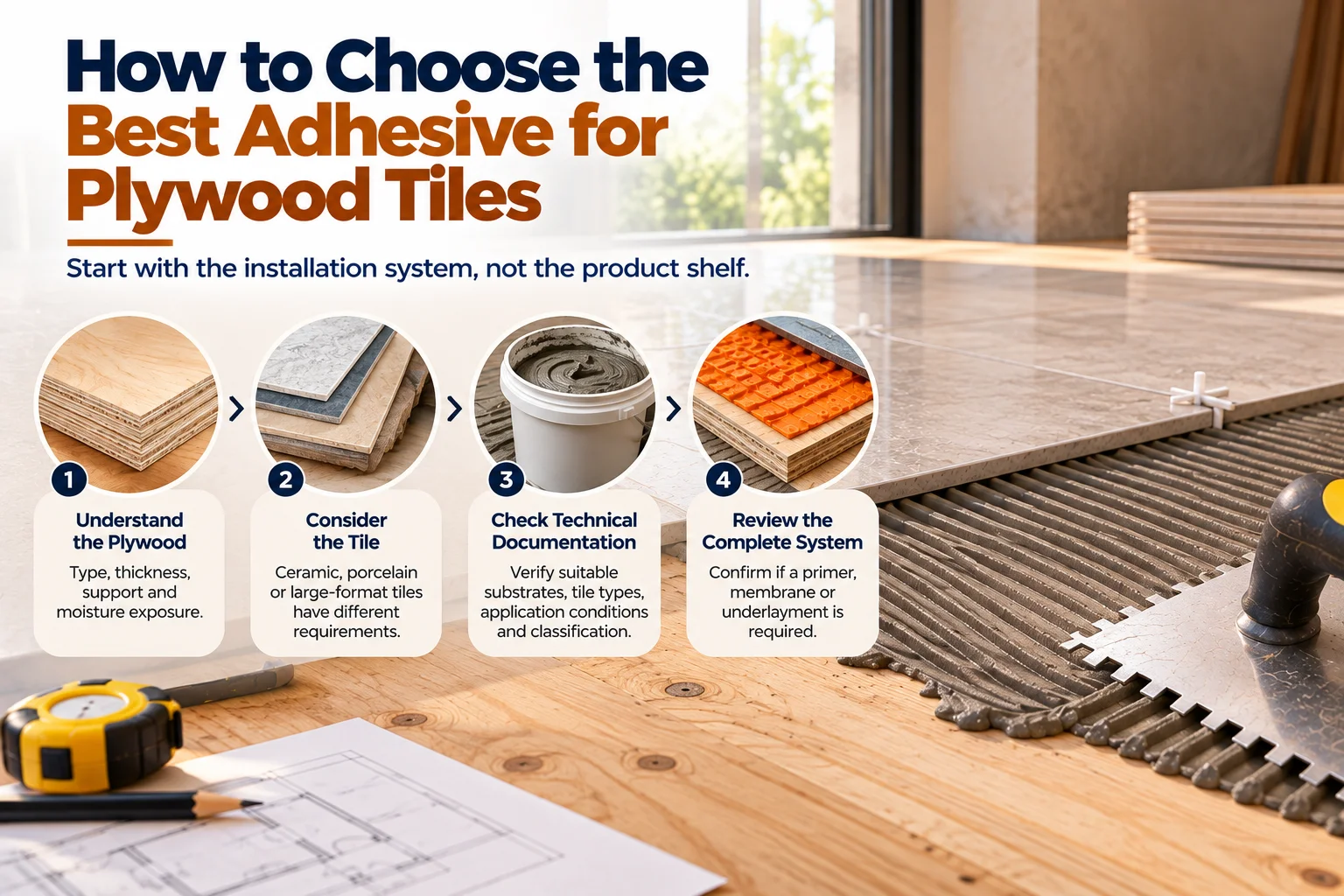
Start with the installation system, not the product shelf.
Ask what the plywood is, how thick it is, how it is supported, whether it is exposed to moisture and whether an underlayment or membrane will be installed.
Then look at the tile. Ceramic and porcelain tiles have different characteristics, while large-format tiles place additional demands on the assembly.
Next, check the adhesive's technical documentation. Confirm the intended substrates, tile types, application conditions, classification and any required primer or membrane.
Only after those questions have been answered should you compare products.
A premium adhesive used over an unsuitable substrate is still an unsuitable installation. The strongest product in the bucket cannot compensate for movement underneath the tile.
Because this article is aimed at a worldwide audience, local requirements deserve special attention.
There is no single building regulation that governs every plywood tile installation around the world. Requirements can differ by country, state, province or municipality, particularly for structural floors, wet areas and waterproofing.
For technical installation systems, recognised manufacturers' installation handbooks can therefore be valuable alongside local building requirements. Schluter's DITRA handbook, for example, provides detailed guidance for tile installations over plywood, OSB and other substrates, including substrate preparation, material selection and movement-joint requirements.
Before starting a project, check the relevant building authority or recognised tile-installation standard for your location. Product instructions should also be current for the market where the material is being installed.
The safest answer is: only when the complete product system explicitly permits it.
Some adhesive products may be suitable for wood-based substrates under specified conditions. Others may require an approved membrane, primer or backer board between the wood and tile.
That distinction is crucial. Tile Adhesive for Plywood is not a generic category where every adhesive works on every wooden surface.
Always check the manufacturer's technical documentation for substrate compatibility. If the manufacturer specifies an intermediate layer, do not remove it simply to make the installation thinner or cheaper.
The additional layer may be performing several important jobs, including movement management, moisture protection and load distribution.

Before beginning a plywood tile installation, check the following:
Is the plywood structurally suitable for the tile assembly?
Is the surface securely fastened and adequately supported?
Is the substrate flat enough for the chosen tile format?
Is the plywood dry and protected from excessive moisture?
Does the adhesive manufacturer approve the substrate?
Is a primer required?
Is an uncoupling membrane or tile backer required?
Is the chosen adhesive suitable for the tile?
Are the installation temperature and environmental conditions acceptable?
Are movement joints and perimeter gaps included where required?
If any answer is unclear, stop before applying adhesive and check the relevant technical documentation.
That small pause can save an enormous amount of work later.
Tile can be installed over plywood in suitable, properly designed assemblies, but the adhesive is only one piece of the puzzle. Plywood movement, structural support, moisture exposure, tile format, substrate preparation, membranes and adhesive compatibility all need to be considered together. Direct bonding may be appropriate for some approved systems, while other installations need an uncoupling membrane or dedicated tile substrate.
The best approach is to treat the floor or wall as a complete system rather than asking which product will simply stick tile to wood. Check the plywood construction first, follow the relevant installation method, and select an adhesive that is specifically compatible with the actual substrate and tile combination.
For projects involving Tile Adhesive for Plywood, choosing the right installation system is more important than choosing the strongest-sounding adhesive on the shelf. Explore the Lapifix tile adhesive range and always check the relevant product documentation for substrate compatibility before starting the installation.
Tiles can work successfully over plywood, but only when the wood-based substrate and tile covering are treated as a complete installation system. Structural stability, moisture control, substrate preparation, movement management and adhesive compatibility are more important than simply finding an adhesive that sticks to wood. In many applications, an uncoupling membrane or dedicated tile substrate provides a more controlled interface between plywood and the rigid tile covering.
If you're planning a plywood tile installation, take the time to verify the substrate and choose the adhesive system before starting. Review the relevant technical documentation, follow local requirements and avoid treating Tile Adhesive for Plywood as a one-product solution. For suitable tile adhesive options, explore the Lapifix tile adhesive range and select the product according to the actual tile, substrate and installation conditions.
Yes, tiles can be installed over some plywood assemblies, but the plywood must be structurally suitable and the complete installation system must be compatible. Depending on the project, an uncoupling membrane, tile backer or other approved intermediate layer may be required to manage movement and moisture.
There is no single adhesive that is automatically best for every plywood project. The correct choice depends on the plywood assembly, tile type, moisture conditions, substrate preparation and whether a membrane or backer board is being used. Always select an adhesive whose technical documentation specifically supports the intended installation system.
Sometimes, but only when the adhesive manufacturer and applicable installation method permit direct bonding to the specific plywood substrate. In many systems, an intermediate uncoupling membrane or tile substrate is used instead. The key issue is not simply whether the adhesive can bond to wood but whether the complete tile assembly can handle movement.
Porcelain tiles can be installed over suitable plywood-based assemblies when the substrate, underlayment and adhesive system are compatible. Large-format porcelain requires particular attention to substrate flatness, structural support, adhesive coverage and movement management. Always follow the tile and installation-system manufacturer's requirements.
Begin by confirming that the plywood floor is sufficiently rigid, supported, securely fastened and suitable for tile. Then determine whether direct bonding or an approved membrane or tile backer system is required. Select a compatible adhesive, prepare the substrate correctly and install the tile according to the manufacturer's instructions, including coverage and movement-joint requirements.