

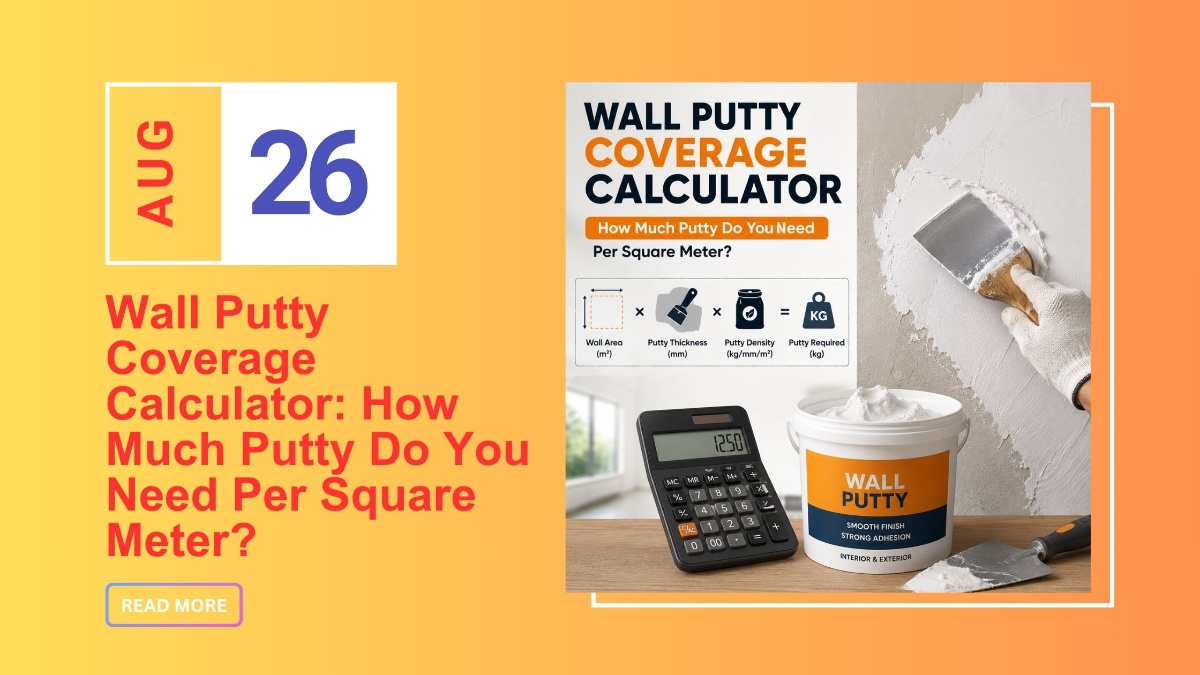
A flawless paint finish begins long before the first coat of paint is applied. One of the most important steps in preparing smooth, durable walls is applying the right amount of wall putty. However, many homeowners, contractors, and builders either purchase too much material—leading to unnecessary costs—or buy too little, causing project delays. That's why using a wall putty coverage calculator is one of the smartest ways to estimate material requirements accurately before starting any painting or finishing work.
Whether you're renovating a home, constructing a commercial building, or managing a large-scale project, understanding wall putty coverage helps you control budgets, reduce material waste, and improve planning. Accurate estimation ensures you have enough putty to achieve a smooth, even surface without overspending on excess bags that may never be used.
In this comprehensive guide, you'll learn how wall putty coverage is calculated, the factors that influence consumption, average coverage rates per square meter and square foot, practical calculation examples, and professional estimation tips that help improve project efficiency.
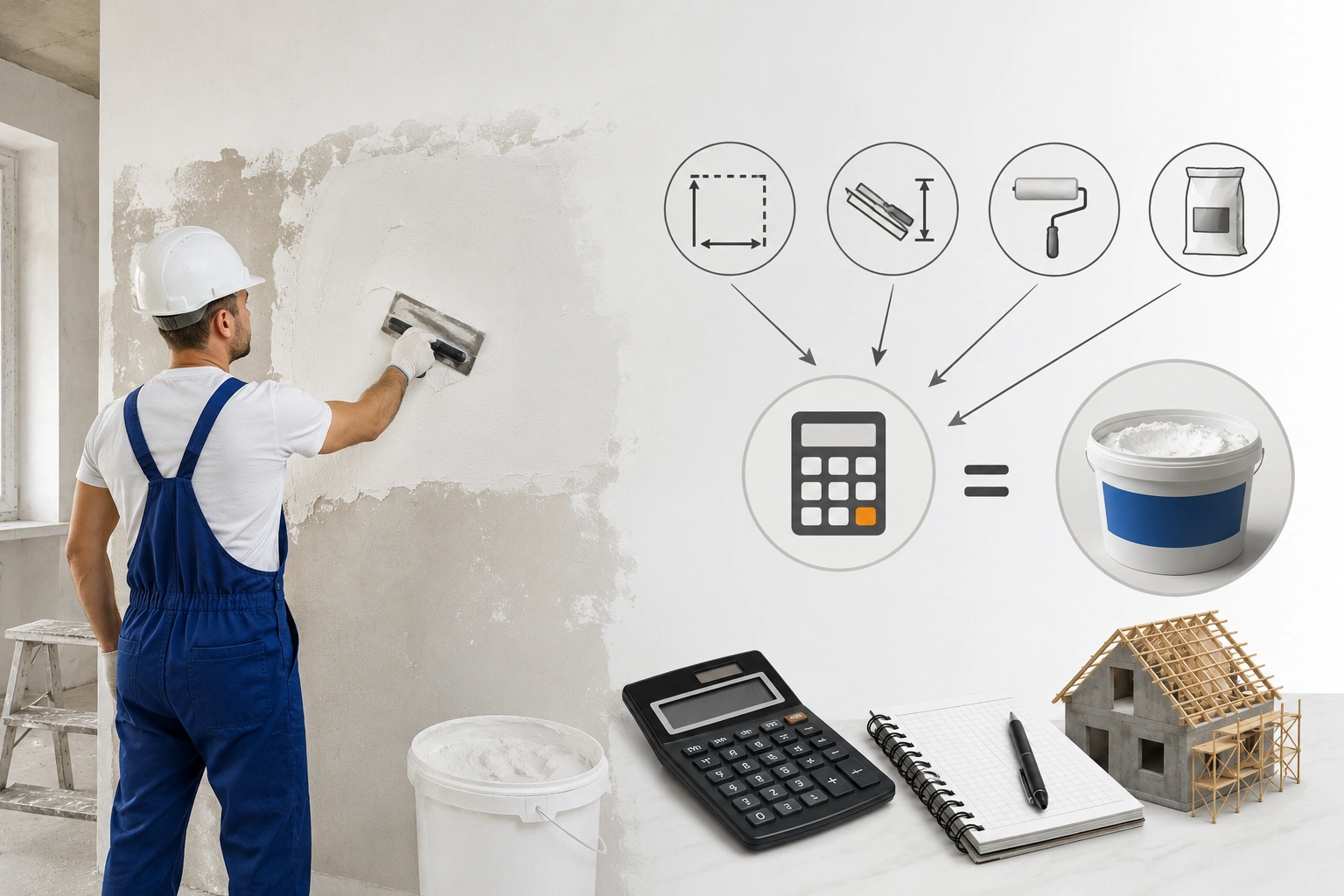
A wall putty coverage calculator is a simple estimation method that helps determine how much putty is required to cover a specific wall area. It considers the total surface area, recommended application thickness, number of coats, and the manufacturer's average coverage rate to estimate the quantity of material needed.
Instead of relying on rough assumptions, contractors use these calculations to plan purchases more accurately and minimize construction waste. Material estimation has become increasingly important as labour and construction costs continue to rise worldwide.
Although online calculators make the process faster, understanding the basic calculation principles allows homeowners and professionals to verify estimates and make better purchasing decisions.
Estimating wall putty correctly affects more than just material costs. It influences project scheduling, labour efficiency, inventory management, and overall finishing quality.
Purchasing insufficient material may interrupt the application process, while buying excessive quantities increases project costs and storage requirements. Large commercial developments, housing projects, hotels, hospitals, and office buildings especially benefit from accurate wall putty estimation because even small calculation errors become significant over large surface areas.
Proper estimation also supports sustainable construction by reducing unnecessary material waste and improving resource efficiency.
One of the most common questions asked before starting a painting project is: How much area does one bag of wall putty cover?
The answer depends on several factors, including the product formulation, application thickness, substrate condition, and the number of coats applied. However, most manufacturers provide an approximate wall putty coverage rate under standard application conditions.
For a smooth plastered surface, cement-based wall putty typically provides coverage in the range of 1.0–1.5 kg per square meter for a 1 mm thickness. Actual consumption may vary depending on the wall's absorbency and surface irregularities.
Instead of viewing these figures as fixed values, they should be treated as planning estimates that may require adjustment based on real site conditions.
For metric calculations, wall area is measured in square meters (m²). The amount of putty required per square meter depends largely on application thickness.
For example:
At approximately 1 mm thickness, consumption is generally around 1.0–1.5 kg per m².
Thicker applications naturally require greater material quantities.
Applying two thin coats often produces better results than one thick coat while maintaining more consistent coverage.
Because every project differs slightly, professionals usually include a small allowance for wastage when estimating total material requirements.
In countries where construction measurements are commonly expressed in square feet, estimating putty required per sq ft follows the same principle.
Coverage can be converted from square meters using standard conversion factors, helping contractors and homeowners estimate material requirements more conveniently for residential projects.
Whether calculations are made in square feet or square meters, accurate measurements remain the foundation of reliable wall putty estimation.
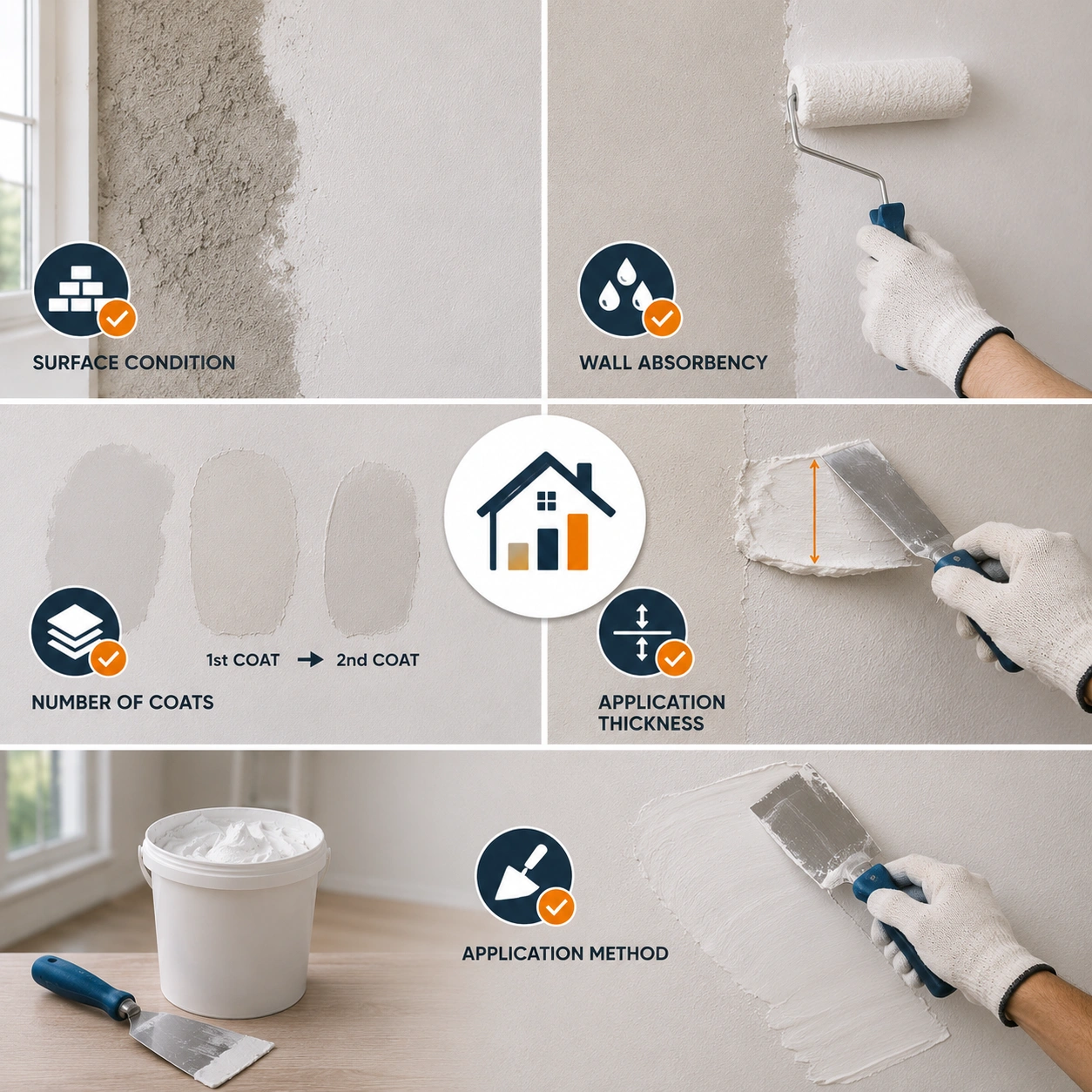
No two construction projects consume exactly the same quantity of putty. Several site conditions influence actual wall putty consumption, making it important to evaluate the surface before estimating material quantities.
The smoothness of the wall has one of the greatest impacts on coverage. Newly plastered surfaces that have been finished properly generally require less putty because fewer imperfections need to be filled.
Older walls, rough plaster, damaged concrete, and uneven masonry often consume considerably more material due to additional leveling requirements.
Proper surface preparation before application helps improve both coverage and final appearance.
Highly porous surfaces absorb more moisture from the putty during application, increasing overall consumption. Cement blocks, lightweight concrete, and certain masonry materials may require additional material compared with dense, well-finished plaster surfaces.
Applying an appropriate primer before putty can sometimes improve application consistency and reduce unnecessary absorption.
Most professional painting systems recommend applying two thin coats rather than a single thick coat. Multiple thin layers improve adhesion, reduce shrinkage, and create a smoother surface for painting.
Naturally, additional coats increase total wall putty consumption, making coat selection an important part of quantity estimation.
The thicker the putty layer, the greater the material requirement.
Excessively thick applications should generally be avoided because they increase drying time and may contribute to shrinkage or cracking. Instead, significant surface irregularities should be corrected gradually using multiple controlled applications.
Maintaining the manufacturer's recommended thickness helps optimize both coverage and finishing quality.
Application technique also affects wall putty coverage. Experienced professionals typically achieve more uniform thickness with minimal waste because they apply material consistently across the surface.
Beginners often use excessive material or apply uneven layers that increase overall consumption. Proper tools, correct mixing, and skilled workmanship all contribute to better material efficiency.
Although many online tools simplify the calculation process, the basic formula remains straightforward:
Wall Putty Required = Total Wall Area × Recommended Consumption Rate × Number of Coats
For example, if a wall measures 100 m², the average consumption is 1.2 kg/m², and two coats are planned:
100 × 1.2 × 2 = 240 kg of wall putty
Adding approximately 5–10% extra for wastage, surface variations, and minor corrections provides a more practical purchasing estimate.
This simple calculation forms the basis of most professional putty quantity calculator tools used in residential and commercial construction projects.
Accurate estimation is one of the easiest ways to improve project planning. A reliable wall putty coverage calculator reduces material shortages, prevents unnecessary over-ordering, and helps contractors prepare realistic budgets before work begins.
For homeowners, this means fewer unexpected trips to purchase additional materials. For contractors and builders, better estimation supports smoother project scheduling, improved inventory management, and lower construction waste.
Professional estimators understand that careful planning at the beginning of a project often results in significant savings by the time painting is complete.
For projects requiring complete surface preparation before painting, you can also explore Lapifix Wall Finishing Products
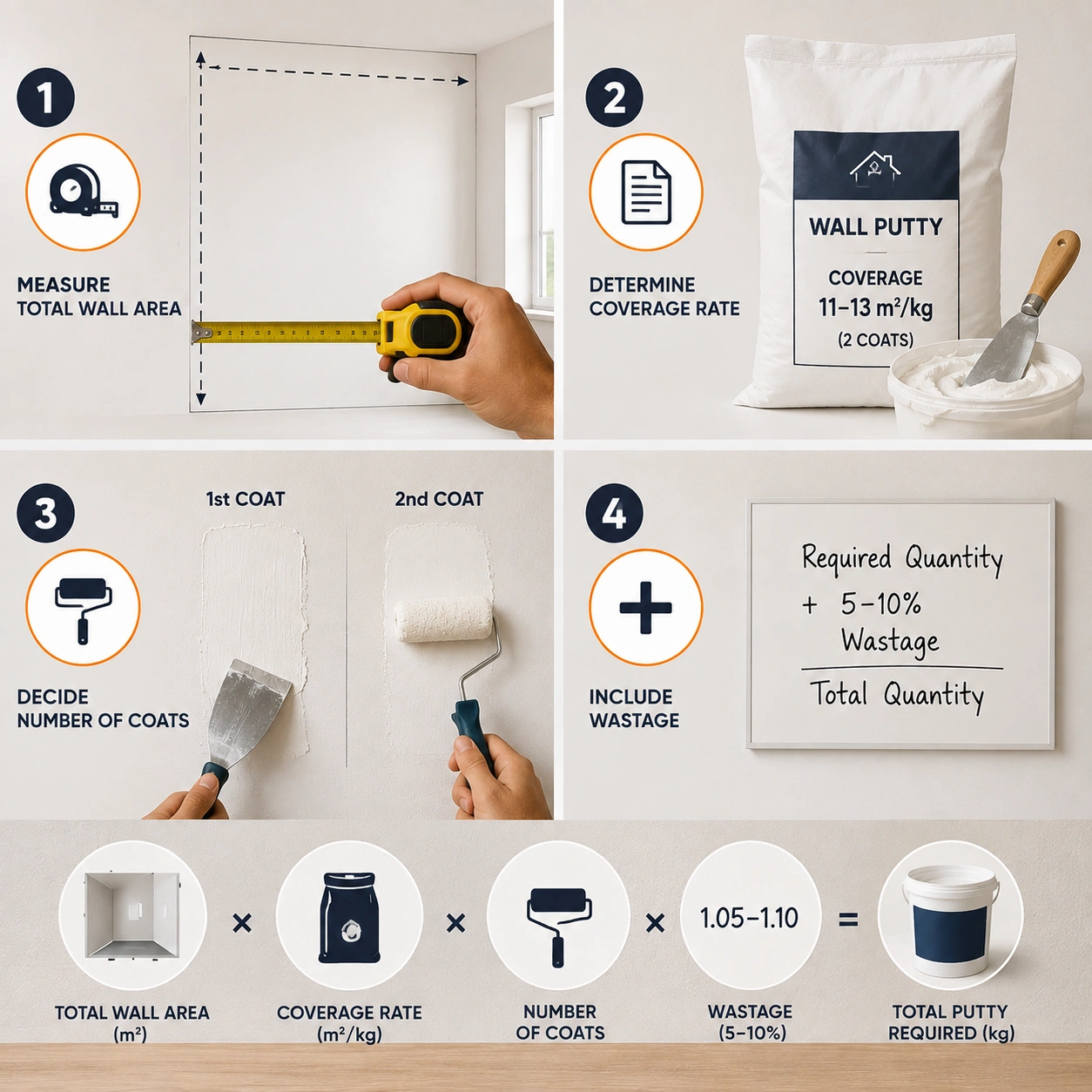
Estimating wall putty accurately is easier when you follow a simple step-by-step process. Professional painters and contractors rarely rely on guesswork because incorrect estimates can increase project costs, delay work, and create unnecessary material waste.
A wall putty coverage calculator uses the total wall area, average consumption rate, number of coats, and a small wastage allowance to determine the quantity required. While manufacturer recommendations may vary slightly, the calculation method remains the same for most residential and commercial projects.
Begin by measuring the height and width of every wall that will receive putty. Multiply these dimensions to calculate the area of each wall, then add all measurements together.
If the project includes ceilings, measure those separately and include them in the total surface area.
For greater accuracy, subtract large openings such as windows and doors. Small openings are often ignored on construction sites because they are offset by material wastage around corners, edges, and finishing details.
Every manufacturer provides an approximate wall putty coverage rate under standard conditions. Coverage generally depends on application thickness, substrate quality, and product formulation.
Instead of assuming one fixed value, use the coverage recommendations printed on the product packaging or technical data sheet. These figures provide a more realistic basis for wall putty estimation.
Most painting professionals recommend applying two thin coats instead of one thick layer. Thin coats improve adhesion, reduce shrinkage, create a smoother finish, and provide better paint performance.
If the wall surface is particularly uneven, additional leveling may be required before the final finishing coat.
Construction projects rarely consume exactly the calculated quantity. Small losses occur during mixing, handling, transport, application, and cleaning.
Adding approximately 5–10% extra material provides a practical safety margin that helps avoid shortages while minimizing unnecessary excess.
Understanding practical examples makes the calculation process much easier.
Suppose a room has a total wall area of 100 sq ft.
If the selected wall putty requires approximately 0.11–0.14 kg per sq ft for one coat, and two coats are planned, the total material requirement will be approximately:
100 × 0.12 × 2 = 24 kg
Adding around 10% for wastage results in approximately 26–27 kg of wall putty.
Consider a residential project with 100 m² of wall surface.
Using an average wall putty consumption of 1.2 kg per m² for each coat:
100 × 1.2 × 2 = 240 kg
Including a 5–10% allowance increases the estimated requirement to approximately 252–264 kg, depending on site conditions.
A typical two-bedroom house often includes walls with varying levels of smoothness. Newly plastered rooms generally consume less material than repaired walls where additional leveling is necessary.
By measuring each room individually instead of estimating the entire house as one surface, contractors achieve more accurate material planning while reducing unnecessary waste.
Large commercial projects such as offices, hotels, schools, and hospitals usually involve thousands of square meters of finishing work.
Because even small estimation errors become significant at this scale, professional quantity surveyors often prepare detailed wall-by-wall calculations using digital putty quantity calculator tools combined with site measurements.
The table below provides general planning estimates for different project sizes. Actual consumption may vary depending on surface condition, application thickness, and manufacturer recommendations.
|
Wall Area |
Estimated Putty Required* |
Typical Coats |
Suitable Project |
|
25 m² |
50–65 kg |
2 |
Small room |
|
50 m² |
100–130 kg |
2 |
Apartment room |
|
100 m² |
200–260 kg |
2 |
Residential floor |
|
250 m² |
500–650 kg |
2 |
Villa |
|
500 m² |
1000–1300 kg |
2 |
Commercial office |
|
1000 m² |
2000–2600 kg |
2 |
Large commercial project |
Values are approximate planning estimates and should always be verified using the manufacturer's recommended wall putty coverage rate.
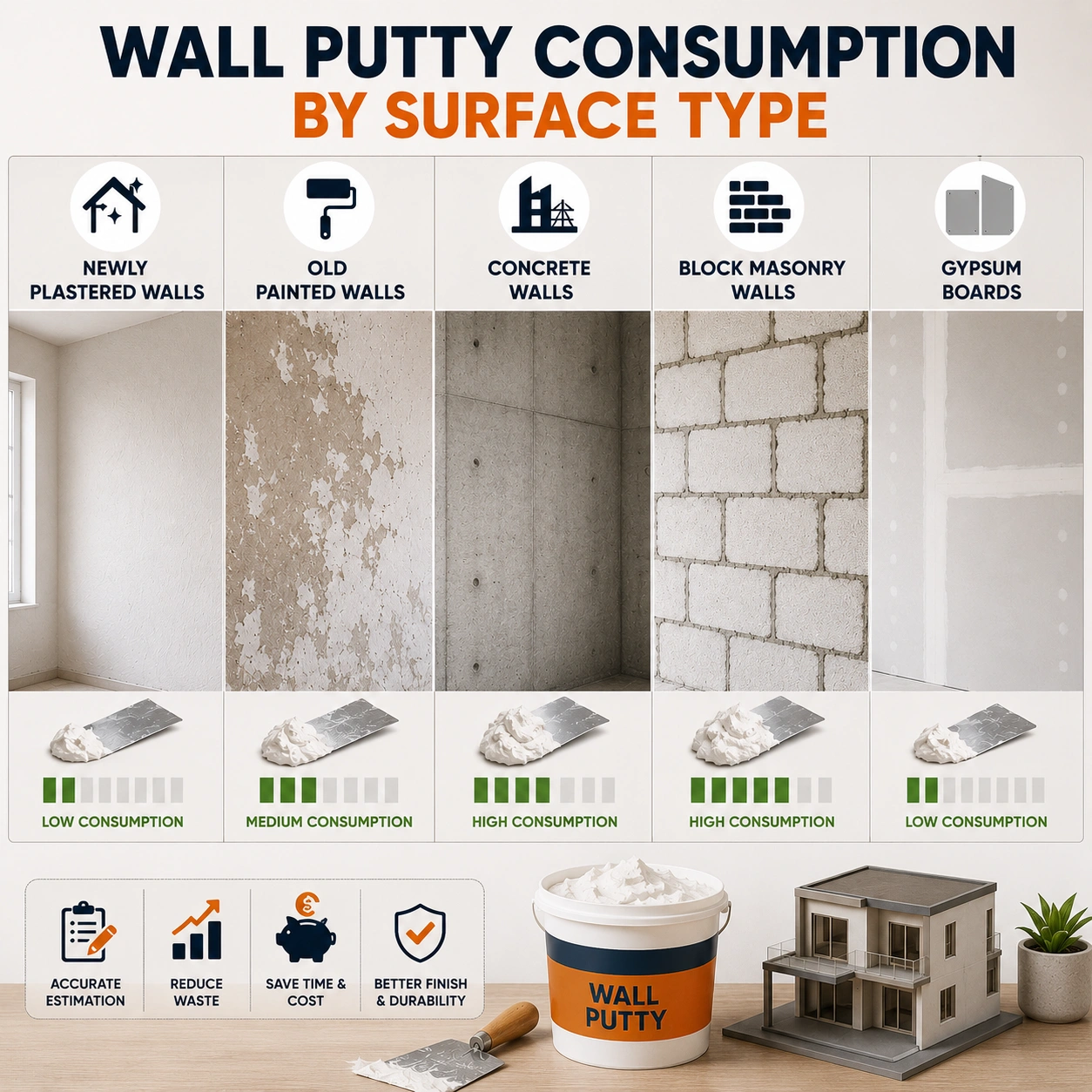
Not every wall consumes the same quantity of putty. Surface quality has a direct impact on wall putty consumption and should always be considered during estimation.
Properly finished plaster generally requires less putty because the surface is already relatively smooth. Thin finishing coats are often sufficient to prepare the wall for primer and paint.
As a result, wall putty coverage is usually more consistent and material wastage remains lower.
Renovation projects frequently involve patch repairs, sanding, and filling damaged areas before putty application.
These additional preparation steps often increase overall putty consumption compared with new construction.
Concrete surfaces may contain blowholes, formwork marks, and uneven textures that require additional leveling.
Depending on the quality of the concrete finish, higher quantities of putty may be required to achieve a paint-ready surface.
Walls constructed from concrete blocks or AAC blocks often exhibit greater surface variation than finished plaster.
Proper plastering before putty application significantly improves wall putty coverage while reducing overall material consumption.
Gypsum boards generally require putty only at joints, fastener locations, and minor surface imperfections.
Because the boards themselves are already smooth, total material consumption is usually lower than conventional masonry walls.
Reducing material usage does not mean applying thinner or lower-quality finishes. Instead, it involves improving efficiency throughout the application process.
Prepare the wall properly before beginning putty application.
Mix the material according to the manufacturer's recommendations.
Apply uniform coats using appropriate tools.
Avoid excessive application thickness.
Repair major surface defects before applying finishing putty.
Employ experienced applicators who maintain consistent coverage.
These simple practices help reduce wastage while improving the quality of the finished surface.
Many inaccurate estimates result from overlooking basic site conditions rather than calculation errors.
One of the most common mistakes is measuring only the floor area instead of the actual wall surface area. Since putty is applied to walls and sometimes ceilings—not floors—this approach produces inaccurate estimates.
Another frequent error is ignoring wall condition. Rough plaster, repaired surfaces, and porous substrates typically require more material than smooth new plaster.
Some projects also fail to include wastage allowances. Although actual waste may appear small, large projects can consume significantly more material than theoretical calculations suggest.
Finally, applying putty in excessively thick layers increases consumption while reducing finishing quality. Multiple thin coats generally produce better results and more predictable coverage.
Experienced contractors rarely depend on calculations alone. They combine mathematical estimation with practical site evaluation.
Before ordering materials, inspect representative wall sections to assess smoothness, absorbency, and repair requirements. Where possible, perform a small trial application to confirm actual coverage under site conditions.
Always use the manufacturer's published wall putty coverage figures as the primary reference rather than relying on generalized industry averages.
For projects involving complete surface preparation systems, you can also explore Lapifix Finishing & Repair Solutions
Even with a reliable wall putty coverage calculator, accurate estimation depends on careful planning and site evaluation. Professional contractors rarely rely only on theoretical calculations because actual consumption varies from one project to another. Instead, they combine manufacturer recommendations with on-site observations to develop more realistic material estimates.
The first step is measuring every wall individually rather than estimating the building as a whole. This approach accounts for differences in room size, ceiling height, and wall condition. Large openings such as doors, windows, and glass partitions should also be considered when calculating the net application area.
Surface inspection is equally important. Newly plastered walls usually require less material than repaired or uneven surfaces. Identifying rough areas before work begins allows contractors to adjust wall putty estimation and avoid unexpected material shortages during application.
For large commercial projects, quantity estimates should always include a contingency allowance for waste, touch-ups, and site variations. This small adjustment helps maintain project continuity without significantly increasing overall costs.
Digital estimation tools have become increasingly popular because they simplify quantity calculations and improve project planning. Many contractors now use mobile applications, spreadsheets, or online calculators to estimate wall putty consumption within minutes.
A digital putty calculator typically requires only a few basic inputs, including wall dimensions, application thickness, number of coats, and the recommended wall putty coverage rate. The calculator then estimates the total material required while often including an optional wastage percentage.
Although these tools improve efficiency, they should still be used alongside practical site inspections. Real-world factors such as wall absorbency, surface roughness, and repair requirements cannot always be predicted accurately by software alone.
Combining digital calculations with professional judgement provides the most reliable results for both residential and commercial projects.
Modern wall finishing continues to evolve as manufacturers develop products that improve application efficiency, reduce waste, and deliver smoother finishes.
One major trend is the increasing adoption of polymer-modified wall putties that provide improved adhesion, better crack resistance, and enhanced workability. These formulations help applicators achieve consistent coverage while reducing shrinkage after drying.
Digital construction planning is another growing trend. Quantity estimation software, AI-assisted project planning, and Building Information Modeling (BIM) are helping contractors calculate material requirements more accurately before work begins.
Sustainability is also influencing wall finishing materials. Many manufacturers are introducing low-VOC products, recyclable packaging, and improved production methods that reduce environmental impact without compromising performance.
These developments support faster construction schedules while helping contractors improve cost control and reduce unnecessary material waste.
Accurate estimation is only one part of a successful finishing project. Proper application techniques are equally important for achieving smooth, durable walls.
Professional painters begin by ensuring that the substrate is clean, dry, and free from dust, oil, loose particles, and curing compounds. Surface preparation significantly affects adhesion and ultimately influences actual wall putty consumption.
Manufacturers also recommend maintaining the specified application thickness rather than applying excessively thick layers. Thin, uniform coats generally produce better finishes, improve drying consistency, and reduce the risk of shrinkage cracks.
Before painting, the putty should be allowed to cure completely according to the manufacturer's instructions. Proper curing improves strength and creates an ideal surface for primer and decorative coatings.
For technical guidance on surface preparation and paint systems, the Painting and Decorating Contractors of America (PDCA) publishes widely recognized best practices for professional finishing projects.
Material estimation is often viewed simply as a purchasing exercise, but its impact extends throughout the entire construction process.
Accurate wall putty estimation helps reduce unnecessary material purchases, prevents costly project interruptions, and improves labour planning. Contractors spend less time arranging emergency deliveries, while homeowners avoid paying for unused materials.
Efficient estimation also contributes to sustainable construction by minimizing product waste and improving inventory management. Over large commercial developments, even small improvements in estimation accuracy can generate substantial savings.
Ultimately, using a reliable wall putty coverage calculator is not only about determining how many bags to purchase—it is about improving the efficiency and quality of the entire finishing process.
A wall putty coverage calculator is one of the most valuable planning tools for achieving accurate material estimation and efficient project execution. By understanding wall putty coverage rates, measuring surfaces correctly, accounting for wall condition, and including a reasonable wastage allowance, homeowners and professionals can reduce unnecessary expenses while ensuring sufficient material is available throughout the project. Careful estimation not only improves budgeting but also contributes to smoother application and higher-quality finishing results.
If you're looking for dependable wall finishing materials for residential, commercial, or industrial projects, explore the professional range from Lapifix. Choosing quality materials and planning accurately from the beginning helps deliver durable, paint-ready walls with confidence.
The amount of putty required per square meter depends on the product, application thickness, surface condition, and number of coats. Under normal conditions, many cement-based wall putties cover approximately 1.0–1.5 kg per m² at 1 mm thickness, but always refer to the manufacturer's technical data sheet for accurate coverage information.
Begin by measuring the total wall area in square feet. Multiply the area by the recommended consumption rate for your selected product and then multiply by the number of coats. Adding approximately 5–10% extra for wastage provides a more practical estimate.
Yes. Smooth, newly plastered walls usually require less material than rough, damaged, or highly porous surfaces. Surface preparation has a significant impact on actual wall putty coverage and should always be considered during estimation.
Most manufacturers recommend applying two thin coats rather than one thick layer. Multiple coats provide better adhesion, smoother finishes, improved paint performance, and more consistent wall putty coverage.
Yes. A wall putty coverage calculator helps estimate material quantities based on wall dimensions, coverage rate, and application thickness. While it improves planning, actual site conditions should always be considered before purchasing materials.