

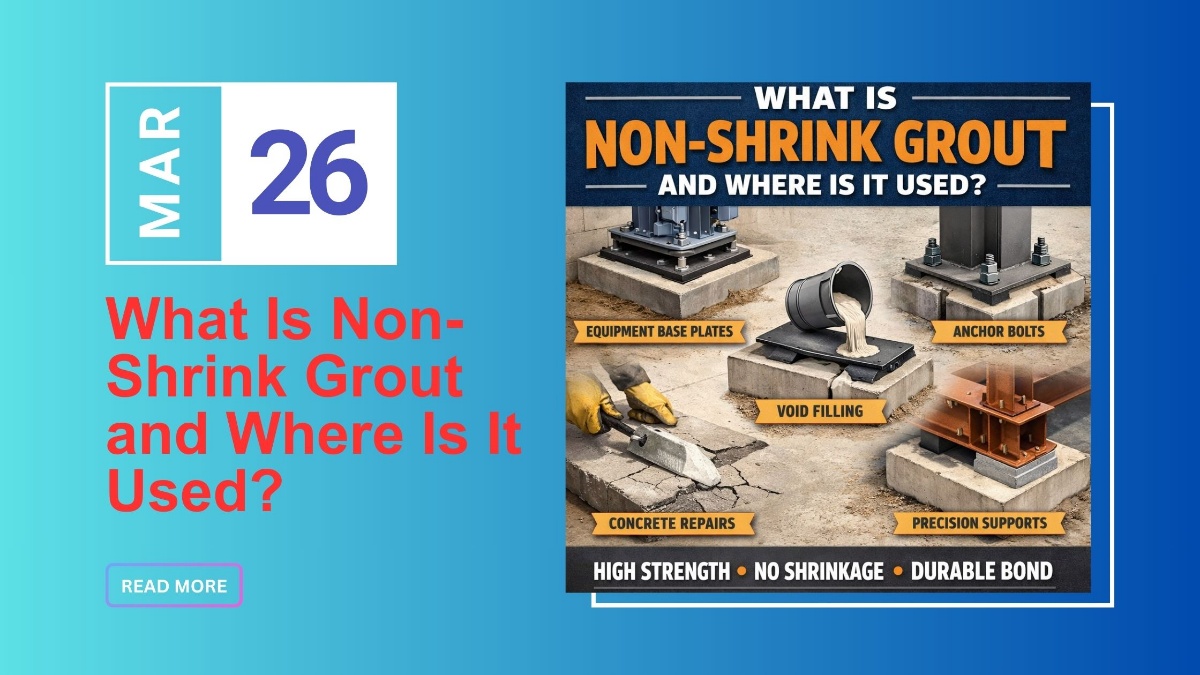
In construction, grout is used to fill gaps, secure structural elements, and transfer loads between concrete and equipment. However, traditional grout may shrink during curing, which can create small voids and weaken the bond between surfaces.
Non-Shrink Grout is specially designed to prevent this issue. It slightly expands during the curing process, ensuring that all gaps are completely filled and structural components remain firmly supported. Because of this property, it is widely used in structural and industrial applications where precision and stability are critical.
Understanding the non shrink grout meaning is important for builders and engineers working on infrastructure and machinery installations. Today, non shrink grout for construction is commonly used for anchoring bolts, installing base plates, supporting heavy machinery, and strengthening structural connections, making it an essential material in modern construction projects.
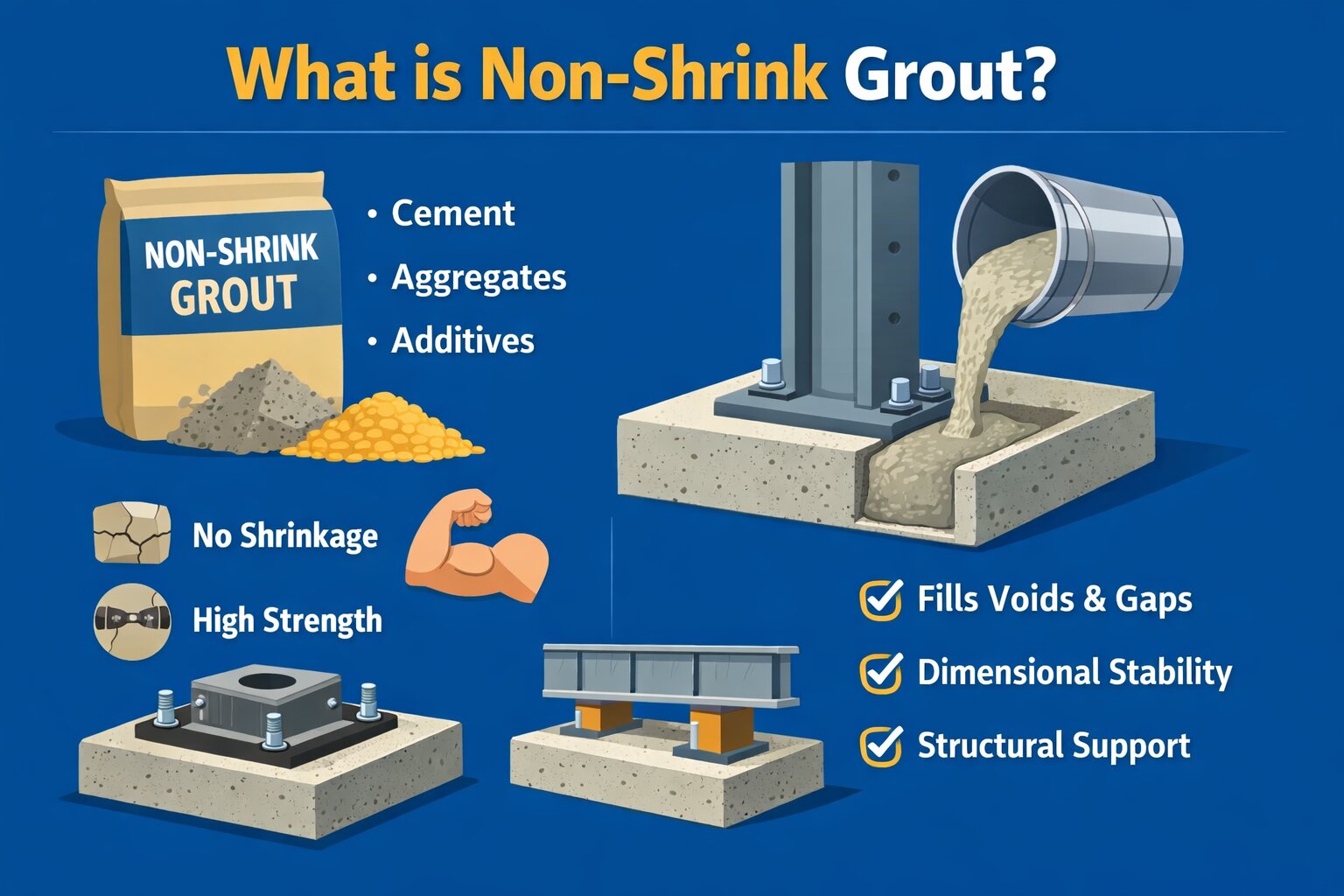
Non-Shrink Grout is a specialized construction material used to fill gaps, voids, and spaces between structural elements without shrinking during the curing process. Unlike traditional grout, non shrink grout is formulated with expansion agents that allow it to maintain its volume or expand slightly after placement.
To understand what is non shrink grout, it is typically a cementitious non shrink grout made from cement, graded aggregates, and additives that improve strength and flowability. This composition helps the grout fill spaces completely while preventing shrinkage cracks.
The non shrink grout meaning refers to a grout that provides strong bonding, dimensional stability, and reliable support in structural and industrial construction applications.
Understanding the non shrink grout properties helps explain why it is widely used in structural and industrial construction. These properties allow the material to provide strong support, stability, and long-term durability.
Controlled Expansion: Non-shrink grout is designed to expand slightly during curing. This controlled expansion helps fill gaps completely and prevents voids between structural elements.
High Compressive Strength: Many formulations are developed as high strength non shrink grout, capable of supporting heavy loads from machinery, columns, and structural components.
Excellent Flowability: The grout has good flow characteristics, allowing it to easily fill narrow spaces, base plates, and complex areas without leaving air pockets.
Non-Metallic Composition: Most non-shrink grouts are non-metallic, which helps prevent corrosion and ensures consistent performance over time.
Crack Resistance: The material is designed to minimize shrinkage and reduce the chances of cracks during curing.
Dimensional Stability: ne of the most important non shrink grout properties is its ability to maintain its volume after setting, ensuring long-term structural stability.
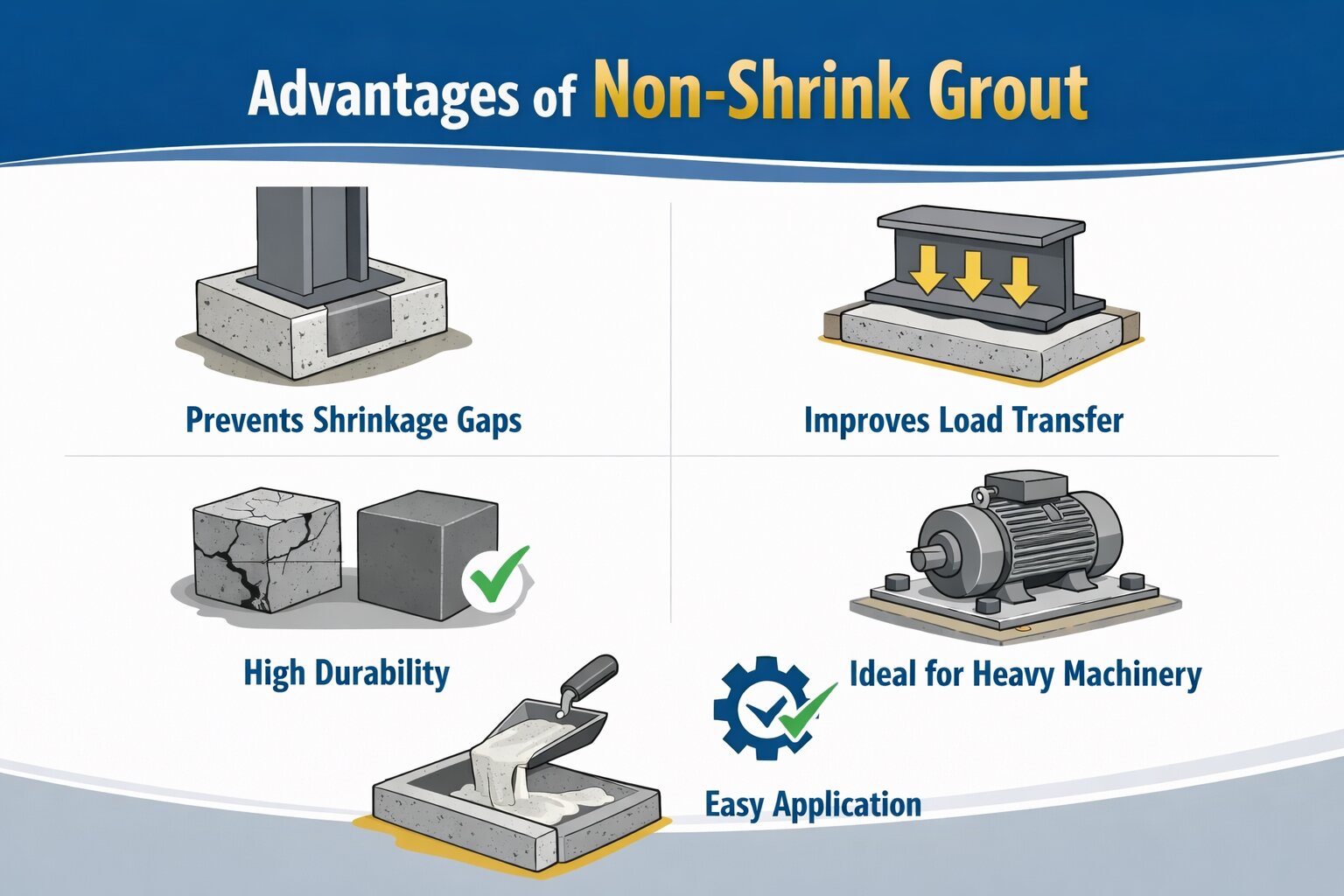
The advantages of non shrink grout make it a preferred material in many structural and industrial construction projects. Its ability to maintain volume and provide strong bonding ensures reliable performance.
Prevents Shrinkage Gaps: Non-shrink grout expands slightly during curing, which helps eliminate voids and ensures complete contact between surfaces.
Improves Load Transfer: It provides strong support between structural components, allowing loads to be distributed evenly and safely.
High Durability: The grout is designed to withstand heavy loads, vibrations, and environmental conditions, making it suitable for long-term use.
Ideal for Heavy Machinery: Because of its strength, it is commonly used for grouting under equipment foundations and base plates.
Easy Application: The material has good flowability, making the non shrink grout application process easier and more efficient for construction professionals.
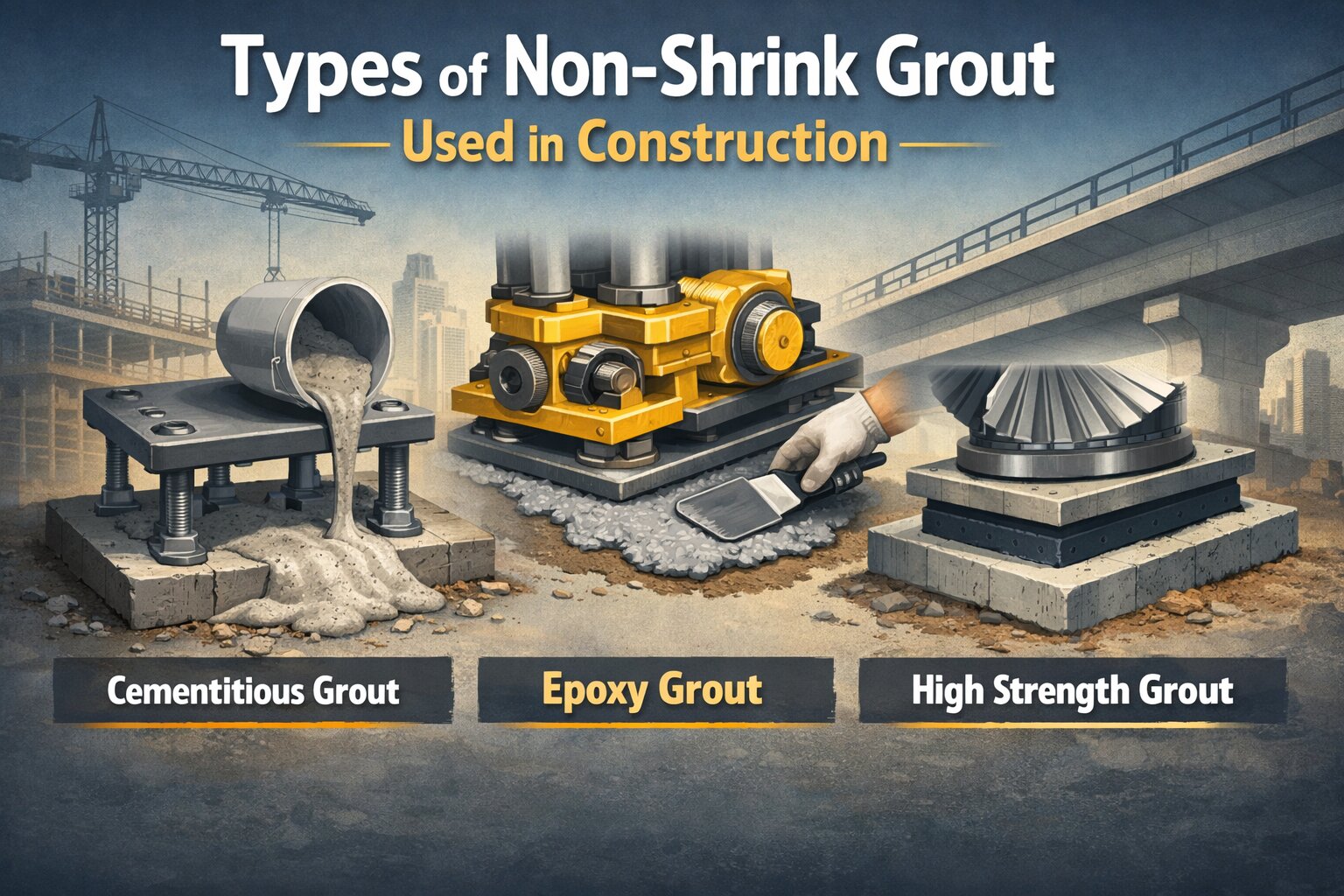
Non-shrink grout is available in different types depending on the application, load requirements, and environmental conditions. Each type is designed to deliver reliable performance in specific construction and industrial situations.
Cementitious non shrink grout is the most commonly used type in general construction. It is made from cement, graded aggregates, and special additives that control expansion and prevent shrinkage during curing.
This type of grout is widely used in civil structures for grouting under base plates, anchor bolts, precast elements, and columns. It offers good flowability, strong bonding, and easy application, making it suitable for many infrastructure and building projects.
Epoxy-based grout is used in environments where high strength and chemical resistance are required. It is made from epoxy resins that provide excellent bonding and durability.
This type of grout is commonly used as industrial non shrink grout in factories, power plants, and chemical plants. It performs well under heavy loads and vibrations, making it ideal for machinery foundations and industrial equipment installations.
High strength non shrink grout is specially designed for applications where heavy load-bearing capacity is required. It provides very high compressive strength while maintaining its non-shrink properties.
This grout is commonly used in infrastructure projects such as bridge bearings, turbine foundations, heavy machinery bases, and structural steel installations where strong and stable support is critical.
Non-shrink grout is widely used in modern construction because it provides strong bonding, stability, and precise load transfer. The material is specially designed to fill voids without shrinking, making it suitable for many structural and industrial installations. These non shrink grout uses are common in infrastructure, building projects, and heavy equipment foundations.
One of the most common non shrink grout application areas is grouting under machinery base plates. It is used beneath turbines, pumps, generators, and compressors to provide a stable foundation. The grout fills gaps between the machine base and concrete foundation, ensuring proper alignment and reducing vibration.
Non-shrink grout is often used beneath steel columns and beams to ensure proper load transfer between the structure and the foundation. This non shrink grout for construction helps distribute loads evenly and improves the overall stability of structural elements.
In precast construction, grout is used to fill joints and gaps between precast concrete elements. It ensures strong bonding and structural continuity between panels, beams, and slabs.
Another important non shrink grout application is securing anchor bolts in concrete foundations. The grout surrounds the bolts and base plates, providing strong support and preventing movement or loosening over time.
In large infrastructure projects such as highways, bridges, and railway structures, non-shrink grout is used beneath bridge bearings and structural supports. These applications highlight where is non shrink grout used in heavy construction, where stability and durability are critical for long-term performance.
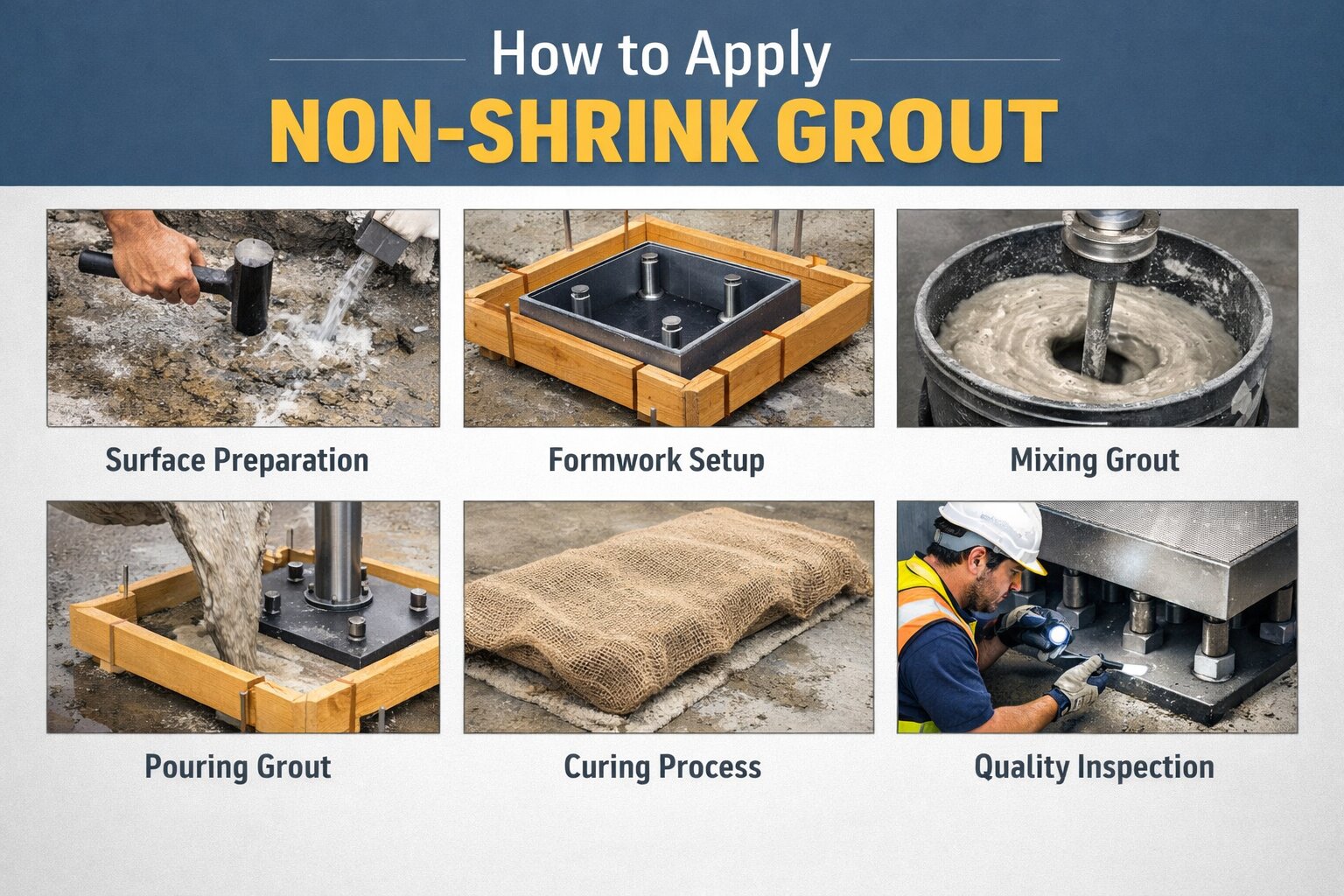
Proper non shrink grout application is essential to ensure maximum strength, durability, and structural stability. When applied correctly, non-shrink grout fills gaps effectively without shrinking during curing, providing strong support for machinery bases, structural columns, anchor bolts, and precast elements. Following a systematic application process helps achieve the best performance and long-lasting results.
The first step in a successful non shrink grout application is proper surface preparation. The substrate must be clean, solid, and free from dust, oil, grease, loose particles, or laitance. Remove any weak concrete using mechanical tools if necessary. Before applying the grout, the surface should be pre-soaked with clean water for several hours to achieve a saturated surface-dry (SSD) condition. This prevents the base concrete from absorbing moisture from the grout mixture.
Formwork should be installed around the area where grout will be placed. It must be rigid, leak-proof, and properly sealed to prevent grout loss during pouring. Ensure that the formwork is slightly higher than the base plate or structure to allow proper grout placement. Leave enough space on one side for pouring and ensure adequate vents to allow trapped air to escape during the grouting process.
For effective non shrink grout application, accurate mixing is very important. Use clean water and follow the manufacturer’s recommended water-to-grout ratio. Mix the grout using a mechanical mixer for about 3–5 minutes until a smooth, lump-free consistency is achieved. Avoid excessive water, as it can reduce the grout’s strength and performance.
Once the grout mixture is ready, it should be poured continuously from one side of the formwork to avoid air entrapment. Do not pour from multiple sides simultaneously, as this can trap air pockets. For larger installations or deep sections, grout pumping methods can be used to ensure proper flow and uniform filling of cavities.
Curing plays a crucial role in the performance of the grout. After placement, protect the grout from rapid moisture loss by covering it with wet burlap, plastic sheets, or curing compounds. Proper curing for at least 3–7 days helps the grout achieve its designed strength and durability.
After curing, conduct a thorough inspection to ensure that the grout has filled all gaps properly and hardened without cracks or voids. Check the alignment and stability of the installed equipment or structural elements. A proper quality check ensures that the non shrink grout application has been completed successfully and that the structure is ready for service.
Correct application techniques not only improve bonding and load transfer but also extend the lifespan of the structure. By following these steps carefully, contractors and engineers can ensure safe, efficient, and reliable grouting results.
Non-shrink grout is designed to provide high strength, stability, and gap-filling performance in structural applications. However, improper handling or incorrect procedures can reduce its effectiveness and lead to structural issues. Understanding the most common mistakes helps ensure a successful and durable grouting project.
One of the most common errors is using an incorrect water-to-grout ratio. Adding too much water may make the grout easier to pour, but it can significantly reduce its compressive strength and durability. On the other hand, too little water can make the mixture difficult to work with and prevent proper flow. Always follow the recommended water ratio specified by the manufacturer.
Surface preparation is a critical step that is often overlooked. If the substrate contains dust, oil, grease, or loose particles, the grout may not bond properly with the base surface. This can lead to weak adhesion, cracks, or failure over time. Ensure the surface is clean, solid, and pre-wetted to achieve the best bonding performance.
Curing is essential for the grout to achieve its designed strength. Skipping or shortening the curing process can cause early drying, surface cracking, and reduced durability. Protect the freshly applied grout from direct sunlight, wind, and rapid moisture loss by using curing compounds, plastic sheets, or wet coverings.
Improper mixing is another common mistake that affects grout quality. Under-mixing can result in lumps and uneven consistency, while over-mixing may introduce excess air into the mixture. Both situations can reduce the grout’s performance. Use a mechanical mixer and follow the recommended mixing time to achieve a smooth and uniform consistency.
Different non-shrink grout products may have specific instructions regarding water quantity, mixing time, placement methods, and curing requirements. Ignoring these guidelines can negatively impact the final results. Always read and follow the manufacturer’s instructions to ensure proper application and maximum performance.
Avoiding these common mistakes helps maintain the strength, durability, and reliability of non-shrink grout installations. Proper preparation, correct mixing, and adherence to recommended practices ensure long-lasting structural stability.
When selecting grout for structural applications, it is important to choose products that offer strength, durability, and easy application. Lapifix provides high-quality grouting solutions designed for demanding construction environments.
Lapifix products are formulated to deliver strong bonding, excellent flowability, and reliable performance in applications such as machinery foundations, anchor bolts, and structural base plates. This makes them a dependable choice for contractors and engineers working on modern infrastructure projects.
Non shrink grout is an essential material in modern construction because it provides strong bonding, durability, and precise gap filling. Its ability to maintain volume during curing helps ensure proper load transfer and long-term structural stability.
Due to its strength and reliability, many non shrink grout uses can be found in machinery foundations, anchor bolts, columns, and infrastructure projects. The key non shrink grout properties, such as high compressive strength and controlled expansion, make it ideal for demanding construction applications.
Using high-quality non shrink grout for construction, such as products from Lapifix, helps improve structural performance, stability, and the lifespan of buildings and infrastructure.
Non shrink grout uses include filling gaps, securing anchor bolts, installing machine base plates, and supporting structural columns.
Regular grout may shrink during curing, while non shrink grout maintains its volume or slightly expands to prevent gaps.
Key non shrink grout properties include high compressive strength, controlled expansion, good flowability, crack resistance, and dimensional stability.
It is used under base plates, steel columns, bridge bearings, precast joints, and anchor bolts. These are common examples of where is non shrink grout used.
High strength non shrink grout can achieve compressive strength above 60 MPa, making it suitable for heavy load applications.
Cementitious non shrink grout is water-resistant but not fully waterproof unless additional protection is applied.
Most grouts set within a few hours and reach good strength in 24 hours, while full curing may take up to 28 days.
Yes, non shrink grout for construction is commonly used under machinery foundations to ensure stability and proper load distribution.