

The tile installation industry has seen a major transformation over the past decade, driven by the need for stronger, more durable, and long-lasting flooring solutions. Traditional materials are no longer sufficient for modern construction demands, especially in high-traffic and performance-driven environments. This shift has led to the growing popularity of advanced bonding solutions like epoxy tile adhesive.
Today’s residential, commercial, and industrial spaces require flooring systems that can withstand moisture, heavy loads, and constant wear. This is where epoxy-based products stand out. Known for their superior strength and reliability, solutions like epoxy floor adhesive are increasingly being adopted by architects, contractors, and builders.
Unlike conventional adhesives, epoxy creates a powerful bond that enhances the lifespan of tiles while reducing maintenance issues. Whether it’s large-format tiles in luxury homes or heavy-duty flooring in factories, epoxy for floor tiles offers unmatched performance.
As construction standards continue to rise, the demand for smarter and more efficient floor tile adhesive solutions is also increasing. This is why epoxy is not just an alternative anymore it is quickly becoming the future of tile adhesives.
Epoxy tile adhesive is a high-performance bonding solution made by combining epoxy resins with a hardening agent. When these two components are mixed, they undergo a chemical reaction that forms a rigid, durable, and non-porous material capable of creating an extremely strong bond between tiles and the substrate.
Unlike traditional cement-based adhesives, epoxy does not rely on water for curing. Instead, it hardens through a chemical process, which makes it far more resistant to moisture, chemicals, and environmental stress. This unique composition is what makes epoxy resin adhesive for tiles a preferred choice in demanding applications.
One of the defining characteristics of epoxy is its ability to bond with a wide range of surfaces, including concrete, metal, and existing tiles. This versatility allows it to be used across various environments, from residential bathrooms to industrial flooring setups. As a result, it plays a crucial role in modern floor tile adhesive solutions.
Additionally, epoxy forms a seamless and non-porous layer, which prevents water penetration and reduces the risk of tile loosening over time. This makes it not only a strong adhesive but also a protective layer that enhances the overall durability of the flooring system.
Because of these advanced properties, epoxy tile adhesive is widely used in areas where performance and longevity are critical, making it a reliable option for both standard and heavy-duty tile installations.
Understanding the different types of epoxy adhesives is essential when selecting the right product for specific flooring needs. Each type is designed to deliver particular performance benefits, depending on the environment and application requirements.
This is the most commonly used form of epoxy tile adhesive. It consists of two components resin and hardener that must be mixed before application.
Once combined, it creates a strong chemical bond that offers excellent adhesion and durability. It is widely used in both residential and commercial projects where reliable performance is required.
This type contains no solvents or water, making it one of the strongest and most durable options available. It is often used as an industrial tile adhesive due to its ability to handle extreme loads and harsh conditions.
It also provides superior resistance to chemicals and moisture, making it ideal for factories, warehouses, and heavy-duty flooring applications.
Modified epoxy adhesives are designed to offer improved flexibility compared to standard epoxy systems. This makes them suitable for surfaces that may experience slight movement or temperature variations.
They are commonly used in areas where both strength and adaptability are needed, contributing to more reliable floor tile adhesive solutions.
Fast-setting variants are formulated for projects that require quick installation and minimal downtime. These adhesives cure rapidly while still maintaining strong bonding properties.
They are especially useful in commercial environments where time efficiency is critical.
Choosing the right type depends on factors such as load requirements, exposure conditions, and the type of tiles being installed. By selecting the appropriate option, users can maximize the performance and lifespan of their flooring system with epoxy for floor tiles.
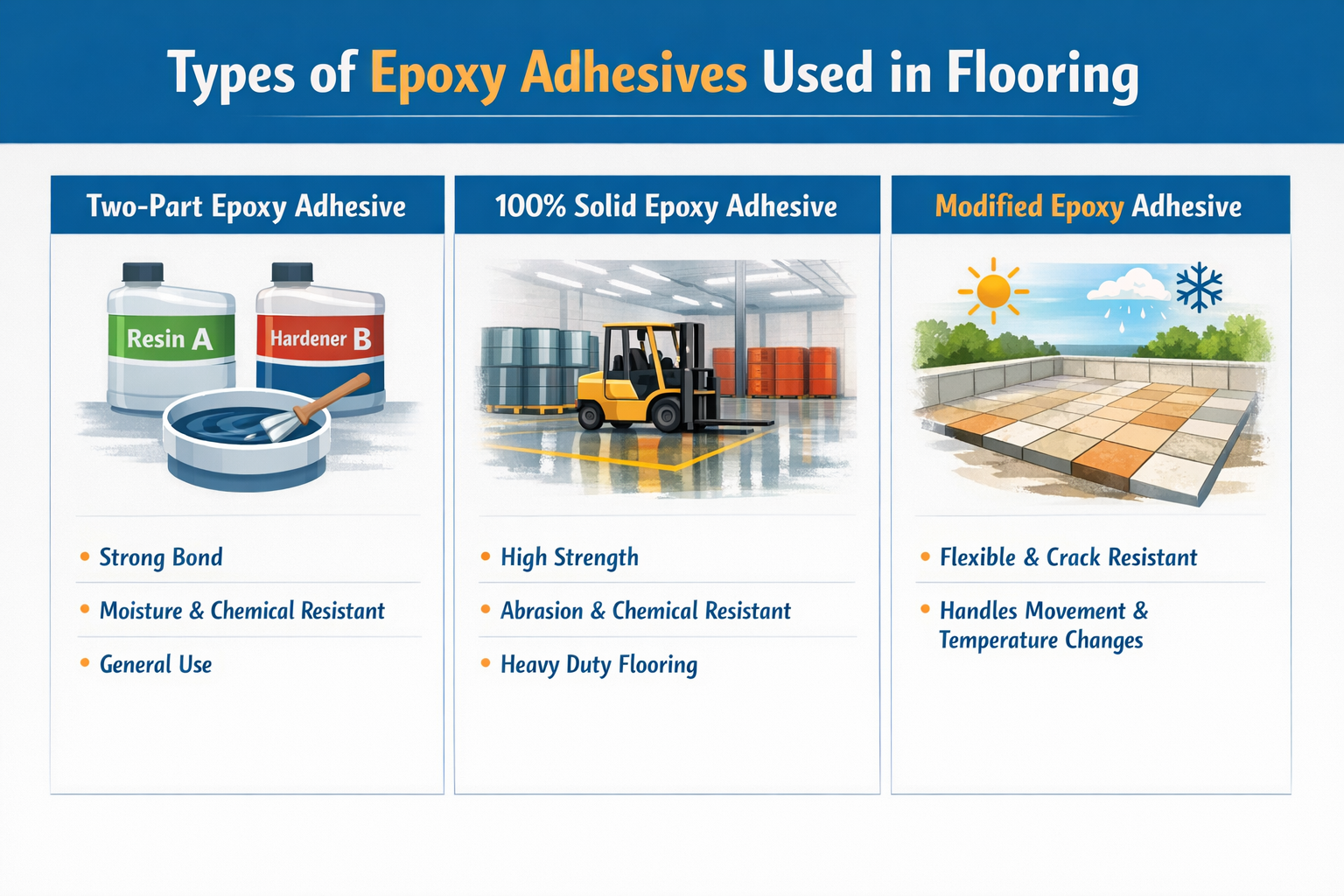
Selecting the right product starts with understanding the different types of epoxy adhesives available in the market. Each type is engineered with specific properties to suit different flooring conditions, load requirements, and environmental challenges.
By choosing the correct adhesive, you not only improve bonding strength but also ensure long-term durability and performance of your tile installation.
Two-part systems are the most widely used epoxy tile adhesive solutions in flooring applications. They consist of two components resin and hardener that must be mixed in a precise ratio before application.
Once combined, a chemical reaction occurs, forming a rigid and highly durable bond. This type delivers excellent adhesion to various surfaces, including concrete and existing tiles.
Key Advantages:
High bonding strength
Strong resistance to moisture and chemicals
Suitable for both residential and commercial use
Best Applications:
Bathrooms and kitchens
Retail spaces
Standard commercial flooring
This type is often considered a reliable epoxy floor adhesive for general-purpose use where strength and consistency are essential.
100% solid epoxy contains no solvents or water, making it one of the most advanced and durable options among the types of epoxy adhesives. Because there is no evaporation during curing, the final bond is dense, non-porous, and extremely strong.
This makes it ideal for environments where performance cannot be compromised.
Key Advantages:
Extremely high strength and load-bearing capacity
Excellent chemical and abrasion resistance
Zero shrinkage during curing
Best Applications:
Heavy industrial flooring
Warehouses and factories
Chemical processing areas
It is widely used as an industrial tile adhesive and is perfect for projects requiring a tile adhesive for heavy duty flooring.
Modified epoxy adhesives are designed to provide enhanced flexibility compared to standard epoxy systems. They include additives that improve elasticity, making them suitable for surfaces that experience slight movement or thermal expansion.
These systems strike a balance between strength and adaptability, making them highly versatile.
Key Advantages:
Improved flexibility
Reduced risk of cracking under stress
Better performance in temperature variations
Best Applications:
Outdoor installations
Areas with temperature fluctuations
Substrates prone to minor movement
These adhesives are often preferred when both durability and adaptability are required in floor tile adhesive solutions.
|
Feature |
Two-Part Epoxy |
100% Solid Epoxy |
Modified Epoxy |
|
Strength |
High |
Very High |
High |
|
Flexibility |
Low |
Very Low |
Medium |
|
Chemical Resistance |
High |
Excellent |
High |
|
Shrinkage |
Minimal |
None |
Minimal |
|
Best Use |
General flooring |
Industrial use |
Dynamic surfaces |
This comparison helps in understanding how each option performs under different conditions, allowing for better decision-making.
Choosing the right adhesive depends on the specific needs of your project. Here’s how to select the best option:
For residential and light commercial use: Two-part epoxy adhesive works best due to its balanced performance.
For heavy-duty and industrial environments: 100% solid epoxy is the ideal choice for maximum durability.
For areas with movement or temperature changes: Modified epoxy adhesives offer the flexibility needed.
By aligning the adhesive type with the application, you can achieve optimal results with epoxy for floor tiles, ensuring long-lasting performance and minimal maintenance.
Understanding these types of epoxy adhesives not only improves installation quality but also helps in selecting the best tile adhesive epoxy for your specific flooring requirements.
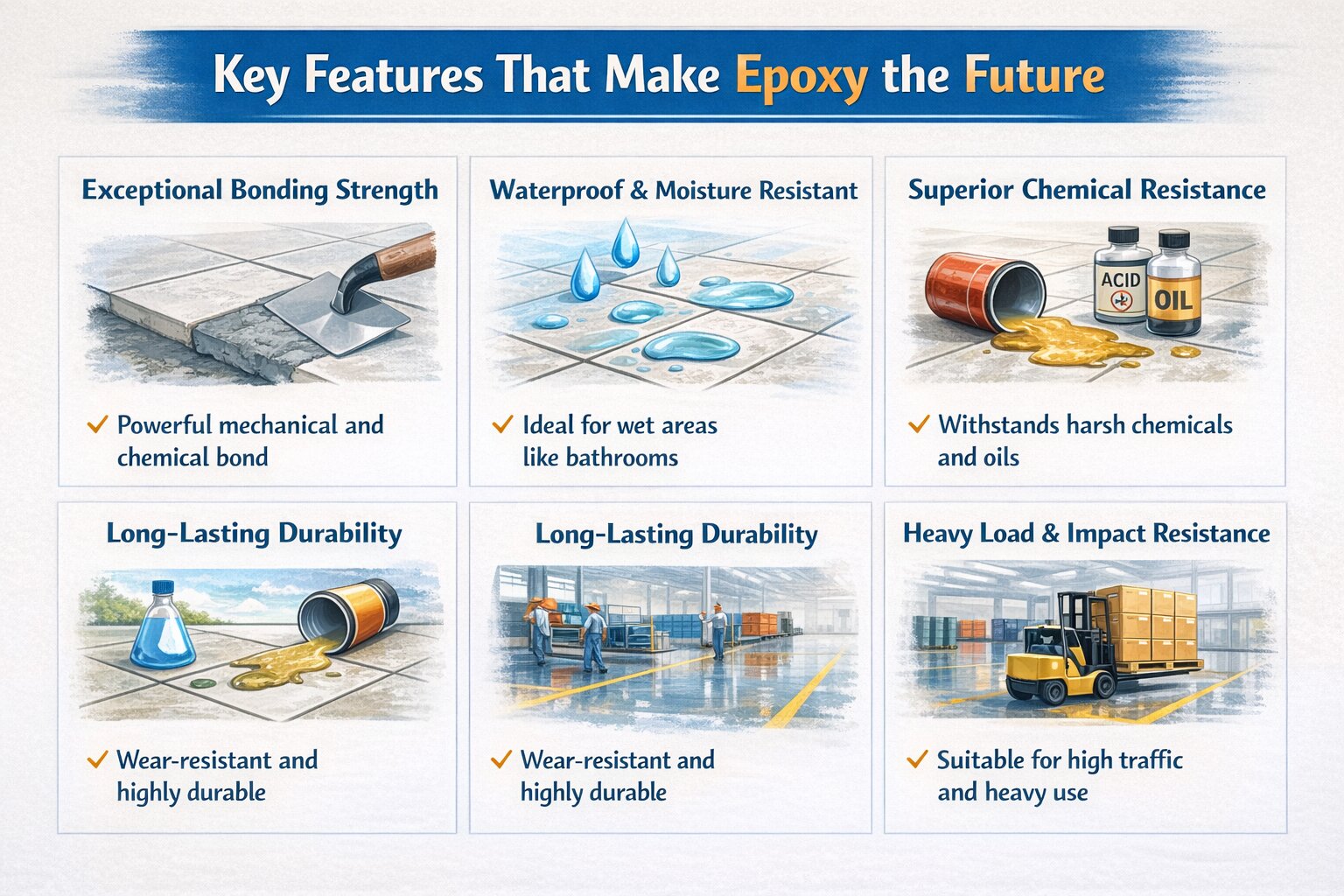
The growing shift toward epoxy-based solutions is not just a trend it is driven by performance. Modern construction demands adhesives that go beyond basic bonding, and epoxy delivers on every critical parameter. From strength to durability, it sets a new benchmark for tile installation.
Let’s explore the key features that make epoxy a future-ready solution for flooring systems.
One of the most important reasons behind the rise of epoxy is its superior bonding capability. As a high strength tile adhesive, epoxy forms a powerful mechanical and chemical bond between the tile and substrate.
Unlike traditional adhesives that may weaken over time, epoxy maintains its grip even under constant stress. This reduces the risk of tile loosening, cracking, or displacement.
Why it matters:
Ideal for high-traffic areas
Supports large and heavy tiles
Ensures long-term stability
This level of strength is what makes epoxy tile adhesive a preferred choice for both residential and commercial projects.
Moisture is one of the biggest challenges in tile installations. Epoxy solves this problem with its non-porous composition, making it a highly effective waterproof tile adhesive.
It prevents water from penetrating beneath the tiles, protecting the substrate and avoiding issues like mold growth or tile detachment.
Where it performs best:
Bathrooms and showers
Kitchens and balconies
Swimming pools and wet zones
Because of this feature, epoxy for floor tiles is widely used in areas exposed to constant moisture.
Epoxy adhesives are engineered to withstand harsh chemicals, oils, and cleaning agents. This makes them a reliable chemical resistant tile adhesive for demanding environments.
Even in spaces where floors are regularly exposed to corrosive substances, epoxy maintains its structure and bonding strength.
Common applications:
Industrial plants
Laboratories
Food processing units
This resistance ensures that flooring systems remain intact and safe, even under aggressive conditions.
Durability is a key factor in any flooring solution, and epoxy excels in this area. As a long-lasting tile adhesive, it resists wear, shrinkage, and environmental damage over time.
Unlike conventional materials that may degrade, epoxy maintains its integrity for years with minimal maintenance.
Key benefits:
Reduced repair and replacement costs
Consistent performance over time
Enhanced lifespan of tiles
This durability is one of the strongest reasons why epoxy is considered the future of floor tile adhesive solutions.
Modern spaces often require flooring that can handle significant weight and pressure. Epoxy is specifically designed to perform under such conditions, making it an ideal tile adhesive for heavy duty flooring.
It distributes load evenly and prevents tile breakage or detachment, even in high-impact environments.
Best suited for:
Warehouses and factories
Airports and malls
Parking areas
Its ability to handle extreme loads also strengthens its position as a dependable industrial tile adhesive.
When combined, these features create a powerful flooring solution that outperforms traditional adhesives in every aspect. From strength and water resistance to durability and load-bearing capacity, epoxy addresses all the limitations of older materials.
This is why more professionals are choosing the best tile adhesive epoxy solutions to meet modern construction standards.
As the demand for high-performance flooring continues to grow, epoxy stands out as a reliable and future-ready choice for long-lasting and efficient tile installations.
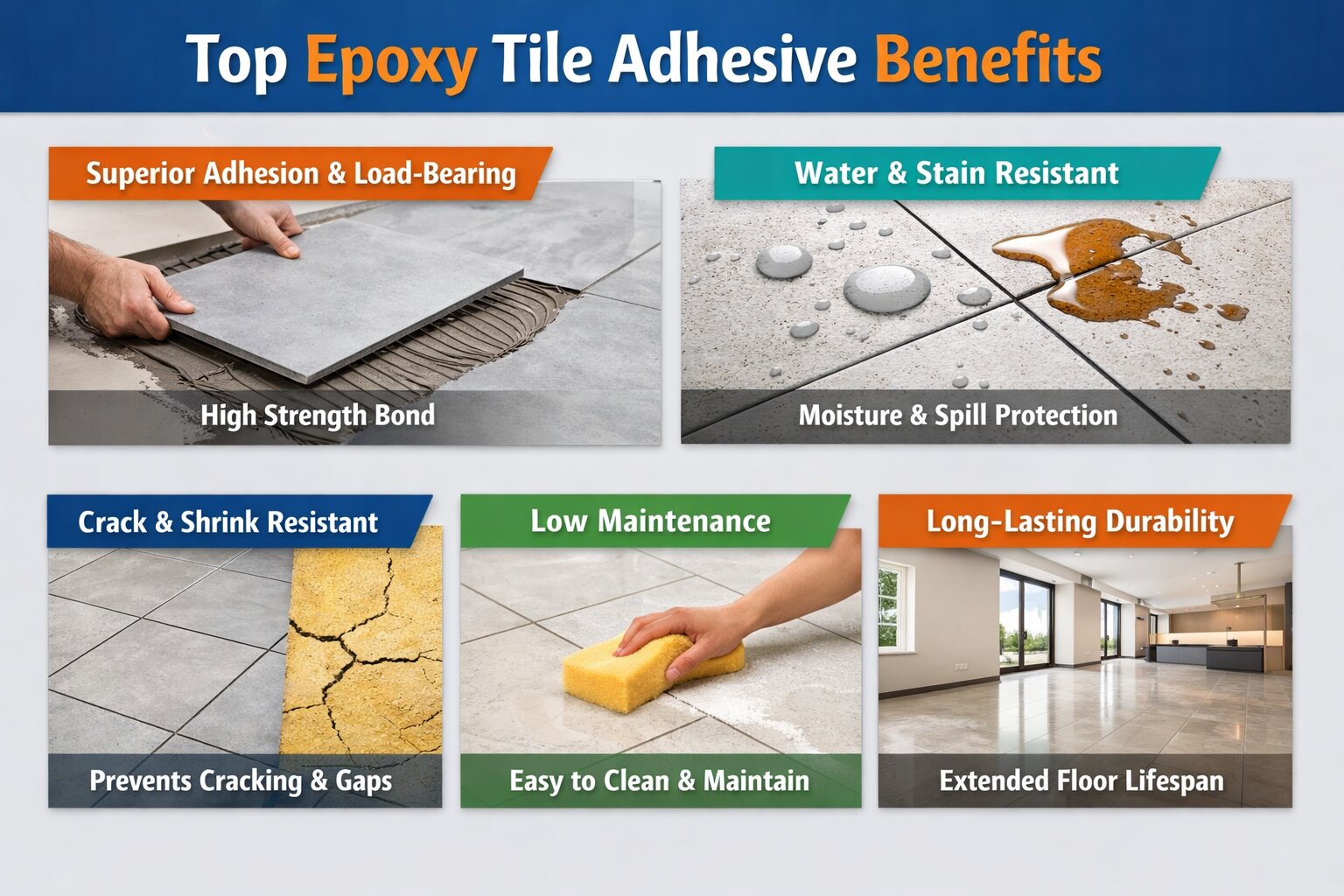
When it comes to performance-driven flooring, understanding the real epoxy tile adhesive benefits helps in making the right choice. Epoxy is not just another adhesive, it is a complete solution designed to enhance durability, strength, and long-term value.
Below are the key advantages that make epoxy stand out in modern floor tile adhesive solutions.
One of the most significant epoxy tile adhesive benefits is its exceptional bonding strength. Epoxy forms a rigid and highly secure bond that keeps tiles firmly in place, even under extreme pressure.
This makes it a reliable high strength tile adhesive for areas where heavy loads and constant movement are common.
Key advantages:
Prevents tile loosening and displacement
Supports large-format and heavy tiles
Ideal for high-traffic environments
Whether in commercial spaces or industrial zones, epoxy floor adhesive ensures long-term structural stability.
Epoxy is naturally non-porous, which makes it highly resistant to water and stains. As a waterproof tile adhesive, it prevents moisture from seeping beneath the tiles and damaging the substrate.
It also resists stains caused by spills, oils, and chemicals, keeping the surface clean and intact.
Best suited for:
Bathrooms and kitchens
Food processing areas
Outdoor and wet environments
This feature makes epoxy for floor tiles a preferred choice where hygiene and moisture control are critical.
Unlike traditional adhesives that may shrink or crack over time, epoxy maintains its structure after curing. This stability ensures that tiles remain properly aligned without gaps or surface damage.
Its resistance to shrinkage also reduces stress on tiles, preventing cracks and extending the life of the flooring system.
Why it matters:
Maintains uniform tile placement
Reduces chances of structural damage
Improves overall finish quality
This reliability is one of the reasons epoxy is considered the best tile adhesive epoxy for long-term applications.
Another major advantage of epoxy is its low maintenance nature. Once applied, it requires minimal upkeep compared to conventional adhesives.
Its resistance to stains, chemicals, and wear ensures that the flooring remains in good condition with basic cleaning.
Maintenance benefits:
Easy to clean surfaces
No frequent repairs needed
Reduced long-term costs
This makes epoxy an efficient choice for both residential users and commercial property owners.
Epoxy outperforms traditional cement-based adhesives when it comes to lifespan. As a long-lasting tile adhesive, it delivers consistent performance for years without degradation.
It resists environmental factors such as moisture, temperature changes, and chemical exposure, ensuring that the flooring remains durable over time.
Comparison advantages:
Longer service life than cement adhesives
Better return on investment
Fewer replacement cycles
This long-term reliability strengthens epoxy’s position as a preferred industrial tile adhesive and a smart investment for modern construction.
These epoxy tile adhesive benefits highlight why epoxy is rapidly replacing conventional materials in the flooring industry. It offers a combination of strength, durability, and efficiency that aligns perfectly with today’s construction needs.
From residential spaces to heavy-duty environments, epoxy delivers unmatched value, making it a future-ready solution for anyone looking for dependable and high-performance tile installation.
Choosing the right adhesive plays a crucial role in the performance and lifespan of any flooring system. The comparison of epoxy vs cement tile adhesive helps in understanding which option is better suited for modern construction needs.
While cement-based adhesives have been widely used for years, epoxy is now emerging as a superior alternative due to its advanced properties and long-term reliability.
|
Feature |
Epoxy Tile Adhesive |
Cement Tile Adhesive |
|
Bond Strength |
Very high (chemical bonding) |
Moderate (mechanical bonding) |
|
Durability |
Excellent, long-lasting |
????? (may degrade over time) |
|
Water Resistance |
Fully waterproof |
Limited, absorbs moisture |
|
Chemical Resistance |
High |
Low |
|
Flexibility |
Moderate |
Moderate to high |
|
Shrinkage |
No shrinkage |
Can shrink and crack |
|
Cost |
Higher initial cost |
Lower upfront cost |
|
Maintenance |
Low |
Moderate to high |
This comparison clearly shows why epoxy floor adhesive is becoming a preferred solution in performance-driven environments.
Understanding where each adhesive performs best is key to making the right choice.
Use Epoxy Tile Adhesive When:
You need a high strength tile adhesive for heavy loads
The area is exposed to water or moisture (bathrooms, kitchens)
Chemical resistance is required (industrial environments)
Long-term durability is a priority
Epoxy is especially suitable for tile adhesive for heavy duty flooring and areas where failure is not an option.
Use Cement Tile Adhesive When:
Budget is a primary concern
The area has low to moderate traffic
Moisture exposure is minimal
Standard residential installations
Cement adhesives still work well for basic applications but may not meet modern performance expectations.
Despite being widely used, cement-based adhesives come with several drawbacks that limit their effectiveness in advanced applications.
Key limitations:
Absorbs water, leading to weakening over time
Lower bonding strength compared to epoxy
Prone to cracks and shrinkage
Requires frequent maintenance and repairs
Not suitable for chemical exposure
These limitations make cement adhesives less reliable for long-term and high-performance flooring needs.
The shift from cement to epoxy is driven by the need for durability, efficiency, and reliability. As construction standards improve, the demand for advanced materials like epoxy resin adhesive for tiles continues to grow.
Reasons for increasing preference:
Superior strength and bonding performance
Acts as a waterproof tile adhesive
Excellent resistance to chemicals and stains
Longer lifespan with minimal maintenance
Ideal for both residential and industrial use
Because of these advantages, epoxy is widely recognized as the best tile adhesive epoxy for modern flooring systems.
In the debate of epoxy vs cement tile adhesive, the choice ultimately depends on the application. However, for projects that demand strength, durability, and long-term performance, epoxy clearly stands out.
As the industry moves toward more reliable and efficient floor tile adhesive solutions, epoxy is not just an upgrade it is becoming the new standard.
The versatility of epoxy floor adhesive is one of the main reasons it is rapidly becoming the preferred choice across multiple sectors. Its ability to deliver strength, durability, and resistance in demanding conditions makes it suitable for a wide range of applications from homes to heavy industrial facilities.
Let’s explore where epoxy performs best and why it is considered a reliable industrial tile adhesive as well as a premium solution for modern spaces.
In modern homes, flooring is not just about aesthetics it also needs to be durable and easy to maintain. Epoxy floor adhesive is increasingly used in residential settings because of its strong bonding and moisture resistance.
Common residential uses:
Living rooms with large-format tiles
Kitchens exposed to spills and stains
Bathrooms and wet areas
Balconies and terraces
Its waterproof nature and long-lasting performance make it ideal for homeowners looking for reliable floor tile adhesive solutions with minimal maintenance.
Commercial environments demand flooring that can handle continuous foot traffic while maintaining appearance and strength. Epoxy meets these requirements with ease.
Popular commercial applications:
Shopping malls and retail outlets
Office buildings and co-working spaces
Hotels and restaurants
Hospitals and healthcare facilities
In such settings, epoxy floor adhesive ensures tiles remain intact despite constant usage, reducing repair costs and downtime.
Industrial spaces are where epoxy truly stands out. As a high-performance industrial tile adhesive, it is designed to handle extreme conditions such as heavy machinery, chemical exposure, and high impact.
Key industrial applications:
Manufacturing units
Warehouses and storage facilities
Chemical processing plants
Automotive workshops
Its strength and resistance properties make it a dependable tile adhesive for heavy duty flooring, ensuring safety and long-term performance.
Areas with heavy footfall or continuous movement require adhesives that can withstand pressure without failure. Epoxy is specifically engineered for such demanding conditions.
Examples include:
Airports and railway stations
Educational institutions
Public corridors and lobbies
Parking areas
As a high strength tile adhesive, epoxy prevents tile loosening and surface damage, even under constant stress.
Certain environments require flooring solutions that go beyond basic durability. Epoxy provides advanced resistance properties, making it suitable for specialized applications.
Specialized use cases:
Laboratories requiring chemical resistant tile adhesive
Food processing units needing hygienic and non-porous surfaces
Pharmaceutical facilities
Cold storage areas
In these settings, epoxy resin adhesive for tiles ensures both safety and compliance with industry standards.
The wide range of applications highlights the adaptability of epoxy floor adhesive. Whether used in homes or as an industrial tile adhesive, it consistently delivers:
Strong bonding performance
Resistance to water, chemicals, and wear
Long-term durability with low maintenance
This versatility is what makes epoxy a future-ready solution for diverse flooring needs, offering reliable performance across every type of environment.
Modern construction is evolving with new design trends, larger tile formats, and higher performance expectations. Traditional adhesives often fall short in meeting these demands, which is why best tile adhesive epoxy solutions are gaining widespread acceptance across industries.
Epoxy is not just an upgrade it is a smarter, more efficient approach to tile installation that aligns perfectly with today’s construction standards.
Contemporary architecture increasingly uses large-format tiles, vitrified tiles, and natural stone surfaces. These materials require strong and reliable bonding to prevent issues like tile slippage or cracking.
Epoxy for floor tiles provides the strength needed to hold heavy and oversized tiles securely in place.
Why it works:
Handles weight without failure
Prevents tile movement during and after installation
Ensures a seamless and premium finish
Modern spaces are exposed to a variety of environmental challenges, including temperature changes, moisture, and heavy usage. Epoxy is engineered to perform consistently under such conditions.
As a chemical resistant tile adhesive, it also withstands harsh cleaning agents and industrial chemicals without degrading.
Suitable for:
Outdoor areas
Industrial zones
Wet and humid environments
One of the biggest advantages of epoxy is its ability to bond with different surfaces. Whether it’s concrete, metal, or existing tiles, epoxy ensures a strong and reliable connection.
This flexibility makes it a dependable option for advanced floor tile adhesive solutions across various project types.
Maintenance is a major concern in both residential and commercial spaces. Epoxy minimizes this issue by offering a durable and non-porous surface that resists damage.
As a long-lasting tile adhesive, it reduces the need for frequent repairs and replacements.
Benefits include:
Lower maintenance costs
Fewer tile failures
Consistent performance over time
Modern flooring systems are designed to handle more than just aesthetics; they must deliver strength, safety, and longevity. Epoxy plays a key role in achieving these goals.
Its ability to act as a high strength tile adhesive makes it suitable for high-traffic and heavy-duty environments.
With increasing demand for durable and efficient materials, epoxy has become a go-to solution for architects and builders. Its versatility allows it to be used in everything from homes to industrial facilities.
This is why many professionals now consider epoxy as the best tile adhesive epoxy for modern construction needs.
From supporting large tiles to reducing maintenance and performing under extreme conditions, epoxy meets every requirement of contemporary flooring. Its advanced properties make it a strong contender in the evolution of epoxy floor adhesive solutions.
As building standards continue to rise, epoxy is not just keeping up it is leading the way.
Performance is one of the most critical factors in any flooring system. From durability to long-term reliability, the choice of adhesive directly impacts how well the floor performs over time. This is where epoxy for floor tiles makes a significant difference.
By offering superior bonding strength and resistance to environmental stress, epoxy enhances the overall efficiency and lifespan of tiled surfaces.
One of the biggest advantages of epoxy for floor tiles is its ability to create an exceptionally strong and stable bond. Unlike conventional adhesives that may weaken due to moisture or load, epoxy maintains its integrity over time.
This reduces the chances of adhesive failure, ensuring that tiles remain firmly attached even in demanding conditions.
Performance impact:
Reduces installation errors
Minimizes tile detachment
Ensures consistent structural stability
This makes epoxy a reliable high strength tile adhesive for both residential and commercial applications.
Tile lifting and surface cracks are common issues in flooring systems, especially when inferior adhesives are used. Epoxy addresses this problem by forming a rigid, non-shrinking bond that keeps tiles securely in place.
Because it resists expansion, contraction, and external stress, it significantly reduces the risk of visible damage.
Key benefits:
Maintains even tile alignment
Prevents hollow spots beneath tiles
Reduces structural stress on flooring
This stability is one of the reasons epoxy is often chosen as the best tile adhesive epoxy for high-performance installations.
A well-installed floor should last for years without requiring major repairs. Epoxy for floor tiles contributes to a longer life cycle by protecting both the tiles and the substrate.
Its resistance to moisture, chemicals, and wear ensures that the flooring system remains intact even under continuous use.
Long-term advantages:
Extends the lifespan of tiles
Reduces maintenance and repair costs
Improves overall return on investment
As a long-lasting tile adhesive, epoxy supports sustainable and cost-effective flooring solutions.
Premium flooring materials such as large-format tiles, vitrified tiles, and natural stones require high-performance adhesives to match their quality. Epoxy provides the strength and reliability needed for such applications.
It ensures that high-end flooring systems maintain their appearance and functionality over time.
Best suited for:
Luxury residential interiors
Commercial showrooms
High-end retail spaces
Its advanced properties make epoxy an essential component of modern floor tile adhesive solutions.
Flooring is a long-term investment, and poor adhesive performance can lead to costly repairs and safety issues. By using epoxy for floor tiles, you ensure that the entire system performs efficiently from installation to long-term use.
With its ability to prevent failures, enhance durability, and support premium materials, epoxy clearly stands out as a future-ready solution for high-performance flooring.
While epoxy delivers outstanding performance, its effectiveness largely depends on proper application. Even the best tile adhesive epoxy can fail if basic installation practices are not followed. Avoiding common mistakes ensures that you get the full benefits of a durable and long-lasting flooring system.
Below are the most frequent errors and how to prevent them.
Epoxy adhesives are typically two-component systems that require precise mixing of resin and hardener. One of the most common mistakes is not following the recommended ratio.
Improper mixing can weaken the chemical reaction, resulting in poor bonding and reduced durability.
What can go wrong:
Weak adhesion
Incomplete curing
Sticky or soft surfaces
Best practice: Always follow the manufacturer’s guidelines and mix thoroughly to achieve a uniform consistency. This ensures that your epoxy tile adhesive performs as intended.
Surface preparation is a critical step that directly affects bonding strength. Applying epoxy on dusty, oily, or uneven surfaces can lead to failure over time.
Even though epoxy is a high strength tile adhesive, it still requires a clean and stable base to work effectively.
Common issues:
Dust or debris preventing proper adhesion
Moisture trapped beneath tiles
Uneven surfaces causing tile misalignment
Best practice: Ensure the surface is clean, dry, and level before application. Proper preparation enhances the performance of epoxy for floor tiles.
Epoxy adhesives require a specific curing period to achieve full strength. Rushing this process is a common mistake that can compromise the entire installation.
Walking on tiles or exposing them to load before complete curing can weaken the bond.
Risks involved:
Reduced bonding strength
Tile movement or displacement
Long-term structural issues
Best practice: Allow sufficient curing time as recommended. This is especially important when using epoxy floor adhesive in high-traffic or heavy-duty areas.
Incorrect application techniques can also affect the final outcome. This includes uneven spreading, using the wrong tools, or applying too much or too little adhesive.
Such errors can lead to weak spots, air gaps, or uneven tile placement.
Typical mistakes:
Uneven adhesive layer
Inadequate coverage beneath tiles
Delayed tile placement after mixing
Best practice: Use proper tools like notched trowels and follow correct application methods. This ensures consistent bonding and optimal results with your floor tile adhesive solutions.
Epoxy is a high-performance material, but it requires precision during installation. Avoiding these common mistakes helps in achieving maximum durability, strength, and reliability.
When applied correctly, epoxy resin adhesive for tiles delivers long-term performance with minimal maintenance, making it a dependable choice for both residential and industrial flooring projects.
As the flooring industry continues to evolve, the demand for stronger, more reliable, and long-lasting solutions is higher than ever. Epoxy has emerged as a clear leader in this transformation, offering unmatched performance across a wide range of applications.
From superior bonding strength to moisture and chemical resistance, the advantages of epoxy tile adhesive make it a future-ready solution for modern construction. Whether it’s residential spaces, commercial environments, or heavy-duty industrial areas, epoxy consistently delivers durability and efficiency.
Compared to traditional options, epoxy for floor tiles provides better longevity, reduced maintenance, and enhanced overall performance. Its ability to adapt to different conditions and support advanced flooring systems makes it a smart investment for long-term value.
For anyone looking to upgrade their flooring with dependable and high-performance materials, choosing the best tile adhesive epoxy is no longer just an option it’s the new standard in tile installation.
Epoxy tile adhesive is used for strong, durable tile fixing in residential, commercial, and industrial spaces, especially where high strength and resistance are needed.
Yes, in epoxy vs cement tile adhesive, epoxy offers better strength, water resistance, and longer durability.
Yes, epoxy is a waterproof tile adhesive that prevents moisture penetration and protects the substrate.
Epoxy floor adhesive is used in homes, commercial areas, and industrial spaces, especially in high-traffic and wet zones.
Yes, it is ideal as a tile adhesive for heavy duty flooring due to its high load-bearing capacity.
It is a long-lasting tile adhesive that can perform effectively for many years with minimal maintenance.