


Choosing the right grout is an important part of achieving a neat, durable tile installation. The gap between adjacent tiles influences how grout can be applied, how effectively the joint can be filled and which products are suitable for the installation. Selecting grout without checking its permitted joint-width range can lead to difficult application, poor finishing or performance problems.
Grout for different joint widths must be selected according to the grout manufacturer's technical data sheet, tile characteristics, joint dimensions and installation conditions. Narrow joints and wider joints can have different requirements, but there is no single grout type or joint-width range that applies to every product.
The depth of the joint, tile-edge characteristics, exposure to moisture and expected traffic also matter. This guide explains how to measure tile joints, compare suitable grout products and choose a solution for floors, walls, bathrooms and other tiled surfaces.
Tile joint width affects the space available for grout and the way the material fills and finishes the gap. A product designed for one range of joint dimensions may not perform as intended outside that range.
When choosing grout for different joint widths, begin by identifying the actual width and depth of the joints. Then check the product documentation to confirm that the grout is suitable for those dimensions and the intended application.
Narrow joints can make it difficult to work grout fully into the gap, particularly when the tile edges are uneven or the joint contains debris. Wider joints may require a formulation designed to fill the available space without unacceptable shrinkage or other product-related problems.
However, joint width alone does not determine grout suitability. Tile material, edge finish, joint depth, surface exposure and application technique must also be considered.
A product's permitted joint-width range should take precedence over generic advice. Two cementitious grouts, for example, may have different application limits even though they belong to the same broad category.
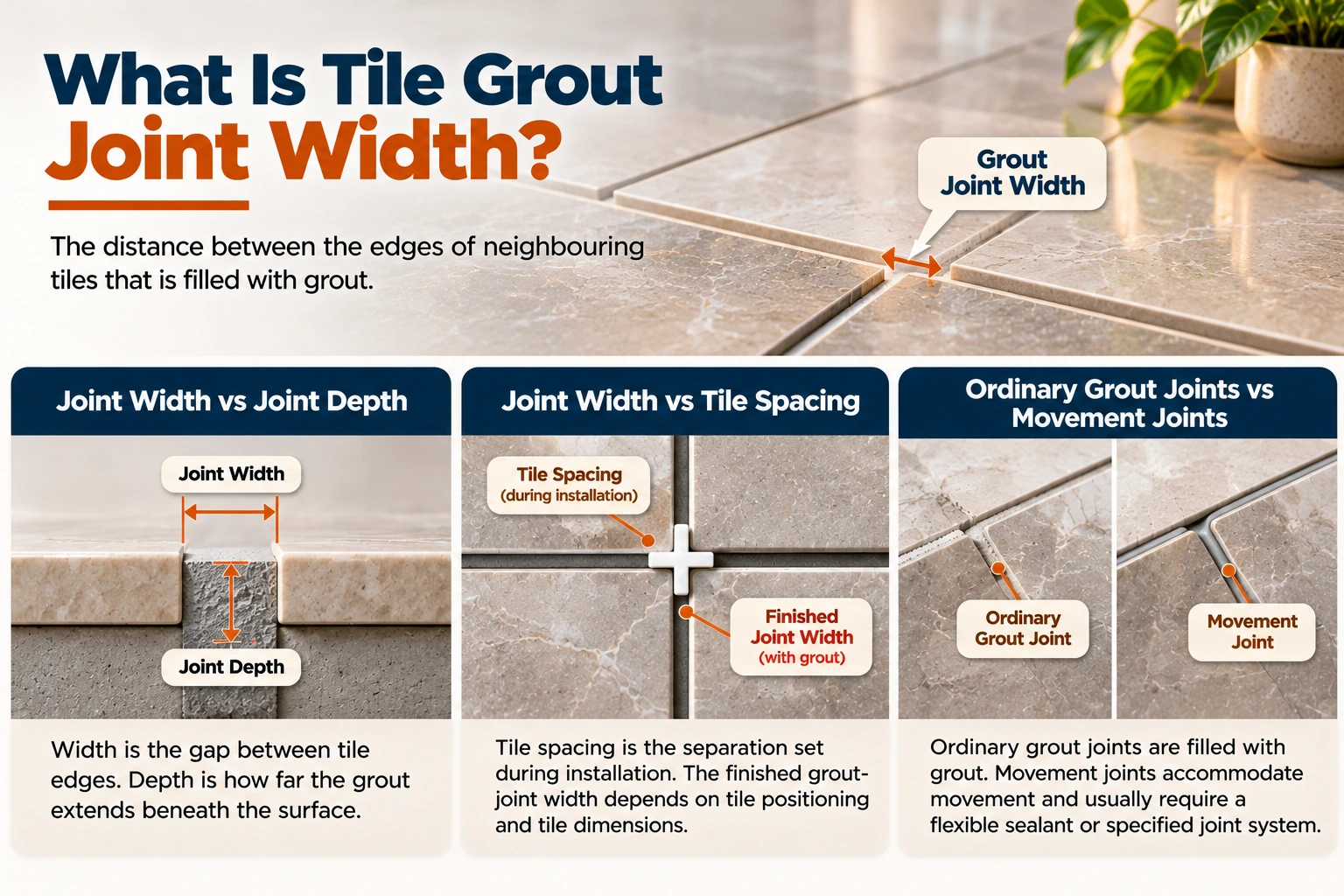
Tile grout joint width is the distance between the edges of neighbouring tiles that is filled with grout. It is usually measured across the visible gap, although the dimensions and shape of the joint beneath the surface can also influence application.
Width describes the gap from one tile edge to the next. Depth describes how far the grout-filled space extends beneath the finished surface. These measurements are related but are not interchangeable.
A joint may appear narrow at the surface but have a different profile below the tile edges. The grout must be suitable for the actual joint geometry and the manufacturer's specified installation requirements.
Tile spacing refers to the separation established during layout and installation. The finished grout-joint width depends on the positioning of the tiles and the consistency of their dimensions.
Tiles described as rectified may have more precisely finished edges, but this does not automatically mean that they can be installed without a joint. The tile manufacturer's recommendations, installation standards and project requirements should guide joint spacing.
Ordinary grout joints are filled with a compatible grout product. Movement joints serve a different purpose: they accommodate movement within the tiled assembly or building.
Designated movement joints, structural joints and certain changes of plane may require a suitable flexible sealant or a specified joint system instead of rigid grout. Filling these locations with ordinary grout can prevent the joint from performing its intended function.
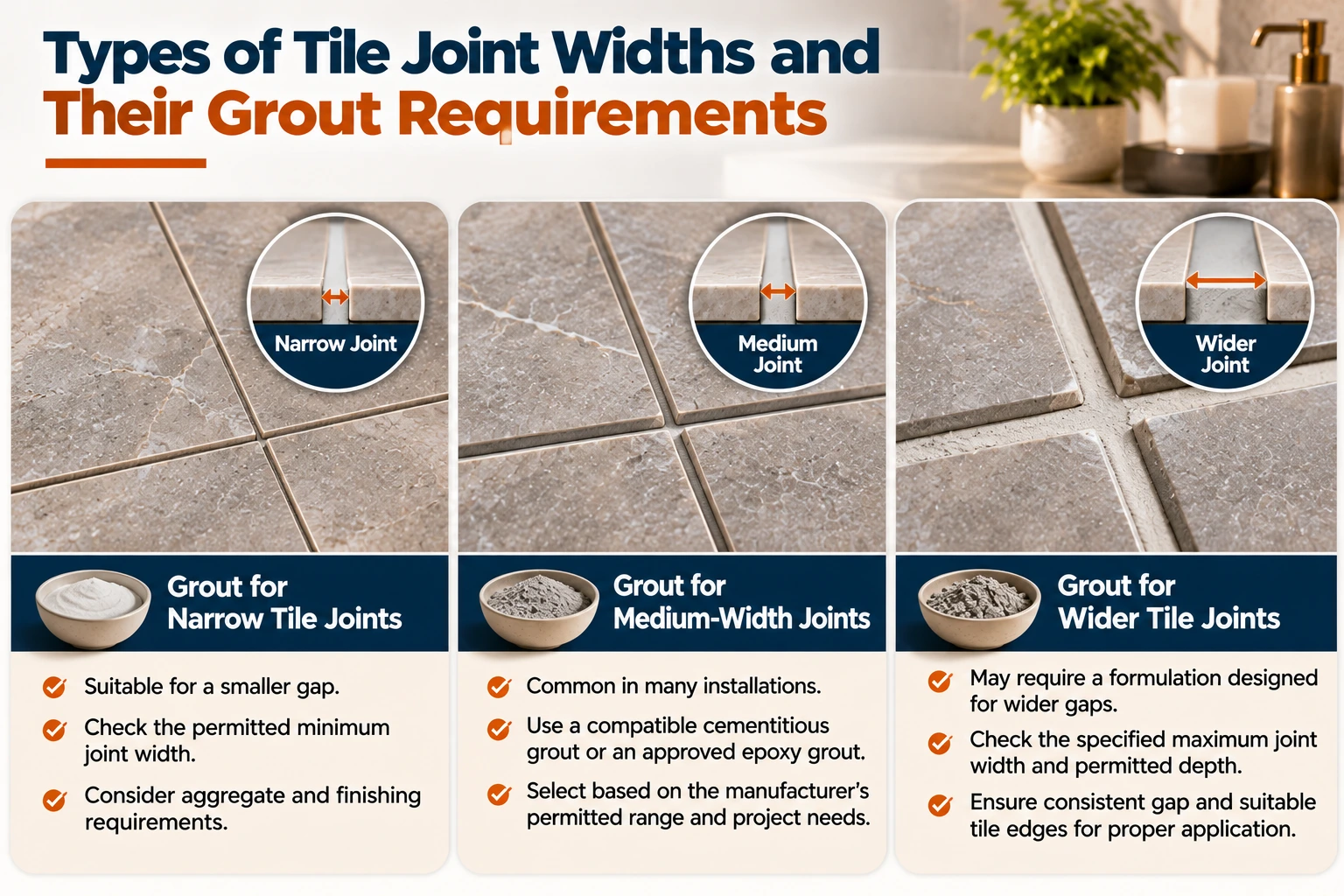
Joint widths can be discussed as narrow, medium and wider joints for practical planning. These categories are descriptive rather than universal measurement ranges. The product documentation must establish the permitted dimensions for the grout being considered.
Narrow joints leave limited space for application and finishing. The selected grout must be suitable for the actual gap and capable of being worked into it according to the manufacturer's instructions.
Check the grout's permitted minimum joint width, aggregate characteristics and finishing requirements. The tile edges should also be suitable for the intended layout.
Do not assume that every unsanded or fine-textured grout is suitable for every narrow joint. Product formulations differ, and some joints may be too narrow for a particular grout to be installed correctly.
Medium-width joints are common in many ceramic and porcelain tile installations. Their suitability depends on the actual dimensions, tile type, joint depth and product specification.
A compatible cementitious grout may be suitable for many applications, while certain epoxy products may also be available for the required joint dimensions. The decision should be based on the manufacturer's permitted range and the project's performance requirements.
Wider joints may require a grout formulation designed for the additional space. Aggregate size, formulation and the manufacturer's application instructions can influence whether the material is suitable.
Check the specified maximum joint width, permitted depth and any restrictions relating to tile material or exposure. Do not assume that a wider gap can be filled with any grout simply because more material is available.
For wider joints, also inspect whether the tile edges and installation layout produce a consistent gap. Significant variations can make application and finishing more difficult.
Cementitious and epoxy grouts differ in composition, application characteristics and performance. However, neither category automatically suits every joint width.
When comparing grout for different joint widths, evaluate the specific product rather than choosing solely by its broad classification.
|
Selection factor |
Cementitious grout |
Epoxy grout |
|
Composition |
Cement-based formulation, often with other specified ingredients |
Resin-based formulation using the components specified by the manufacturer |
|
Joint-width suitability |
Depends on the individual product's permitted range |
Depends on the individual product's permitted range |
|
Application |
Usually mixed and applied according to product instructions |
Requires careful preparation, application and cleanup according to product instructions |
|
Finishing |
Working time and cleanup method vary by formulation |
Cleanup timing and method are particularly important for the selected product |
|
Moisture and staining |
Performance depends on formulation, exposure and maintenance requirements |
Many products offer high stain and chemical resistance, subject to their specifications |
|
Installation environment |
Suitable for applications explicitly permitted by the manufacturer |
Suitable for applications explicitly permitted by the manufacturer |
|
Main selection check |
Joint dimensions, tile compatibility and required performance |
Joint dimensions, tile compatibility, handling requirements and required performance |
Cementitious grout is used in a wide range of tile installations. Its suitability for a particular joint depends on the formulation and its stated application limits.
Some products are designed for narrower joints, while others accommodate wider gaps. Tile surface sensitivity, joint dimensions and environmental conditions should all be considered before selecting the material.
For more detail on product categories, see Lapifix's guide to cementitious tile grout types and uses.
Epoxy grout can be useful in installations where the product's specified stain, chemical or moisture resistance is required. It may also be available for particular joint-width ranges.
However, epoxy grout is not automatically suitable for every narrow or wide joint. Its application, working time, cleanup requirements and permitted dimensions vary by product.
For a broader explanation of material differences, read Lapifix's epoxy versus cement grout guide. This article focuses on joint-width compatibility rather than repeating a general comparison of grout types.

Measure the joint at several locations instead of relying on a single measurement. Variations can occur because of tile dimensions, edge characteristics, alignment and installation tolerances.
Confirm that the grout is suitable for both the measured width and the joint geometry. If the dimensions fall outside the permitted range, select a suitable alternative or obtain technical advice.
Ceramic, porcelain, natural stone and glass tiles can have different surface and edge characteristics. Some tile surfaces may be vulnerable to scratching from abrasive grout components or may require particular application methods.
Tile dimensions can influence the layout and consistency of the joints, but tile size alone does not determine the correct grout. Follow the tile manufacturer's guidance and check the grout's compatibility.
Floor and wall installations have different practical requirements. Floors may experience foot traffic, furniture loads or other service conditions, while walls can require particular attention to application and finishing.
Choose a grout that is explicitly approved for the intended installation. Do not assume that a product suitable for a wall joint will automatically meet the requirements of a floor application.
Bathrooms, kitchens, swimming pools and commercial environments may require particular resistance properties. Consider the expected exposure and check the grout's technical data sheet for relevant limitations.
Grout should not be treated as a substitute for a required waterproofing membrane. The complete wet-area system must be designed and installed according to the relevant requirements.
A residential wall and a heavily used commercial floor may need different grout performance. Assess abrasion, cleaning frequency, possible chemical exposure and the consequences of joint deterioration.
The grout must be suitable for both the joint dimensions and the conditions under which it will be used.
The manufacturer's technical data sheet is the primary reference for the permitted joint-width range. It should also explain the applicable preparation, mixing, application, cleanup and curing requirements.
Do not transfer joint-width recommendations from one grout product to another without checking whether they apply.

Ceramic tiles are available in a variety of formats, finishes and edge types. Select a grout that matches the joint dimensions and is compatible with the tile surface.
For glazed or delicate ceramic finishes, confirm that the grout will not damage the surface during application or cleanup. Follow the tile and grout manufacturers' recommendations.
Porcelain tiles are generally dense and have low water absorption. Their joint requirements depend on the tile design, edge finish and intended installation.
Choose a grout approved for porcelain and the actual joint dimensions. Large-format porcelain tiles may have particular layout and joint requirements, but a large tile does not automatically call for a wider or narrower joint.
Bathroom grout must suit the joint dimensions and the expected moisture exposure. The correct choice may differ between a wall outside the shower and a surface exposed to regular direct water contact.
Check whether the product is approved for the intended wet-area application. Ensure that waterproofing, corners, penetrations and designated movement joints are handled as part of the complete installation system.
For additional information on product suitability in wet environments, consult Lapifix's guide to tile grout for kitchens and bathrooms.
Kitchen installations can experience food spills, grease, frequent cleaning and varying levels of traffic. Select grout according to the joint dimensions, tile surface and expected exposure.
A backsplash may have different service demands from a kitchen floor. Consider the manufacturer's cleaning and maintenance guidance as well as the permitted joint width.
Commercial corridors, retail floors and other busy areas may require grout with performance characteristics suited to repeated use and cleaning. The joint dimensions must still fall within the product's permitted range.
Do not choose grout solely because it is described as heavy-duty. Verify the specified applications, joint-width limits and compatibility with the tile installation.
An unsuitable grout can make it difficult to fill, compact or finish the joint properly. Depending on the product and installation conditions, this may contribute to surface defects or reduced joint performance.
In a narrow joint, a material that cannot be worked into the available space may leave incomplete filling. In a wider joint, a product used outside its permitted range may be more susceptible to problems associated with its formulation or application.
These outcomes are not inevitable, and joint width is not the only possible cause of grout failure. Incorrect mixing, poor preparation, premature cleaning, movement or unsuitable curing conditions may also contribute.
If a grout joint cracks or deteriorates, investigate the underlying cause before replacing the material. Recurring problems may require an assessment of the tile installation, movement joints or substrate.
A systematic selection process helps reduce guesswork and makes it easier to compare products.
Measure the actual gap. Check several joints across the installation to identify variations rather than relying on one measurement.
Assess the joint depth. Consider the space available for grout and any restrictions in the product instructions.
Identify the tile. Confirm the material, surface finish and edge characteristics, and check the tile manufacturer's installation recommendations.
Determine the application. Establish whether the grout will be used on a wall, floor, bathroom surface, kitchen installation or another environment.
Check the technical data sheet. Confirm that the specified joint-width range includes the actual joint dimensions.
Verify system compatibility. Make sure the grout is suitable for the tile, installation conditions and any relevant components of the system.
Follow the application instructions. Use the specified preparation, mixing, application, cleaning and curing methods.
When selecting grout for different joint widths, do not rely on generic measurements if the chosen product's documentation specifies something different. If the joint is outside the stated range or the requirements are unclear, consult the manufacturer or a qualified tiling professional.
Avoid these common selection errors:
Choosing grout without checking its permitted joint-width range.
Assuming the same grout is suitable for every narrow and wide joint.
Confusing ordinary grout joints with movement joints.
Ignoring variations in tile edges and actual joint dimensions.
Selecting products without considering the installation environment.
Following generic recommendations instead of the manufacturer's instructions.
A careful assessment before purchase can help avoid application problems and unnecessary rework.
Choosing grout according to joint dimensions requires more than identifying whether the gap looks narrow or wide. Tile material, edge characteristics, joint depth, installation environment and product specifications all influence suitability.
Grout for different joint widths should always be selected by checking the manufacturer's permitted application range and confirming that the product is compatible with the complete installation. Avoid assuming that all cementitious or epoxy grouts have identical limits, and distinguish ordinary grout joints from movement joints that require a different treatment.
Before purchasing, measure the joints, review the technical data sheet and confirm the requirements for the intended application. Lapifix offers tile grout products for different installation needs. Explore the Lapifix tile grout range and review the relevant product documentation to identify a suitable option for your project.
The best grout is one whose technical data sheet permits the actual joint width and depth and confirms suitability for the tile and installation environment. Compare the individual product specifications rather than relying only on whether the grout is cementitious or epoxy.
Sometimes, if the manufacturer's permitted joint-width range covers both applications. However, not every grout is suitable for every joint. Verify the product documentation before using one grout across joints of different dimensions.
There is no single width suitable for every tile installation. Joint spacing depends on the tile manufacturer's recommendations, tile dimensions and edge tolerances, the layout and applicable installation requirements. Follow the relevant specifications rather than choosing a width based on appearance alone.
Some epoxy grouts are approved for narrow joints, but suitability depends on the individual formulation and its stated application range. Check the manufacturer's instructions for minimum joint width, application method and tile compatibility.
Yes, some cementitious grout products are designed for wider joints. The permitted width varies by product, so check the technical data sheet before selecting or applying the grout.
Tile size influences layout and may affect joint consistency, but it does not independently determine the correct joint width. Tile edge characteristics, manufacturer recommendations, installation requirements and the intended appearance must also be considered.
No. Ordinary grout joints fill the spaces between tiles. Movement joints accommodate movement in the tiled assembly or building and may require flexible sealant or another specified joint treatment. Do not fill a designated movement joint with ordinary grout unless the system instructions explicitly require it.
Check the technical data sheet and installation instructions for the exact grout product. These documents should identify the approved applications and any joint-width limitations. If the information is unclear, contact the manufacturer before installation.