

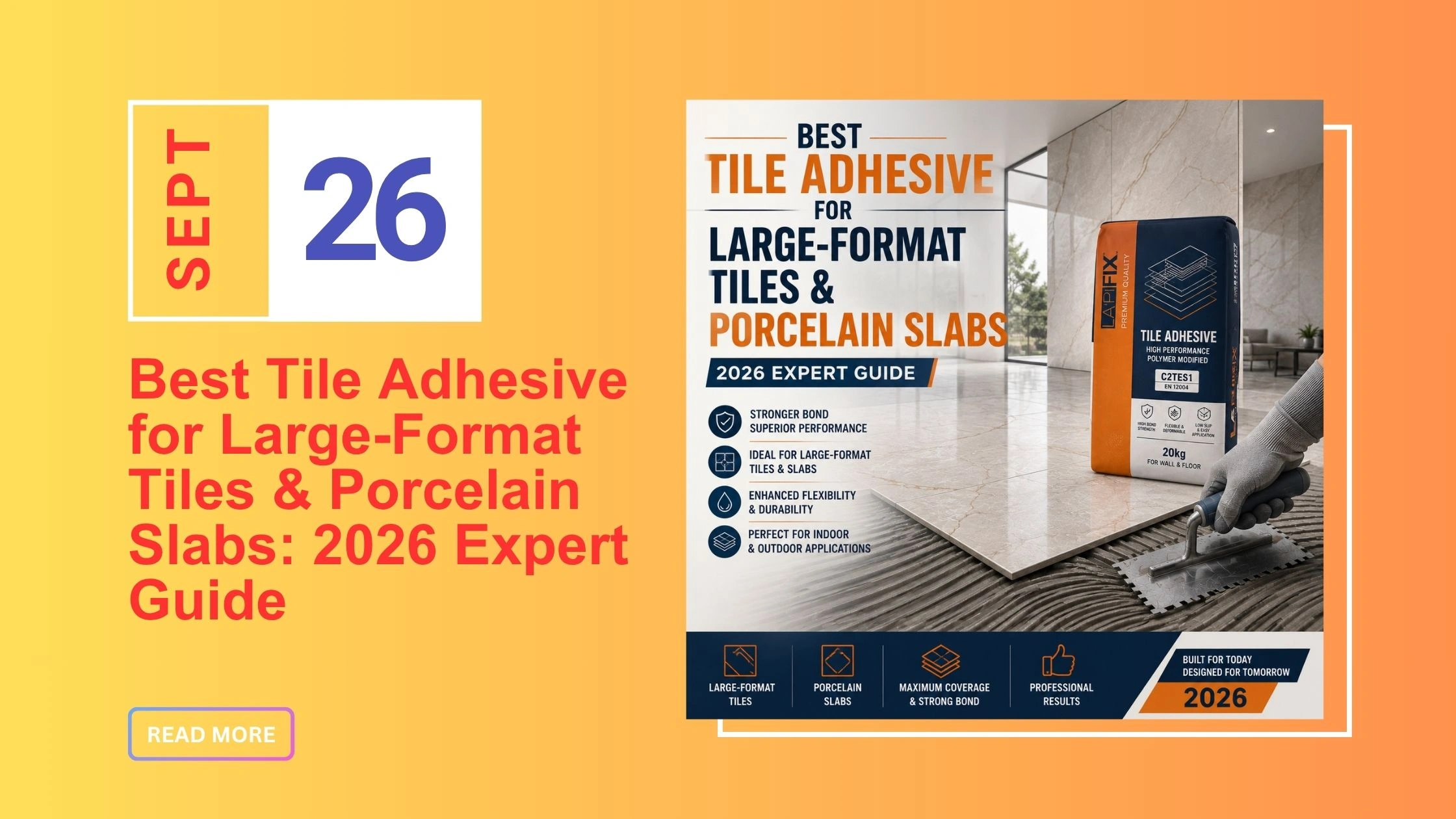
Large-format tiles and porcelain slabs can transform an ordinary room into a clean, contemporary space, but their impressive appearance comes with a demanding installation process. Their larger dimensions, low water absorption and weight require careful attention to adhesive selection, substrate preparation and installation technique.
Choosing the right tile adhesive for large format tiles is therefore not simply about finding a product with strong bonding. The adhesive must be suitable for the tile, substrate, installation location and expected movement. A mismatch can contribute to hollow areas, poor adhesion, cracked joints or tile debonding over time.
This matters for homeowners, contractors, architects, builders and commercial project teams worldwide. As larger porcelain and vitrified formats become increasingly popular, understanding adhesive performance can help prevent expensive installation failures. Before selecting a product, buyers can also review a professional tile adhesive product range to compare solutions designed for different applications.
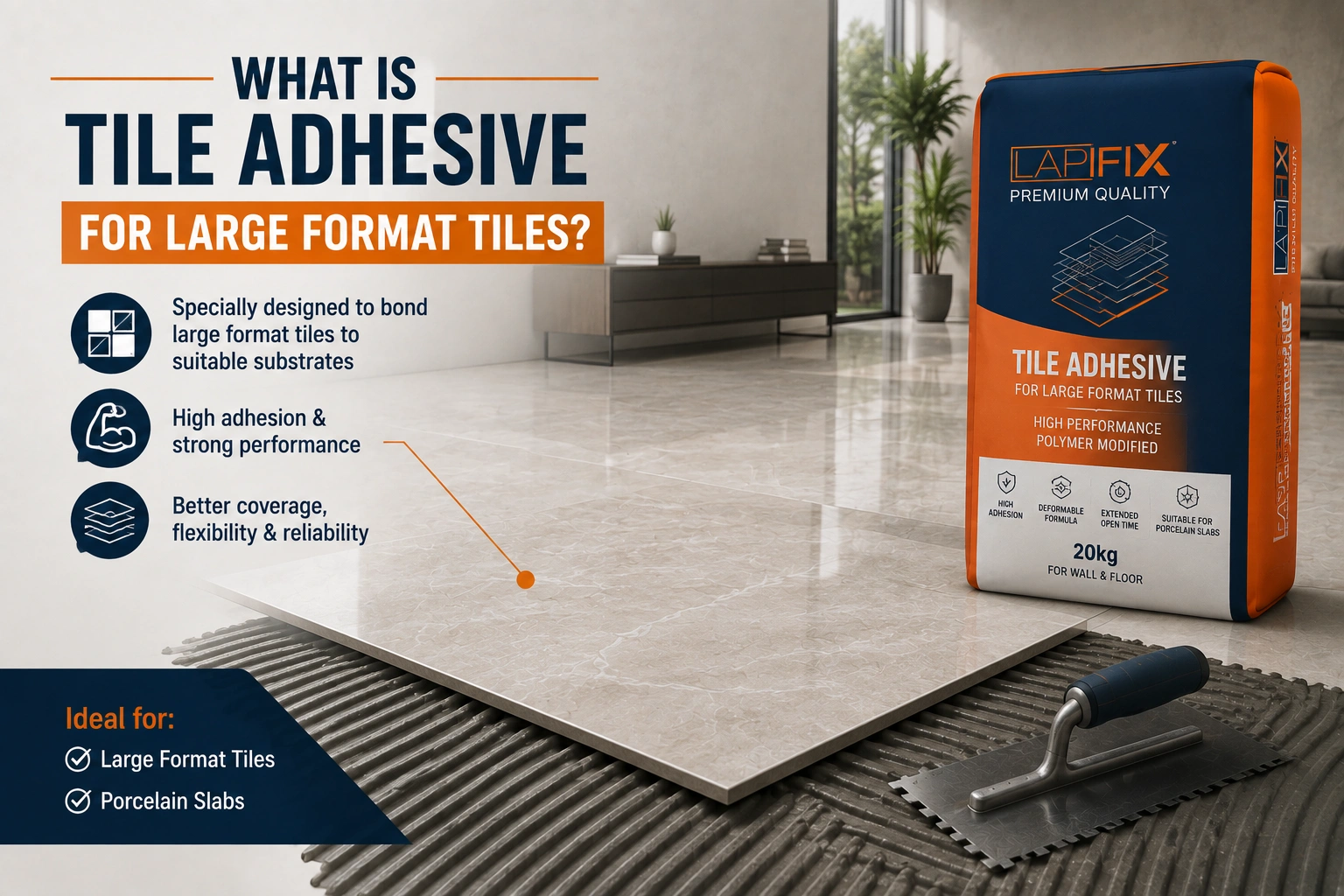
Tile adhesive for large format tiles is a specially selected bonding material used to secure oversized ceramic, porcelain or vitrified tiles to suitable substrates. Unlike smaller conventional tiles, large formats provide a greater surface area and can be more sensitive to uneven substrates and inadequate adhesive coverage.
The adhesive needs to provide reliable contact between the tile and substrate while accommodating the characteristics of the installation. Depending on the application, buyers may consider a large format tile adhesive with higher adhesion and appropriate deformability.
For porcelain slabs, the requirements can become even more demanding. Porcelain is dense and typically has very low water absorption, so selecting a suitable porcelain slab adhesive is important for achieving a dependable bond.
Large-format tiles behave differently from small tiles during installation. A larger tile can bridge minor imperfections in the substrate, creating voids beneath the tile if the surface has not been prepared properly.
Those voids can become weak points. Under foot traffic, furniture loads or temperature-related movement, unsupported areas may increase the risk of damage. Proper adhesive selection therefore needs to work together with accurate substrate preparation and installation technique.
The weight and dimensions of the tile also affect handling. A professional installer needs sufficient working time to position, align and adjust the tile before the adhesive begins to set. This is why installation conditions should be considered alongside the adhesive's technical classification.
Porcelain slabs and vitrified tiles are both dense tile materials, but their formats and applications can vary considerably. A conventional vitrified floor tile may be considerably smaller than a large porcelain slab used for walls, floors, countertops or feature surfaces.
As tile dimensions increase, installation precision becomes more important. A suitable vitrified tile adhesive should be selected according to the tile manufacturer's recommendations, substrate and installation environment.
For very large porcelain surfaces, a tile adhesive for slabs may need to provide high adhesion and appropriate flexibility. However, no adhesive can compensate for a structurally unsuitable substrate or poor installation practice.
A standard cementitious adhesive can be appropriate for many routine tile installations, but large-format applications may require greater performance depending on the project conditions.
A flexible tile adhesive is designed to accommodate a degree of movement within the installation system. This can be valuable where substrates or surfaces may experience thermal changes, minor movement or other stresses.
For demanding installations, buyers may consider a heavy duty tile adhesive with an appropriate classification. The objective is not to automatically select the strongest product available, but to choose a formulation whose performance matches the actual application.
C2TE S1 is a classification used to describe specific performance characteristics of cementitious tile adhesives under EN 12004. "C2" indicates improved adhesion performance compared with standard C1 adhesives, while "T" indicates reduced slip and "E" indicates extended open time. "S1" indicates a deformable adhesive category.
This combination can be relevant for demanding installations involving large-format tiles when the product is specifically designed and recommended for that application.
Buyers should still read the manufacturer's technical data sheet rather than selecting a product based solely on the classification. Tile size, substrate, location, environmental exposure and installation method all influence the appropriate specification.
Correct tile adhesive thickness is essential for achieving appropriate contact without creating an unnecessarily thick adhesive bed. The required thickness depends on the product, substrate condition, tile format, trowel selection and installation method.
Likewise, tile adhesive coverage should not be estimated from the bag weight alone. Actual consumption can vary significantly depending on substrate flatness, tile dimensions, trowel profile and whether additional adhesive is applied to the back of the tile.
For large-format tiles, installers should focus on achieving the coverage specified by the relevant installation guidance and adhesive manufacturer. Consistent contact beneath the tile is more important than simply trying to minimise adhesive consumption.
Selecting the best tile adhesive for large format tiles starts with understanding the complete installation rather than looking at the adhesive price alone. Consider the tile material, dimensions, weight, water absorption, substrate, location and expected movement. A large porcelain tile installed over a stable interior concrete floor may have different requirements from a large tile installed outdoors or over an existing tiled surface.
For demanding applications, look for an adhesive with appropriate adhesion, open time, slip resistance and deformability. The manufacturer's technical data sheet should clearly state the recommended tile sizes and substrates. This approach helps contractors choose a large format tile adhesive that is technically appropriate rather than relying on general-purpose products.
Large porcelain slabs require particularly careful adhesive selection because their dimensions leave less room for installation errors. Even a relatively small variation in the substrate can create gaps beneath a slab, while insufficient adhesive contact can affect long-term performance.
A suitable porcelain slab adhesive should provide reliable adhesion to dense porcelain and work effectively with the recommended installation method. The slab manufacturer may also specify particular adhesive classifications or installation techniques. Following both the tile and adhesive manufacturer's instructions is important, especially for thin, oversized slabs used on floors, walls or feature surfaces.
For professional projects, the adhesive should be viewed as one part of a complete installation system that includes the substrate, primer where required, movement joints and correct setting technique.
A C2TE S1 tile adhesive can be relevant to large-format applications where improved adhesion, reduced slip, extended open time and deformability are required. Under EN 12004 classification, C2 represents improved cementitious adhesive performance, while T indicates reduced slip, E indicates extended open time and S1 indicates a deformable adhesive.
This does not mean every large tile automatically requires S1 adhesive. The correct specification depends on the installation conditions and manufacturer's recommendations. However, deformability can become particularly valuable where the installation may experience movement or thermal variation.
A flexible tile adhesive can therefore provide an important performance advantage in appropriate applications. It can help the adhesive layer accommodate certain movements within the installation system rather than behaving as a completely rigid layer.
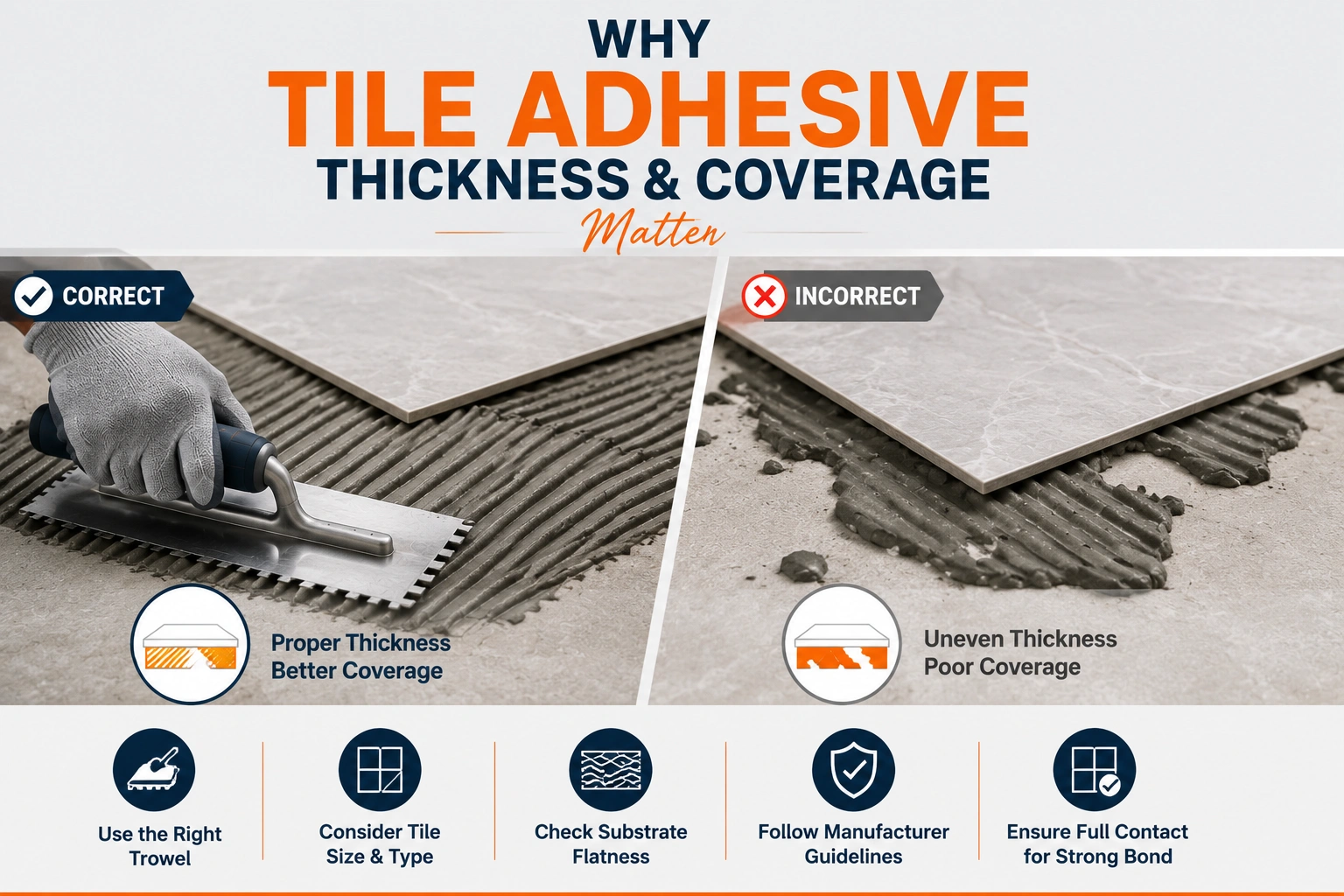
Tile adhesive thickness should follow the manufacturer's recommended application range and should be achieved using an appropriate notched trowel. Increasing thickness simply to compensate for an uneven substrate is not a reliable substitute for proper surface preparation.
Large-format tiles also require particular attention to tile adhesive coverage. The objective is to achieve consistent contact between the tile and substrate and minimise significant voids beneath the finished surface. The larger the tile, the more important correct trowel technique and substrate flatness become.
Actual adhesive consumption depends on several variables, including tile dimensions, substrate condition, trowel size, adhesive-bed thickness and installation technique. Therefore, coverage figures printed on packaging should be treated as practical estimates rather than guaranteed quantities for every project.
Even the best adhesive cannot correct a poorly prepared substrate. Before installation, the surface should be structurally sound, clean and appropriately prepared according to the adhesive manufacturer's instructions. Dust, grease, loose material, curing residues and other contaminants can interfere with bonding.
Flatness is particularly important when working with large-format tiles. Smaller tiles can sometimes accommodate minor variations because of their dimensions and installation pattern, while large tiles can bridge uneven areas and leave unsupported sections.
If the substrate requires levelling or repair, those works should be completed before tile installation. Allow the relevant materials to cure as specified, then check the surface again before applying adhesive.
Back-buttering involves applying adhesive to the back of the tile in addition to applying it to the substrate when the installation method and product instructions call for it. This technique can improve contact for large-format tiles and slabs, particularly where achieving adequate coverage is challenging.
The adhesive should be combed consistently in one direction using the correct trowel. The large tile is then pressed and moved appropriately to collapse the adhesive ridges and improve contact. Installers should avoid leaving large unfilled areas beneath the tile.
For oversized porcelain tiles and slabs, professional handling may also be required because the tile needs to remain properly supported while being positioned. The exact installation method should always follow the tile manufacturer's instructions and the adhesive manufacturer's technical guidance.
Indoor installations generally experience fewer environmental stresses than exterior installations, but adhesive selection still depends on the substrate and tile. Large porcelain tiles used in living rooms, kitchens, commercial interiors or corridors need consistent support and suitable adhesion.
Outdoor installations can be more demanding because surfaces may experience temperature changes, moisture and weather exposure. For these applications, an appropriate heavy duty tile adhesive may be considered when specified for exterior use.
Balconies, terraces, façades and outdoor walkways require additional attention to drainage, movement joints and substrate conditions. Choosing an adhesive alone does not make an installation suitable for outdoor exposure; the complete system must be designed and installed correctly.
Large-format tile failures often result from several small errors rather than one obvious mistake. One common problem is installing over an uneven substrate and attempting to correct the variation with excessive adhesive. This can produce inconsistent adhesive thickness and poor contact.
Another issue is allowing the adhesive surface to remain exposed beyond its usable open time. Environmental conditions such as heat, wind and low humidity can affect working time. Installers should work within the product's stated limitations rather than spreading excessive adhesive ahead of the installation.
Other frequent problems include inadequate adhesive coverage, incorrect mixing, using the wrong trowel, failing to follow movement-joint requirements and walking on the installation before the adhesive has reached the required setting stage.
The safest approach is to treat preparation, adhesive selection and installation technique as interconnected steps rather than separate tasks.
For projects requiring different levels of adhesive performance, Lapifix provides products across several application categories. Its range includes LX Standard, LX Super, LX Platinum, LX Premium and LX PU Superior, allowing buyers to select according to project requirements..
For demanding large-format applications, LX Premium is listed as a highly flexible rubber polymer-modified adhesive with a C2TE S1 classification and is recommended for applications including large-format vitrified tiles, natural stone, swimming pools, marble, terrazzo and heavy-traffic areas.
The important point is to match the product to the specific installation rather than assuming one adhesive is suitable for every large-format tile project.
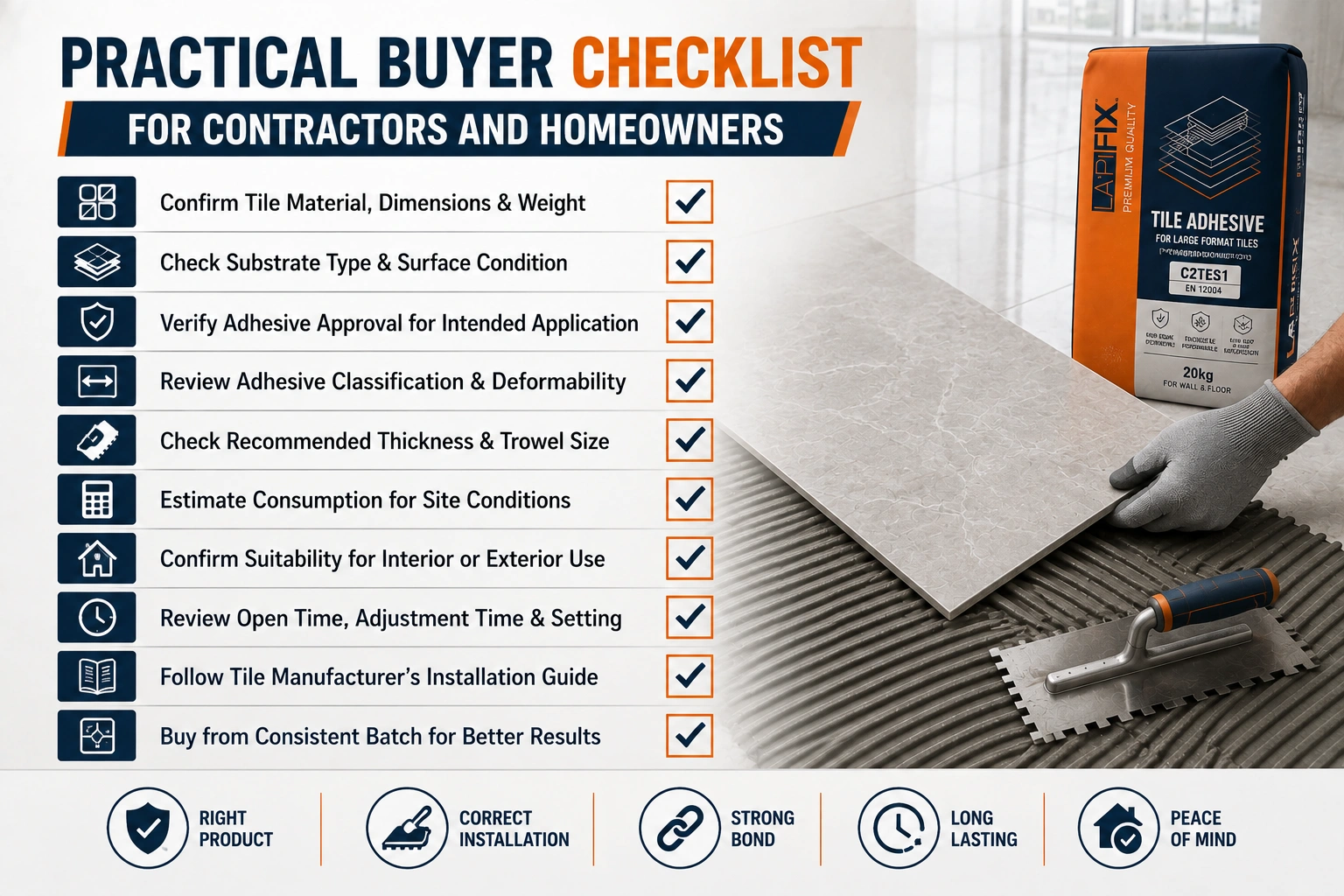
Before purchasing tile adhesive for large format tiles, check the product documentation and installation requirements carefully. The following factors provide a practical starting point:
Confirm the tile material, dimensions and weight.
Check the substrate type and surface condition.
Verify whether the adhesive is approved for the intended application.
Review the adhesive classification and deformability requirements.
Check recommended adhesive thickness and trowel size.
Estimate consumption based on actual site conditions.
Confirm suitability for interior or exterior use.
Review open time, adjustment time and setting requirements.
Follow the tile manufacturer's installation recommendations.
Purchase enough material from a consistent production batch where practical.
For homeowners, asking the installer which adhesive classification and installation method will be used can also provide useful reassurance. For contractors and procurement teams, maintaining technical documentation alongside purchase records makes it easier to verify that the selected product matches the project specification.
The best tile adhesive for large format tiles is not simply the strongest or most expensive product. It is the adhesive whose performance matches the tile, substrate, environment and installation method. Large-format porcelain and slabs demand particular attention to substrate flatness, adhesive coverage, application thickness and movement.
Choosing a tile adhesive for large format tiles should always depend on the project conditions. For standard indoor applications, a suitable polymer-modified cementitious adhesive may provide the required performance. When tiles become larger, heavier or more difficult to bond, a higher-performance formulation may be more appropriate.
For large porcelain tiles and slabs, consider adhesion, deformability, open time, slip resistance and compatibility with the substrate. A C2TE S1 tile adhesive can be particularly relevant for demanding installations where improved adhesion and flexibility are required, provided the product is specified for the intended application.
A simple way to think about the selection is this: the larger and more demanding the tile installation, the more important it becomes to match the adhesive specification to the entire installation system.
Manufacturers normally provide approximate tile adhesive coverage based on recommended application conditions, but actual consumption can vary. Tile size, substrate flatness, trowel notch, adhesive thickness and installation technique all influence how much material is used.
For large-format tiles, trying to reduce adhesive consumption by applying an unnecessarily thin layer can compromise contact. On the other hand, using excessive adhesive to compensate for an uneven substrate can create inconsistent thickness and installation problems.
The better approach is to prepare the substrate properly, select the recommended trowel and apply the adhesive according to the manufacturer's instructions. For particularly large tiles or slabs, back-buttering may also be required to achieve the desired coverage.
A flexible tile adhesive can be useful when an installation needs to accommodate a degree of movement or deformation. This may be relevant for certain large-format tiles, heated floors, exterior applications or substrates subject to thermal variation.
A heavy duty tile adhesive may be appropriate for demanding areas where the installation experiences higher loads or environmental exposure. However, "heavy duty" should not be treated as a universal specification. Always verify the product's technical classification and intended applications.
For porcelain slabs and large vitrified tiles, the tile manufacturer's recommendations should also be considered before finalising the adhesive.
Selecting the right tile adhesive for large format tiles requires more than comparing product prices. Tile material, size, substrate, location, adhesive classification, flexibility, thickness and coverage all influence long-term performance. Large porcelain tiles and slabs especially require careful substrate preparation and consistent adhesive contact, while demanding environments may require a suitably classified flexible or deformable adhesive.
For contractors, architects, builders and homeowners looking for an appropriate solution, Lapifix offers a range of tile adhesive products for different installation requirements. Explore the Lapifix tile adhesive range and review the relevant product specifications before starting your project. For large-format and demanding applications, selecting the correct adhesive at the planning stage can help improve installation quality and reduce avoidable repair costs.
Before placing a bulk or project order, buyers should confirm whether the adhesive is compatible with the tile and substrate, whether it is suitable for the installation environment, and what classification applies to the product. It is also useful to verify recommended adhesive thickness, coverage, working time and curing requirements.
For professional projects, ask for the current technical data sheet and product documentation. This gives contractors and project managers a reliable reference for installation rather than depending only on sales descriptions or general recommendations.
The best adhesive depends on tile size, material, substrate and installation environment. For demanding large-format applications, a high-performance polymer-modified adhesive with suitable deformability may be appropriate, but the final specification should follow the tile and adhesive manufacturer's recommendations.
C2TE S1 is a high-performance classification that combines improved adhesion, reduced slip, extended open time and deformability. It can be suitable for demanding large-format porcelain applications when the specific adhesive is designed and approved for that use.
There is no single thickness suitable for every large-format tile installation. The required adhesive thickness depends on the product, substrate, tile dimensions and trowel. Follow the manufacturer's specified application range rather than increasing thickness to compensate for an uneven surface.
Back-buttering can help improve adhesive contact beneath large-format tiles and slabs when recommended by the installation system. It should be carried out using the correct technique and in combination with properly prepared, level substrate and appropriate adhesive application.
Good substrate preparation, correct trowel selection, consistent adhesive combing and proper tile placement can improve coverage. For large tiles, installers should follow the manufacturer's installation instructions and check contact during installation rather than relying only on theoretical coverage figures.