

When it comes to tile installation, the adhesive is as vital as the tile itself. Tile adhesives offer the necessary bond between the tile and the substrate that gives durability, stability and long-life performance. Different adhesives are developed under different conditions, and it is vital to learn them.
Of these, Type 3 tile adhesive is particularly relevant in exterior residential tiling projects. With conditions such as weather exposure, temperature changes, and high loads, Type 3 is made to withstand conditions where standard interior adhesives leave short. This polymer-modified adhesive is recognized as ANSI standard which provides improved bonding, curing, slip resistance, outdoor durability and is widely used in facades, cladding and other outdoor applications.
Adhesives used in tiles are not a universal product. To establish reliability and performance, they are categorized into groups according to established standards, e.g. ANSI A136.1 in the U.S. and EN classifications in Europe. This set of standards is used by the installers, contractors, and homeowners to select an appropriate adhesive that is strong, flexible, and capable of surviving depending on the environment to which they are exposed.
Broadly, adhesives are grouped into three main categories:
Type 1 Adhesive – An organic mastic featuring excellent bond strength and water resistance, therefore it is suited to most interior wall tile fixing, such as a non-waterproofed bathroom.
Type 2 Adhesive – This is a less water resistant than the Type 1 mastic. It is opted to use in the interior dry zones like; kitchen backsplashes, and interior feature walls, where there is no constant exposure to water.
Type 3 Adhesive – A cement based polymer modified adhesive that can resist outdoor conditions. It has a longer lifespan and better weather toleration so that it can be used in exterior cladding, facades and high duty tile installation.
The classification will make certain that installers put the right product to the right environment; whether it is a common indoor wall, a damp bathroom situation, or an outdoor exposed facade. Selecting the incorrect category could result in failure of the tiles, delamination or poor long service, that is why these standards are important in ensuring project success.
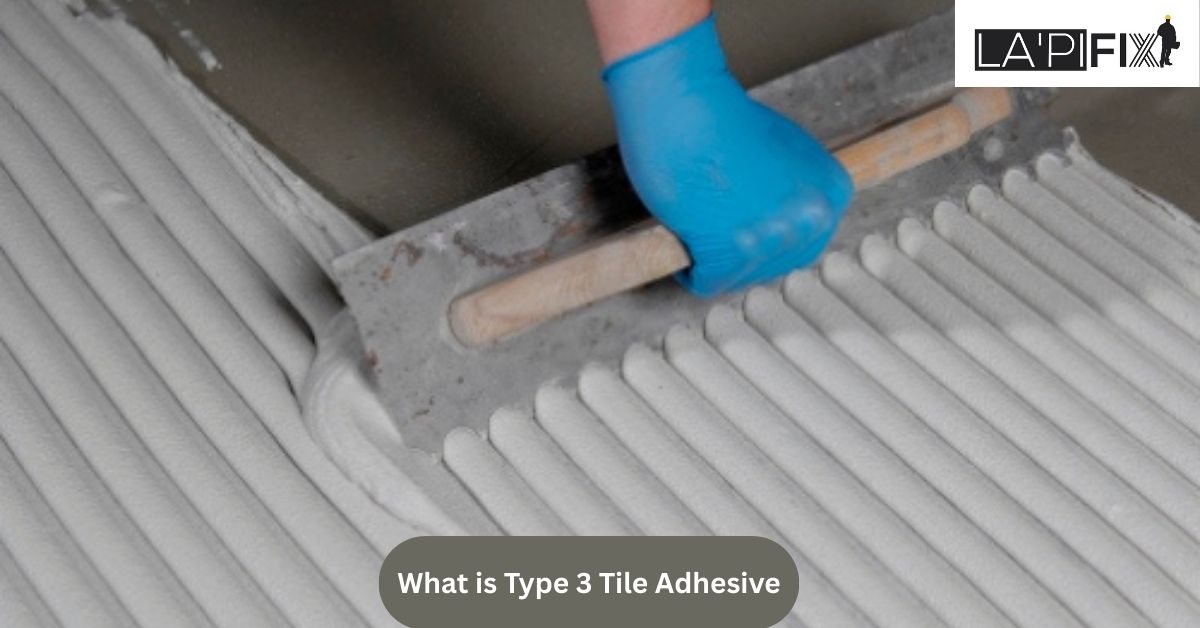
Type 3 tile adhesive refers to the polymer- modified, cement- based along with the adhesive system especially designed or formulated to be used in the areas of exterior or outdoors. Compared to organic mastics (Type 1 and Type 2), although they can only be used indoors, Type 3 adhesives can be used outdoors, and are more durable, strong, and can withstand harsh weather conditions.
This adhesive is ideal for fixing tiles to concrete walls, exterior plaster, natural stone substrates, and façade surfaces, where conventional adhesives would fail. Because it is cementitious, it undergoes a hydration and curing process, creating a strong mechanical bond between the tile and the substrate.
Key characteristics of Type 3 adhesive include:
High adhesion and bonding strength – suitable for heavy tiles, porcelain, and stone.
Shear resistance – designed to withstand wind loads, vibrations, and temperature shifts.
Weather and water resistance – essential for outdoor cladding and façades.
Controlled drying time – allows flexibility for professional installers to adjust tiles during installation.
Excellent spreadability – provides even coverage across large exterior surfaces.
In short, Type 3 adhesive is the go-to solution for exterior tiling projects, where reliability and durability matter most.
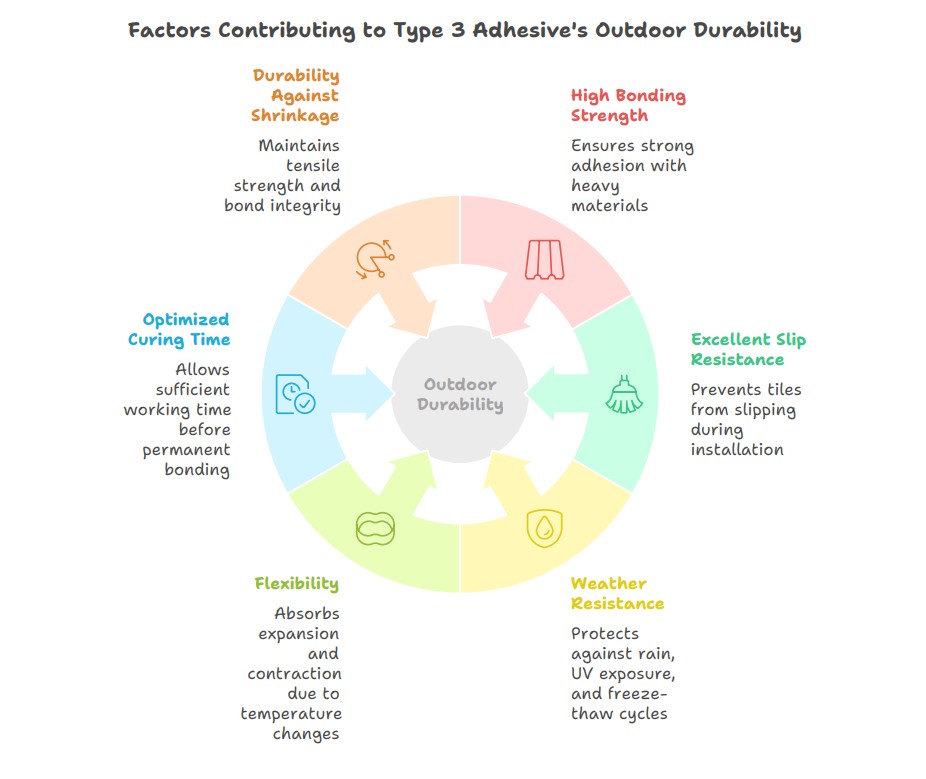
An advantage of Type 3 tile adhesive is its capability to work in extreme outdoor environments and where interior adhesive fails. Being a polymer-modified cement-based adhesive it is a combination of the strength of cement bonding and increased flexibility and resistance to water of a modern polymer adhesive.
High Bonding Strength : Type 3 is specially designed to bond with heavier tiles, porcelain, and natural stones and it can be used to achieve strong adhesion on concrete and exterior walls.
Excellent Slip Resistance : Reduces slippage of tiles during installation, particularly on vertical cladding and façade installations.
Weather Resistance : The formulation makes it weather resistant to resist rain, UV exposure, and freeze-thaw cycles, consequently reliable in outside long-term applications.
Flexibility for Thermal & Moisture Movement : The adhesive can also absorb slight expansion and contraction due to changes in temperature and moisture that is given by polymer additives.
Optimized Curing & Open Time : Allows sufficient working time before curing to a strong, permanent bond plus the installation time is not wasted.
Durability Against Shrinkage & Stress : Designed to resist shrinking on curing, maintaining the tensile strength of the adhesive and the integrity of the bond.
In short, the Type 3 adhesive performance cannot be ignored when considering outdoor durability, since tiles would want to remain intact even under the pressure of environmental factors.
Type 3 tile adhesive is specifically designed to meet the requirements of the high-strength and high durability concrete tiles plan. Its polymer-modified, cement-based composition qualifies it to be used in heavy-duty applications that exceed what Type 1 and Type 2 adhesives can achieve.
Exterior Wall Cladding & Façades: It is used to glue ceramic, porcelain, or natural stone tiles to the exterior walls and architectural facades of buildings where adhesion and resistance to freezing may be vital.
Concrete & Masonry Substrates: The substrates which are cement or concrete walls, cement render, and brickwork, form excellent anchorage to Bonds.
Natural Stone Installations : Gives the tensile strength and durability requirements to support heavy stone tiles and slabs without cracking.
Mosaics & Decorative Outdoor Features : Suitable for decorative wall mosaics, garden features, and anything that is vertically positioned and likely to experience a range of weather conditions.
Damp but Non-Submerged Areas : Can be used in semi-outdoor areas like patios, verandas and covered exterior walls, but not in full immersion (e.g., swimming pools).
Type 3 adhesive is best suited to a professional exterior tile installation due to its slip resistance, heavy load-bearing capacity, and versatility.
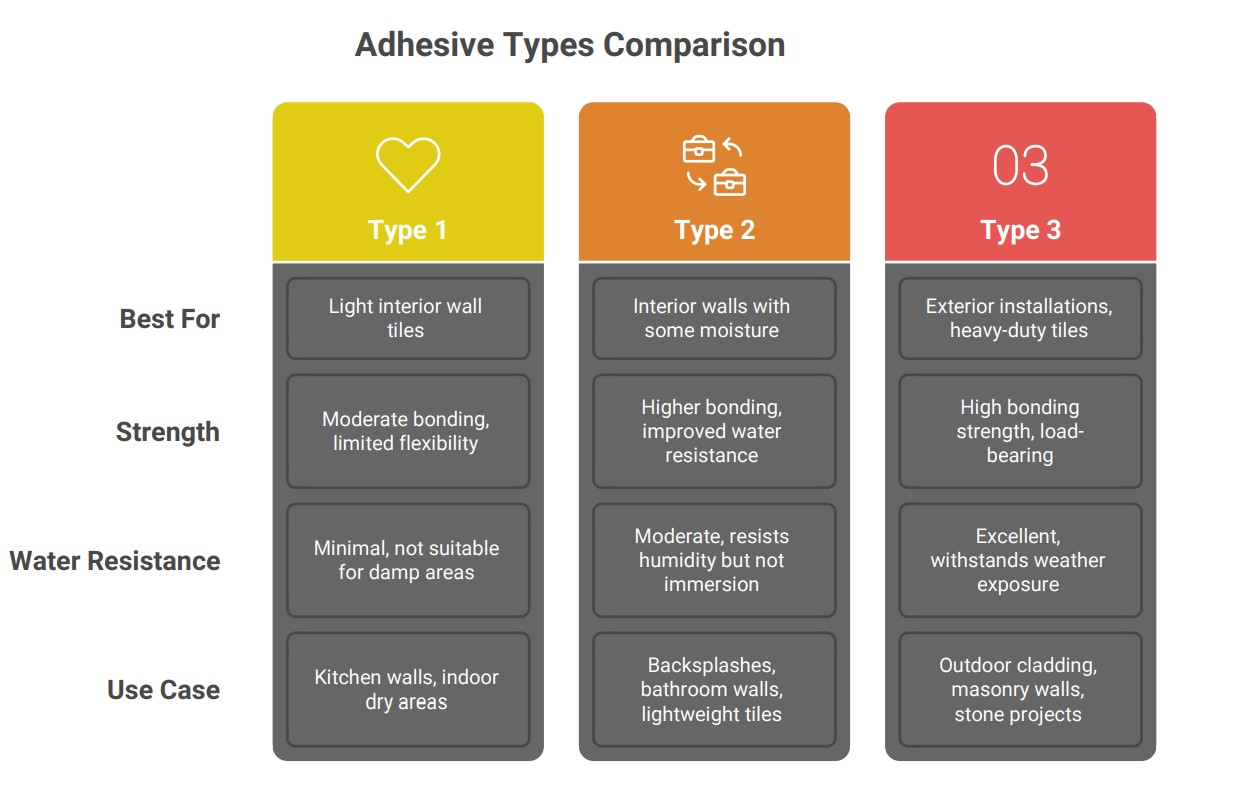
The right tile adhesive should be selected depending on the location and method of installation. All adhesives possess advantages and weaknesses and Type 3 can be used in the most appropriate ways when it comes to exterior and heavy-duty use.
Best for: Light interior wall tiles in dry environments.
Strength: Moderate bonding, limited flexibility.
Water Resistance: Minimal — not suitable for humid or damp areas.
Use Case: Kitchen walls, decorative tiling, indoor dry areas.
Best for: Interior walls in areas with some moisture exposure (e.g., kitchens, bathrooms — not submerged).
Strength: Higher bonding than Type 1, improved water resistance.
Water Resistance: Moderate resists humidity but not immersion.
Use Case: Backsplashes, bathroom walls, lightweight indoor tiles.
Best for: Exterior installations, façades, natural stone, and heavy-duty tiles.
Strength: High bonding strength, designed for load-bearing and vertical applications.
Water Resistance: Excellent — withstands rain, freeze-thaw cycles, and weather exposure.
Use Case: Outdoor cladding, masonry walls, natural stone projects.
Thinset Mortar: This type of mortar is common in interior and exterior areas, particularly floors and submerged areas like pools. It includes high strength and flexibility.
Epoxy Adhesive: High end adhesive due to chemical properties, sub immersion application, and ultimate strength. More expensive but incomparable performance
|
Adhesive Type |
Environment |
Bonding Strength |
Water/Weather Resistance |
Best For |
|
Type 1 |
Indoor, dry |
Moderate |
Low |
Kitchen walls, décor |
|
Type 2 |
Indoor, damp |
Good |
Moderate (not submerged) |
Backsplashes, bathroom walls |
|
Type 3 |
Outdoor |
High |
Excellent (weatherproof) |
Façades, exterior cladding |
|
Thinset |
Indoor/Outdoor |
Very High |
Excellent (submersion OK) |
Floors, pools, showers |
|
Epoxy |
Any |
Superior |
Superior |
Pools, labs, industrial use |
When it comes to demanding exterior installations, Type 3 adhesive provides benefits that make it the preferred choice for both professional contractors and DIY homeowners tackling large or exposed tiling projects.
Provides stability to tiles to ensure that they are firmly fixed to vertical external surfaces including facades and exterior walls.
Prevents tile slippage even with heavy natural stone or porcelain tiles.
Designed especially to resist rain, sun exposure, freeze-thaw cycles, and humidity changes.
Maintains adhesion in harsh outdoor conditions where Type 1 and Type 2 would fail.
Maintains strength and flexibility over time, reducing the risk of cracks, delamination, or tile failure.
Provides thermal stability, allowing for expansion and contraction in varying temperatures.
Although Type 3 adhesive is designed for demanding exterior tiling, it is not a universal solution. Knowing its limitations is essential for avoiding failures and ensuring a safe, durable installation.
Choosing the appropriate tile adhesive is the key to installing success and long lasting durability. Type 3 adhesives are best suited in exterior uses, but again, all choices should be based on tile type, surrounding environment, and substrate conditions.
Use Type 3 adhesives for exterior wall tiles, porcelain, and natural stone.
Select Type 1 or Type 2 adhesives when using lighter indoor walls.
In the case of a heavy-duty floor,submerged areas, or tiles of large format, you may want to use thinset or epoxy adhesives.
When exposed outdoors use adhesives that are weather-resistant and slip-resistant (Type 3 or specialty mortars).
Type 2 adhesives can be used on wet although non-immersed surfaces (walls of the bathrooms, kitchen backsplashes).
When using pools, fountains, or constant immersion, epoxy based adhesives are always preferable.
Make sure the substrate is stable, clean and well prepared before applying adhesive.
You should never apply rigid adhesives such as Type 3 directly to plywood or flexible bases, but should apply a cement backer board or other substrate.
The most appropriate tile adhesive is based on three factors, tile material, environment, and substrate. Type 3 is more ideal on the exteriors and vertical, heavy-duty jobs but when to use thinset or epoxy is also important to make a successful project.
In its support of exterior tiles, Type 3 tile adhesive is a cement based adhesive with cement, polymer added that is specifically larger slip, strength and weather-ability. It is stronger than lighter indoor adhesives in terms of bond reliability and is the moving and multiple-purpose choice of facades, outdoor claddings and heavy-duty vertical tiling.
Selecting an adhesive is not restricted to the placement of tile; it is highly influential toward its longevity, durability, and safety in the end. Although Type 3 is best applied outdoors, other adhesives such as Type 1, Type 2, thinset, and epoxy can be more appropriate in other situations, such as indoor walls, wet rooms, and subwoofer surfaces.
In the case of both homeowners and contractors, the most suitable policy is matching the adhesive to the project specifications and meeting ANSI/EN criteria and consulting a professional tile installer when undertaking an elaborate undertaking. Use of the right varieties will guarantee successful installation, resistance to weather and long life in the residential or commercial premises.
Type 2 adhesive is primarily used for indoor walls in areas with light to moderate moisture, such as kitchens and bathrooms (not submerged). Type 3 adhesive, on the other hand, is cement-based and polymer-modified, designed for exterior applications like façades, outdoor cladding, and heavy-duty wall tiles. It offers higher bonding strength, weather resistance, and slip resistance compared to Type 2.
No. Type 3 adhesive is not recommended for submerged conditions such as pools, fountains, or water tanks. For constant water immersion, epoxy-based or specialized thinset adhesives are required.
Type 3 adhesive is water-resistant but not fully waterproof. It is suitable for exterior walls and damp conditions where it can resist rain, humidity, and temperature changes, but it is not designed for continuous submersion in water.
Yes. While primarily intended for outdoor projects, Type 3 adhesive can also be used indoors for heavy stone or large-format tiles where extra bonding strength is needed. However, it may be unnecessary for light-duty interior wall tiles where Type 1 or Type 2 adhesives are sufficient.
Type 3 adhesive works best with porcelain tiles, ceramic tiles, mosaics, and natural stone when applied to exterior walls, cladding, or heavy vertical installations. Its high bonding capacity makes it ideal for projects requiring strong adhesion.
On average, Type 3 adhesive requires 24–48 hours of curing time before grouting, depending on temperature, humidity, and tile size. Always check the manufacturer’s guidelines for specific curing times.
Type 3 is generally formulated for vertical exterior applications. For floors, especially in high-traffic or wet areas, thinset mortar or epoxy adhesives are better suited due to their load-bearing strength and immersion resistance.
Type 3 adhesive can hold a variety of tiles including ceramic, porcelain, vitrified, mosaics, and natural stones. It is particularly strong for large-format and heavy tiles on exterior vertical substrates like concrete, plaster, and masonry.