

A smooth painted wall does not begin with the paint. It begins with what happens underneath it. If the putty is too thick, too watery or mixed inconsistently, the finished wall can develop ridges, uneven coverage and unnecessary sanding work.
Understanding the Wall Putty Mixing Ratio is therefore an important part of good wall preparation. The right balance of powder and water affects workability, consistency and application. But there is one important point to remember: there is no universal mixing ratio for every wall putty. Different formulations have different requirements, so the product's technical instructions should always take priority.
For example, published manufacturer guidance for one JK Cement wall putty specifies 38–42% water, mechanical mixing and a five-minute waiting period before application.That does not mean the same ratio should automatically be used for every brand or formulation.
If you are comparing wall-finishing materials, you can also explore Lapifix Wall Putty for product information.
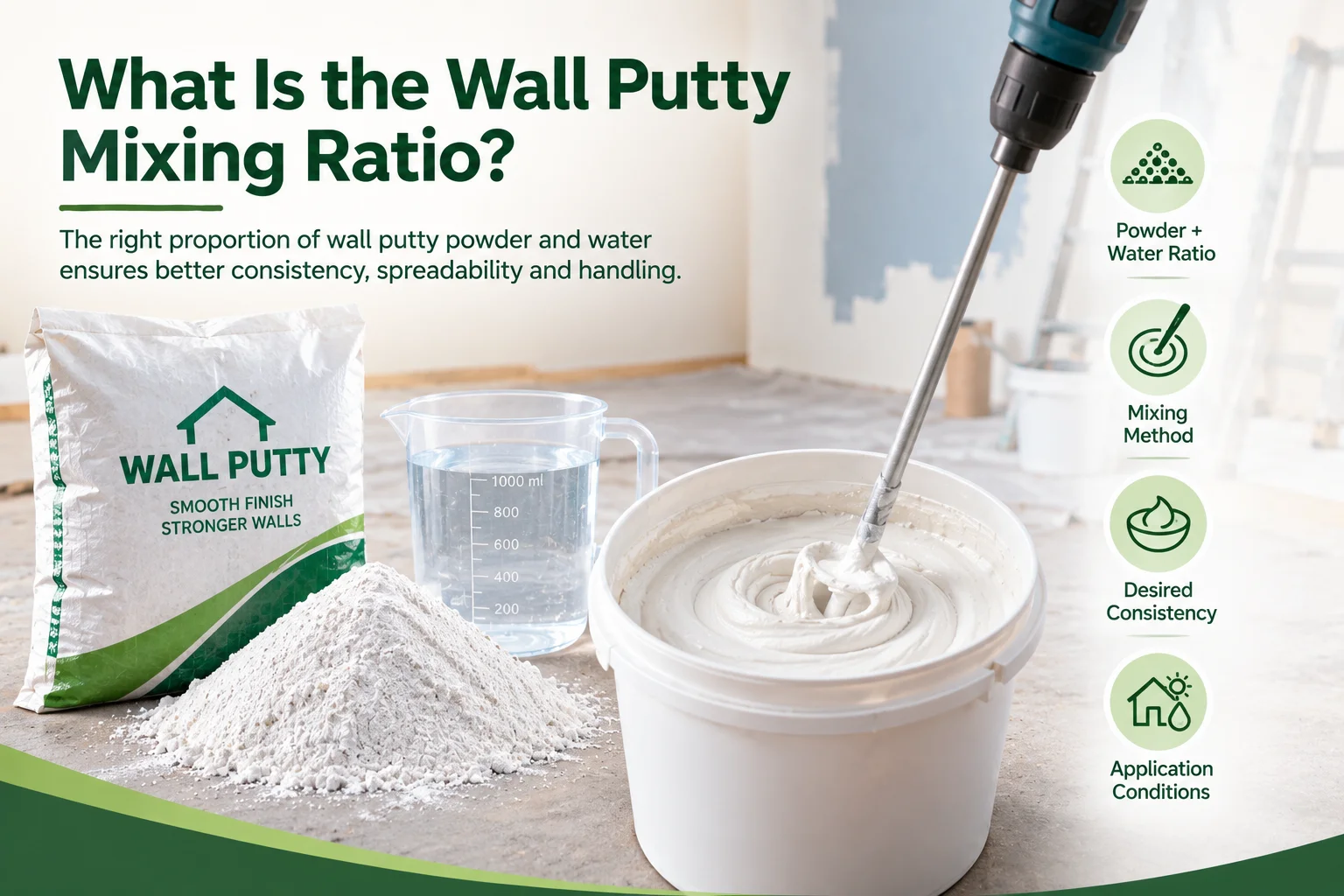
The Wall Putty Mixing Ratio refers to the proportion of wall putty powder and water used to create a workable paste. It directly affects the material's consistency, spreadability and handling, so it should not be treated as a rough "add water until it looks right" exercise.
There is no universal Wall Putty Mixing Ratio for every product. Cement-based, polymer-modified and acrylic wall putties can have different preparation requirements. Some manufacturers specify water by weight, while others provide a recommended consistency or dilution range.
|
Wall Putty Preparation Factor |
What It Means |
Why It Matters |
|
Powder quantity |
Amount of dry wall putty being prepared |
Determines the required water quantity |
|
Water quantity |
Water added according to product instructions |
Controls the working consistency |
|
Mixing method |
Manual or mechanical mixing as specified |
Helps create a uniform mixture |
|
Final consistency |
Smooth, homogeneous and workable paste |
Makes application easier and more even |
|
Application conditions |
Temperature, humidity and substrate condition |
Can influence handling and drying |
The Wall Putty Mixing Ratio directly affects the consistency of the prepared material. A properly mixed paste should spread smoothly without excessive force while remaining stable on a vertical wall.
If the mixture is too thick, the applicator may need to press harder against the surface. That can leave visible blade marks, ridges or an uneven coat. If the mixture is too thin, controlling the thickness becomes more difficult and the material may not behave as intended.
Correct wall putty consistency also helps make different batches behave more similarly. This matters on larger projects where several buckets may be mixed throughout the day.
Think of it like cooking. Adding extra water does not automatically make a recipe better. There is a useful range, and the right balance depends on the ingredients. Wall putty works in much the same way.
The answer depends on the exact product.
Rather than relying on a generic Wall Putty Mixing Ratio, check the packaging or technical data sheet for the wall putty you are using. The manufacturer's instructions may specify water as a percentage of the powder weight, a measured quantity or a particular consistency.
For example, JK Cement's technical information for one wall putty specifies 38–42% water and recommends mechanical mixing. It also states that the prepared paste should be used within 2–3 hours.
This illustrates an important principle: how much water to mix with wall putty is a product-specific question.
For a professional result, measure the water rather than pouring it into the bucket by eye. A small difference between batches can affect how the material spreads and behaves.
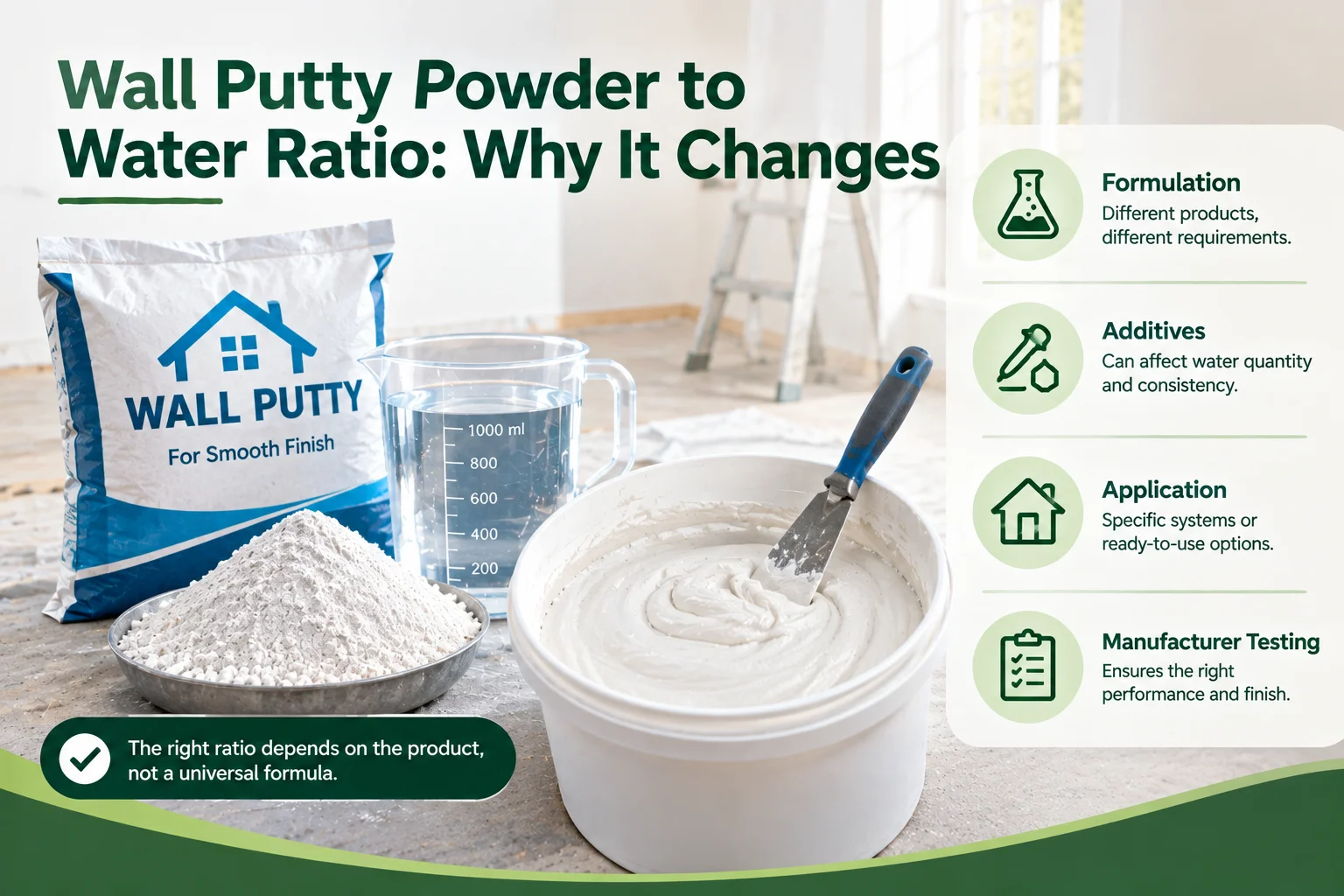
Search for a wall putty powder to water ratio and you will find plenty of different numbers. That is not necessarily because one source is right and the others are wrong. They may simply be referring to different products.
The formulation, additives, intended application and manufacturer's testing can all influence the required water quantity. Some wall putties are designed for specific application systems, while others allow water to be added as required to achieve a paste.
Asian Paints, for instance, states that water can be added as required to its Acrylic Wall Putty to form a paste, while its Professional Wall Putty documentation specifies a 40–50% dilution parameter for the application process.
So the correct Wall Putty Mixing Ratio should always be linked to the product being used rather than treated as a universal construction formula.
Good wall putty preparation starts with clean equipment and accurate measurement. Use a clean mixing container and clean water, then measure the required quantity according to the product instructions.
For powder-based products, add the powder progressively while mixing instead of dumping the entire quantity into the water in one go. This can make it easier to produce a consistent mixture and reduce dry pockets or lumps.
Mechanical mixing can be particularly useful for larger projects. JK Cement specifically recommends mechanical mixing with a stirrer for the referenced wall putty product.
The purpose of the Wall Putty Mixing Ratio is not simply to make the powder wet. It is to produce a uniform material with the intended working characteristics.
If the manufacturer specifies a resting period after mixing, follow it. JK Cement's instructions for the cited product, for example, specify waiting five minutes before application.
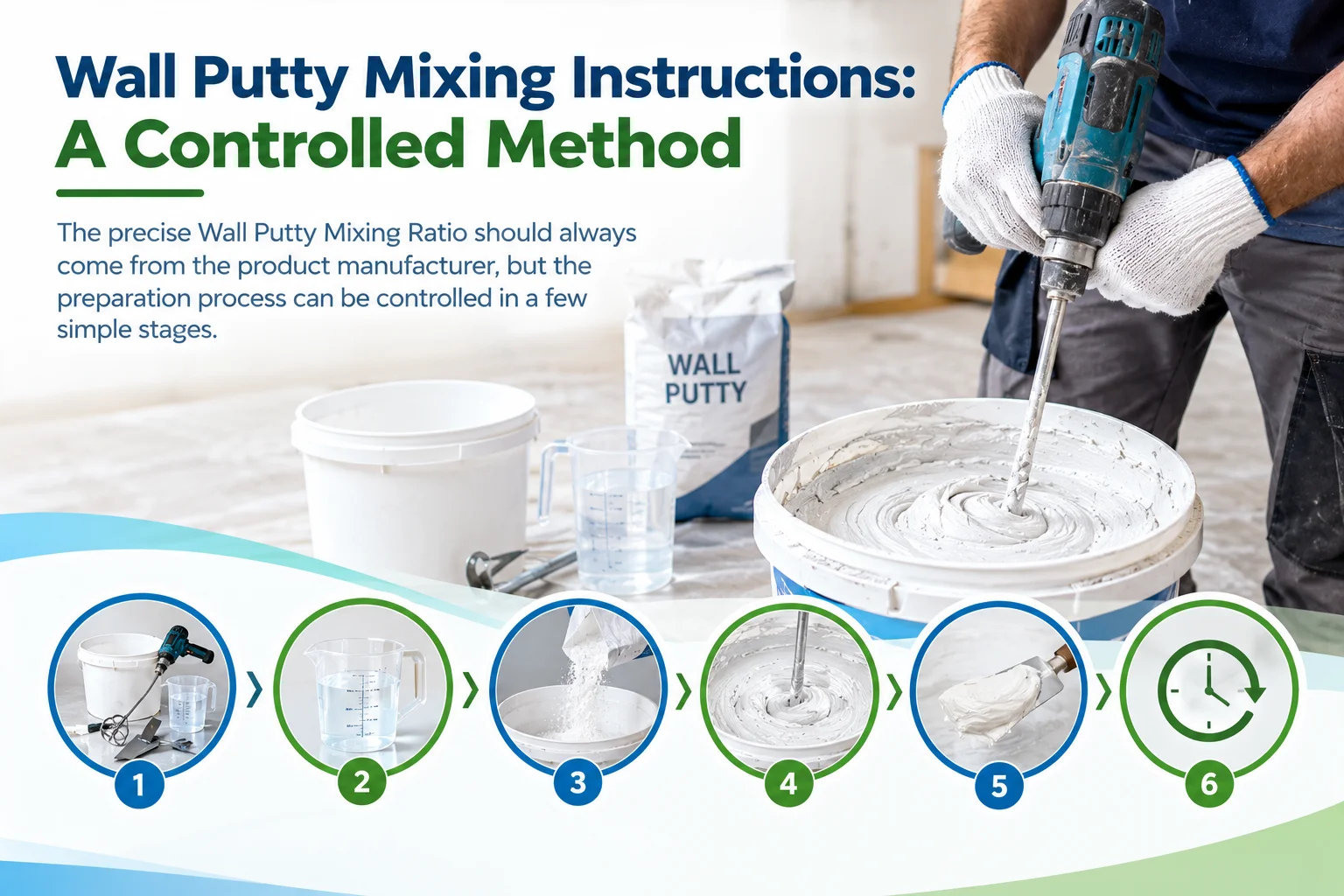
The precise Wall Putty Mixing Ratio should always come from the product manufacturer, but the preparation process can be controlled in a few simple stages.
Prepare clean equipment: Use a clean bucket, clean water and suitable mixing equipment.
Measure the water: Follow the manufacturer's stated quantity instead of estimating.
Add the powder gradually: Introduce the powder while mixing to encourage an even blend.
Mix thoroughly: Continue until the material is homogeneous and free from obvious lumps.
Check consistency: The paste should be smooth and workable for the recommended application method.
Respect working time: Prepare only the amount that can be used within the manufacturer's stated working period.
This method makes the Wall Putty Mixing Ratio easier to reproduce between batches. It also reduces the temptation to keep adding water whenever the mixture feels slightly difficult to spread.
Getting the Wall Putty Mixing Ratio right is only one part of the process. The wall itself needs to be suitable for application.
Dust, dirt, oil, loose material and other contaminants can interfere with adhesion. The substrate should therefore be cleaned and prepared according to the selected product's instructions.
Some products require the surface to be pre-wetted before the first coat. JK Cement, for example, recommends pre-wetting the wall surface to remove loose dust particles for the product described in its application guidance.
Asian Paints' Professional Wall Putty documentation similarly includes sanding, wiping and pre-wetting as part of its preparation process.
If the wall has persistent dampness or water penetration, putting another finishing layer over the problem is not a substitute for addressing the underlying moisture issue.
Once the Wall Putty Mixing Ratio has produced the intended consistency, the next priority is controlled application.
Use the recommended blade, spatula or trowel and apply the material evenly. Avoid trying to correct significant wall irregularities by applying one unnecessarily thick layer.
The number of coats and direction of application depend on the product. JK Cement's published method, for example, describes applying the first coat from bottom to top and the second coat horizontally.
Allow the first coat to dry before preparing the next stage. The same manufacturer instructs users to remove loose particles after the first coat has dried before applying the second.
This shows why the Wall Putty Mixing Ratio is only one part of a successful wall-finishing system. Surface preparation, application thickness, drying and sanding all matter.
Using too much water can move the mixture away from the intended Wall Putty Mixing Ratio.
An overly wet paste can become difficult to control on a vertical surface. It may also behave differently during application and drying. Conversely, too little water can produce a stiff mixture that is harder to spread evenly.
If the material feels wrong, do not immediately add more water. First check whether the correct quantity was measured and whether the manufacturer's mixing method was followed.
The issue could also be related to the product itself, storage conditions or contamination in the mixing equipment. Simply adding more water can make the original problem harder to diagnose.
A mixture prepared with insufficient water may feel heavy or difficult to spread. The applicator may need to apply excessive pressure, which can make achieving a consistent coat more difficult.
A stiff mixture can also encourage uneven application. Some areas may receive more material than others as the worker tries to move the paste across the surface.
The solution is not to guess the correct amount. Check the specified Wall Putty Mixing Ratio and prepare a fresh batch if the existing mixture has already moved significantly outside the manufacturer's preparation requirements.
Consistency should come from measurement and method, not trial and error.
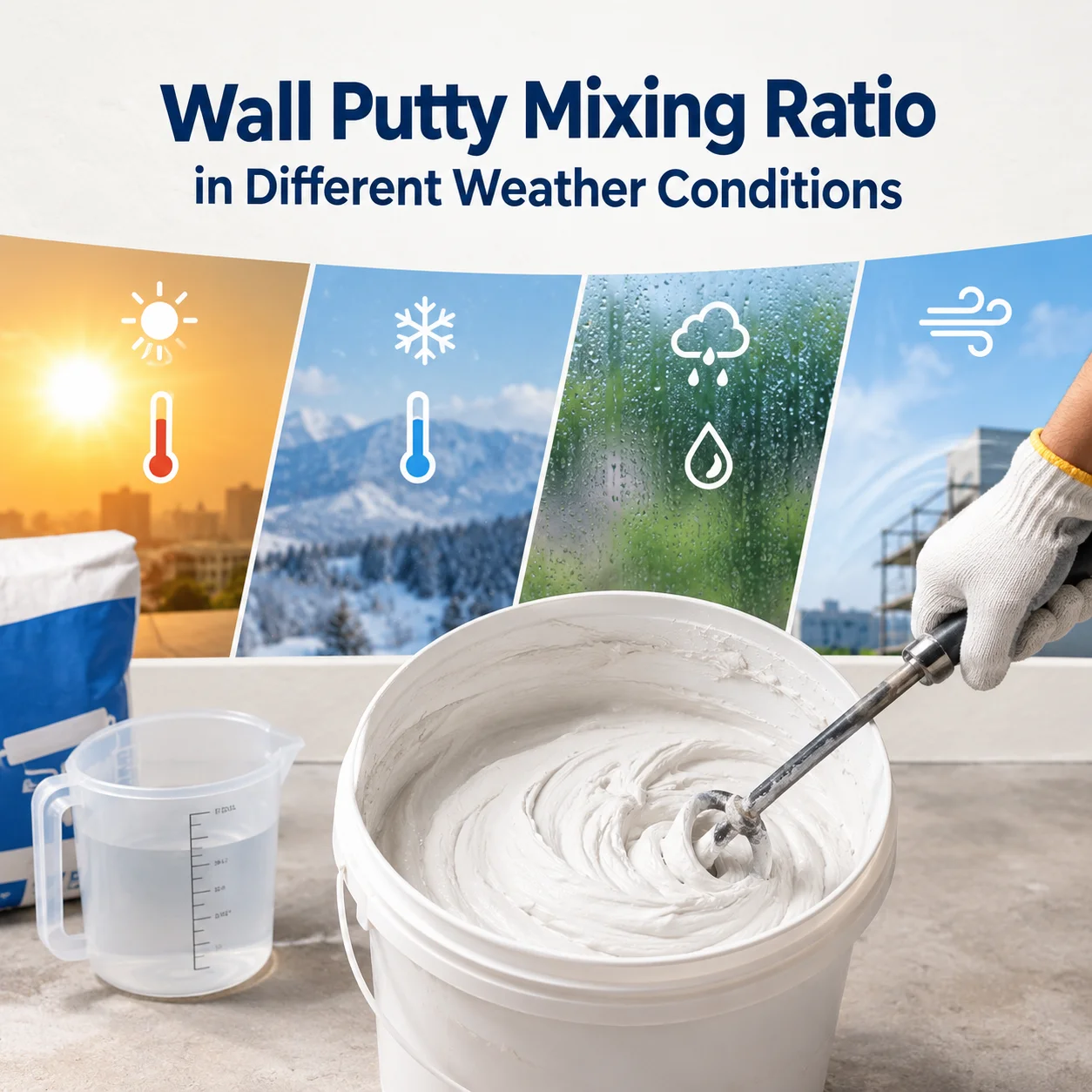
Temperature and humidity can influence how wall putty behaves during application and drying, but they do not automatically mean you should change the specified Wall Putty Mixing Ratio.
Hot and dry conditions can cause moisture to leave the surface more quickly. Cold or humid conditions can slow drying. Strong airflow may also influence surface behaviour.
Instead of changing the water quantity randomly, follow the manufacturer's specified ratio and application conditions. Asian Paints, for example, notes that its stated recoat period is based on particular temperature and relative-humidity conditions and may vary under different conditions.
The Wall Putty Mixing Ratio should remain product-specific while the working process accounts for environmental conditions.
A smooth wall is produced through several stages rather than mixing alone.
After achieving the correct Wall Putty Mixing Ratio, apply the material evenly and allow the coat to dry according to the product instructions. Sanding and surface cleaning then prepare the wall for the next coating stage.
The goal is not to apply as much putty as possible. It is to create a uniform surface with the appropriate thickness and finish.
Lighting can be surprisingly useful during inspection. A bright light positioned at a low angle across the wall can reveal ridges, hollows and scratches that ordinary room lighting hides.
A smooth wall putty finish is much easier to achieve when imperfections are identified before primer and paint make them more visible.
The Wall Putty Mixing Ratio is working as intended when the resulting material matches the manufacturer's recommended consistency and application behaviour.
The paste should be smooth, homogeneous and workable. It should spread with the recommended tool without requiring excessive force, while remaining stable on the surface.
Visible dry powder, lumps or separated material are warning signs that the mixture needs further preparation. However, visual appearance alone should not replace the manufacturer's instructions.
For professional work, batch-to-batch consistency is particularly important. If the first bucket is mixed carefully but the second is prepared using a rough estimate, the two may behave differently during application.
The Wall Putty Mixing Ratio is simple in principle, but small preparation mistakes can affect the final result.
One common mistake is estimating water instead of measuring it. Another is adding the powder too quickly and creating lumps. Dirty buckets or tools can introduce contaminants, while oversized batches can leave material sitting beyond its recommended working time.
Another problem is trying to rescue every poorly prepared batch by adding more water. That may produce a mixture that looks smoother without actually restoring the intended preparation.
If a batch behaves unexpectedly, check the product instructions, measurements, equipment and mixing process before changing the ratio.
The appropriate mixing method depends on the product and project size.
For a small application, manual mixing may be practical if the manufacturer's instructions permit it. Larger projects can benefit from mechanical mixing because it can provide more consistent batches and reduce physical effort.
However, faster mixing is not automatically better. Equipment should be appropriate for the material, and the manufacturer's recommended method should be followed.
For example, JK Cement specifically recommends mechanical mixing for the product covered by its published application instructions.
Regardless of the equipment, the important principle is consistency. Use the same measured Wall Putty Mixing Ratio and preparation method throughout the project.
The purpose of the Wall Putty Mixing Ratio is ultimately to help create a suitable surface for the finishing system that follows.
Once the putty has been applied and adequately dried, the wall may require sanding, cleaning, primer and paint according to the product system. Asian Paints' Professional Wall Putty documentation, for example, specifies sanding, two putty coats and subsequent primer and emulsion coats.
Do not rush directly from wet putty to paint. The surface needs to be properly prepared for the next stage.
If sanding is required, dust control should also be considered. OSHA notes that certain construction materials can generate respirable crystalline silica during activities such as sanding and dry mixing, depending on the material. Appropriate workplace controls should therefore be followed where applicable.
For a worldwide audience, the relevant workplace-safety requirements will depend on the country and job conditions.
The correct Wall Putty Mixing Ratio is an important starting point for achieving a smooth, workable and consistent wall finish. However, there is no universal powder-to-water formula that applies to every product. The formulation, manufacturer's instructions, substrate, application method and environmental conditions all matter. Measuring water accurately, adding powder gradually and mixing thoroughly can help produce the intended wall putty consistency and reduce avoidable application problems.
For a dependable wall-finishing process, the material and preparation method need to work together from the beginning. Explore Lapifix Wall Putty for more information about wall putty, or contact Lapifix to discuss the appropriate solution for your project.
The correct Wall Putty Mixing Ratio depends on the specific product. Different wall putties can have different water requirements, so the manufacturer's technical data sheet or packaging should be treated as the primary reference.
The required water quantity depends on the formulation. Some products specify a percentage, while others provide a measured quantity or describe the desired consistency. For example, one JK Cement product specifies 38–42% water.
Do not automatically add water without checking the product instructions. If the Wall Putty Mixing Ratio was followed correctly but the mixture still appears unsuitable, check the measurement, product and mixing method before making adjustments.
Correct wall putty consistency should be smooth, homogeneous and workable for the recommended application method. It should spread without excessive force while remaining stable on the wall.
Temperature and humidity can affect application and drying, but they do not normally mean you should randomly change the manufacturer's specified Wall Putty Mixing Ratio. Follow the product instructions and its stated environmental conditions.
No. Different products can have different formulations and preparation requirements. A Wall Putty Mixing Ratio that works for one product should not automatically be transferred to another.