

Exterior wall tiling can give a building a distinctive finish, but outdoor installations face challenges that indoor walls may not experience to the same degree. Rain, direct sunlight, temperature changes, wind and moisture movement can all affect the performance of the tiled surface. Choosing a suitable bonding product is therefore only one part of designing a durable installation.
The right tile adhesive for exterior walls must be compatible with the tile, substrate, installation method and expected exposure. The installer must also prepare the wall correctly, achieve the specified adhesive contact, incorporate required movement joints and protect the work while it develops strength.
This guide explains how to evaluate adhesive suitability, understand weather-related risks and follow installation practices that help reduce the likelihood of tile detachment. It is intended for contractors, builders, architects, tile installers and construction-material buyers working on exterior projects.
Tile adhesive for exterior walls is a bonding material selected for fixing tiles to suitable external wall substrates under the environmental conditions expected at the project location. Depending on the product and installation system, it may be formulated to provide appropriate adhesion, workability and resistance to stresses associated with moisture and temperature variation.
Exterior walls differ from many interior surfaces because they may receive direct sunlight, wind-driven rain and repeated heating and cooling. The tile, adhesive and substrate can respond differently to these conditions. If the installation cannot accommodate the resulting stresses, the bond may deteriorate or tiles may become detached.
A reliable exterior installation therefore depends on more than the adhesive itself. The substrate, any specified waterproofing or preparation layer, the tile, the bonding material, grout, movement joints and any required mechanical restraints must work together as a compatible system.
For façade work, the consequences of failure can be particularly serious because detached tiles may fall from height. The project specification and applicable local requirements should determine the installation method and any additional support needed.
There is no single adhesive that is automatically suitable for every outdoor wall. The correct selection depends on the product's documented intended use and the conditions of the project.
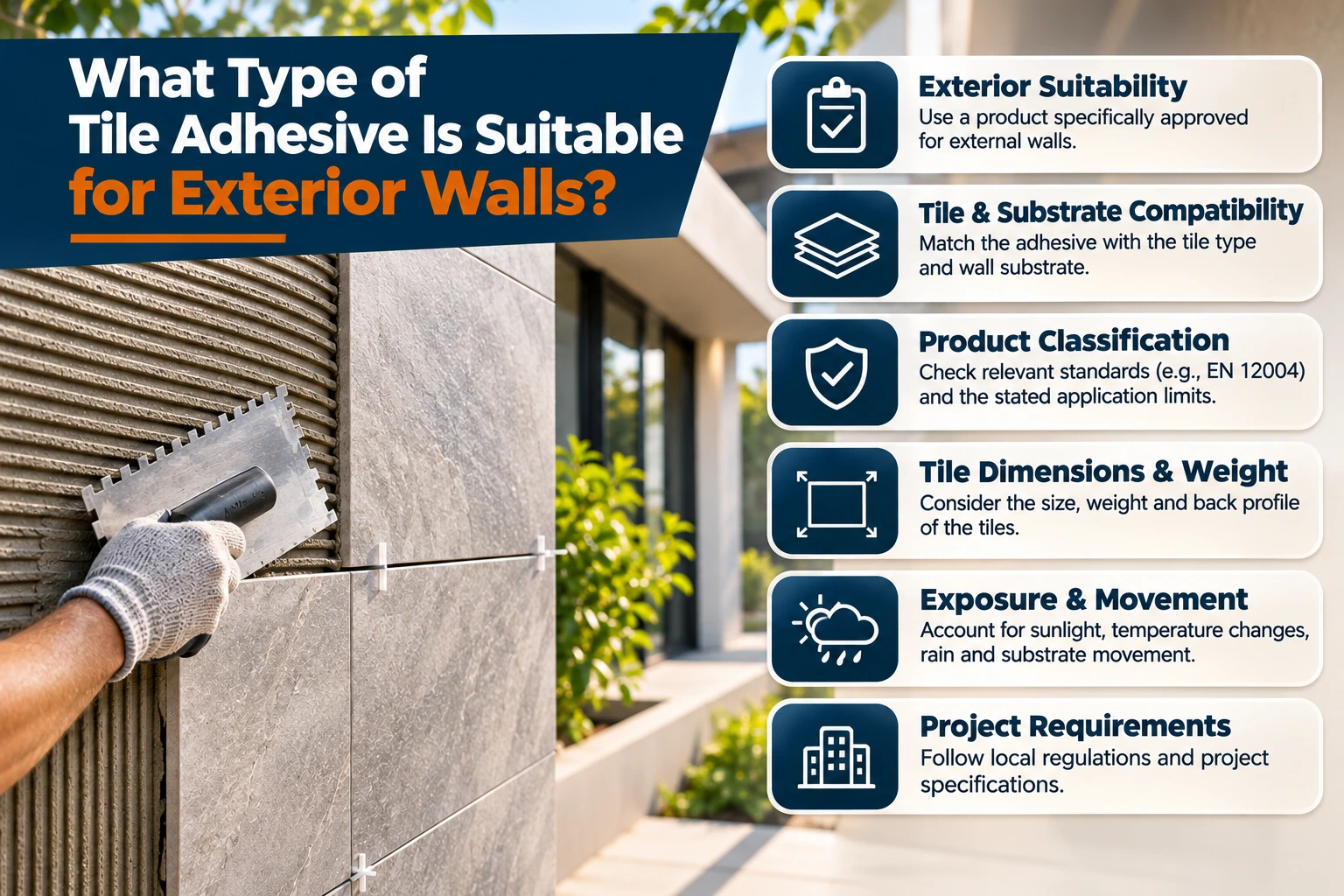
When comparing products, assess the following factors:
Manufacturer-stated exterior suitability. Confirm that the technical data sheet specifically permits the intended external wall or façade application. A general statement that a product is strong, flexible or water-resistant is not enough to establish suitability.
Tile and substrate compatibility. Check that the adhesive is suitable for the tile material and the actual substrate. Porcelain, ceramic and natural stone can have different bonding requirements. Concrete, cement render and other wall systems also differ in their condition and compatibility.
Product classification. Where a recognised classification such as EN 12004 is relevant to the project, read the full designation and the manufacturer's stated application limits. A classification describes defined product performance; it does not independently approve every possible façade design.
Tile dimensions and weight. Large, heavy or low-absorption tiles may require a product and installation method designed for those demands. Consider the tile's back profile as well as its face dimensions.
Exposure and movement. Evaluate direct sunlight, temperature variation, rain exposure, moisture conditions and the likely movement of the substrate. These factors may influence the required adhesive properties and the wider installation design.
Project requirements. Check local regulations, building specifications, height restrictions, façade-system requirements and any need for mechanical support.
For further background on adhesive classifications, see Lapifix's guide to different classes of tile adhesives. Use that information as a starting point, then verify the suitability of the particular product against its current technical documentation.
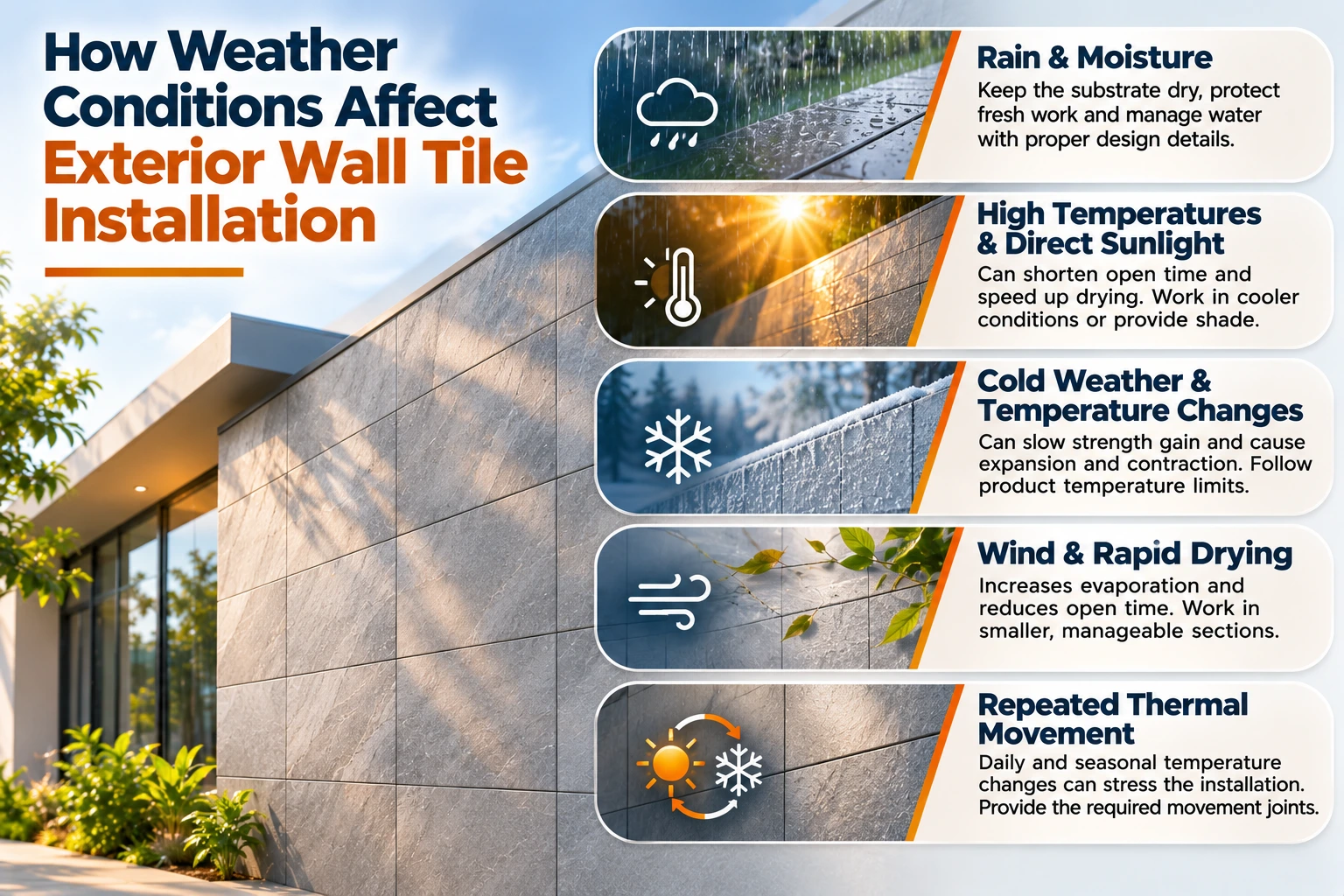
Rain can affect the installation before, during and after tiling. A wet, contaminated or unsuitable substrate may prevent the adhesive from performing as intended. Rain reaching freshly installed tiles can also disturb the work or expose the installation to moisture before the product has developed sufficient strength.
Moisture management is a separate consideration from adhesive selection. Depending on the wall design and exposure, the project may require specified waterproofing, flashing, drainage details or other measures to direct water away from vulnerable areas. Adhesive should not be assumed to provide a complete waterproofing system unless the manufacturer explicitly specifies it for that purpose.
Before installation, check the substrate's moisture condition and any limits stated by the adhesive or membrane manufacturer. Protect the work from rain as required by the installation instructions.
Sunlight can heat the wall and tile surface beyond the surrounding air temperature. Hot substrates, warm materials and direct sun may shorten the adhesive's workable time, while rapid moisture loss can make it harder to achieve good contact.
Do not rely only on the weather forecast. Assess the actual surface conditions and follow the product's stated application limits. Where permitted by the installation system, scheduling work during a cooler period or providing shade may help control conditions.
Spread only the amount of adhesive that can be covered with tiles within the specified open time. If adhesive has formed a skin and no longer transfers correctly to the tile, do not simply press the tile into it. Remove the affected material and apply fresh adhesive according to the manufacturer's instructions.
Low temperatures can slow the development of strength and extend the time before the installation can be exposed to moisture or other stresses. Some products also have minimum application and curing temperatures.
Temperature changes after installation create a different challenge. Tiles, adhesive and the supporting wall may expand and contract at different rates. The installation must accommodate the movement expected in service rather than relying on bond strength alone.
Follow the selected product's temperature and curing requirements, and avoid exposing freshly installed tiles to conditions outside the specified limits.
Wind can increase evaporation from exposed adhesive, especially when combined with heat and direct sunlight. This may reduce the effective open time and interfere with adhesive transfer.
Work in manageable sections and check contact during installation. If the adhesive no longer transfers to the tile back as required, remove it and replace it rather than adding fresh adhesive over material that has already skinned over, unless the product instructions expressly permit a particular procedure.
Exterior walls may experience daily and seasonal temperature variation. Dark tiles and sun-exposed façades can become particularly warm, while shaded areas remain cooler. These differences can place stress on the bond and surrounding joints.
Movement accommodation must be considered in the design. Required movement joints should be located and detailed in accordance with the project specification and applicable installation guidance. Grout joints and movement joints serve different purposes; ordinary grout should not be used as a substitute for a specified movement joint.
The Tile Council for North America guidance discussed by the Ceramic Tile Education Foundation emphasises movement accommodation and appropriate installation materials.
Flexibility or deformability can be an important consideration when the installation is exposed to thermal variation or when the substrate and tile are likely to move differently. A suitably deformable adhesive may help accommodate certain stresses within the limits of its design.
However, flexibility alone does not make a product suitable for every outdoor wall. The adhesive must still be approved for the intended exterior use and compatible with the tile, substrate and complete installation system.
Where relevant, classifications such as S1 or S2 under EN 12004 indicate defined deformability characteristics for cementitious adhesives. They should be interpreted alongside the full product classification and technical data sheet, not used as a shortcut for selecting a façade adhesive.
The design must also address substrate stability, joint layout, moisture management and any required mechanical restraints. For additional context on product classes and performance terminology, consult the Lapifix article on different classes of tile adhesives.
Ceramic tiles vary in porosity, dimensions, thickness and back profile. A product suitable for a small, relatively light ceramic tile may not be suitable for a larger tile on an exposed façade. Check both the tile manufacturer's recommendations and the adhesive's stated application range.
Porcelain generally has low water absorption, so the bonding product must be suitable for the tile's surface characteristics and intended location. Do not assume that an adhesive suitable for ordinary ceramic tiles will automatically be suitable for exterior porcelain installations.
Large-format tiles require particular attention to substrate flatness, adhesive transfer, handling and installation technique. Their size can make it more difficult to achieve consistent contact, and their weight may affect the fixing method.
Review Lapifix's large-format tile adhesive guide for additional information on matching adhesive and installation methods to larger tiles. For exterior façades, the project designer must also confirm whether adhesive bonding alone is permitted for the tile size, weight, height and building conditions.
Natural stone and other heavy cladding materials should only be installed using a system specifically designed and approved for the material and application. Stone can vary in weight, porosity, sensitivity to moisture and susceptibility to staining or warping.
For high-level or heavy exterior cladding, mechanical restraints or a specialist façade system may be necessary. The choice must follow the project design, local requirements and system manufacturer's instructions rather than a general recommendation for adhesive.
A suitable substrate must be strong, stable, clean, appropriately flat and compatible with the proposed installation system. The surface should be capable of supporting the tiles and resisting the forces expected throughout the installation's service life.
Concrete and cement-based render may be suitable when properly designed, cured and prepared, but their condition must be assessed. Dust, grease, curing compounds, loose material, weak render, unstable coatings and other contaminants can interfere with bonding.
Existing painted walls or other finished surfaces should not be tiled over unless the proposed system explicitly permits it and the surface has been assessed and prepared accordingly. Do not use adhesive as an improvised levelling compound unless the product is designed and specified for that purpose.
For tall façades, large tiles or heavy cladding, a qualified designer or façade specialist should confirm the substrate requirements, fixing method and any necessary mechanical support. The project may require pull-off testing or other checks specified by the applicable design or installation standard.
Preparation begins with inspecting the wall and confirming that the proposed system is suitable. Identify cracks, loose render, signs of water ingress, unstable coatings, uneven areas and other defects that could affect performance. Address underlying problems before tiling rather than concealing them with adhesive.
Confirm that the substrate has achieved the condition required by the manufacturer, including any curing or moisture requirements. Remove dust, grease, weak material and contaminants using methods compatible with the substrate. Correct surface irregularities with an appropriate preparation product rather than increasing adhesive thickness beyond its permitted range.
Where the design requires a waterproofing membrane, primer, drainage detail or other intermediate layer, verify that each component is compatible with the adhesive and tile. Products from different manufacturers should not be combined on the assumption that they will work together; check the documented system requirements.
Finally, check the weather, material storage conditions and access arrangements. Exterior wall work should not begin unless the team can maintain the conditions required by the selected products and protect the installation for the specified period.
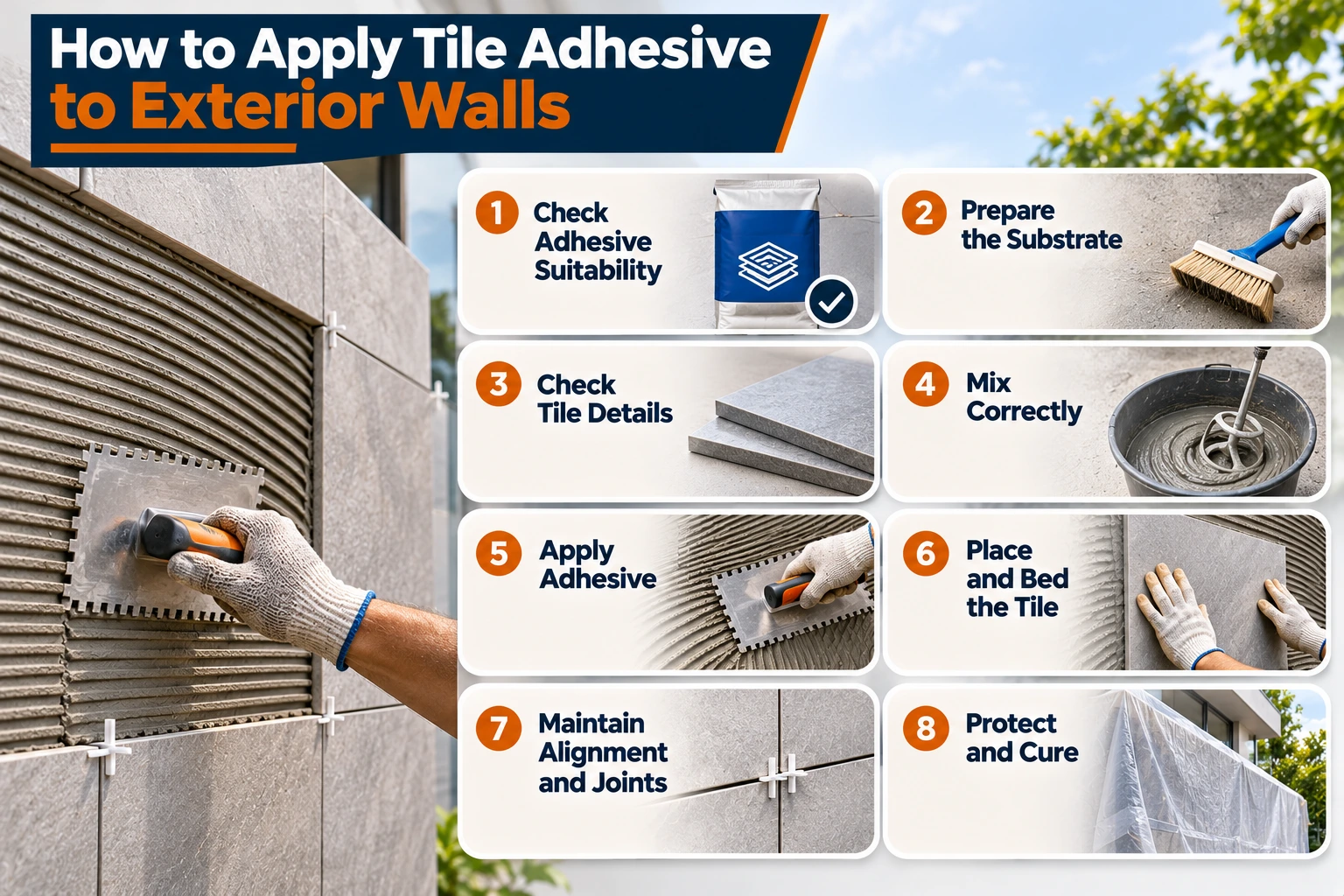
The exact method varies by product and tile system, so the current technical data sheet and project specification should govern the work. A practical sequence is:
Confirm that the selected adhesive is specified for the exact exterior wall application.
Inspect and prepare the substrate, including any specified primer, membrane or repair work.
Check the tile dimensions, weight, material and back profile against the adhesive's application limits.
Mix and use the adhesive according to the manufacturer's instructions. Do not improvise the water ratio or mixing procedure.
Apply the adhesive using the specified trowel and bedding method. For applicable façade and large-format installations, the system may require adhesive to be applied to both the substrate and the tile back.
Place and bed the tile using the recommended technique. Periodically remove a freshly placed tile to check whether the required contact has been achieved.
Maintain alignment, joint details and any specified temporary support. Do not assume that adhesive alone can hold every heavy tile safely during installation.
Protect the work from unsuitable weather, disturbance and premature exposure. Follow the product's stated requirements for curing, grouting and readiness for service.
Full and consistent adhesive contact is important because significant voids can create weak areas and allow moisture to collect. MAPEI's technical guidance on external tiling discusses full bedding, checking coverage, weather conditions and movement joints. Its recommendations are technical context, not a replacement for the instructions for the product selected for a particular project.
Avoid these preventable problems:
Using an adhesive without verifying that it is suitable for the intended exterior application.
Fixing tiles to a weak, dusty, contaminated or unstable substrate.
Working outside the product's permitted weather or surface-temperature conditions.
Selecting an adhesive without checking tile dimensions, weight, material and substrate compatibility.
Allowing adhesive to skin over before the tile is placed, or failing to verify adhesive contact.
Ignoring movement joints, moisture management or other required installation details.
Assuming adhesive-only fixing is appropriate for every façade, tile size, building height or cladding system.
If tiles become hollow, crack or detach, investigate the full installation system rather than automatically blaming the adhesive alone. Lapifix's guide to common tile adhesive failures, their causes and prevention provides related background.
The distinction between interior and exterior adhesive should be based on documented suitability and intended use, not simply on the product name or marketing description.
|
Selection factor |
Exterior wall installation |
Interior wall installation |
|
Intended application |
Product must explicitly permit the relevant external wall or façade use |
Product must be suitable for the specific interior room and substrate |
|
Weather exposure |
May face rain, direct sunlight, wind and wider temperature changes |
Usually more sheltered, although kitchens, bathrooms and sun-exposed areas have their own conditions |
|
Tile and substrate compatibility |
Must account for tile type, dimensions, weight, wall stability and exposure |
Must still match the tile, substrate and room conditions |
|
Product documentation |
Check exterior-use statement, classification, application limits and system requirements |
Check the intended interior use, tile compatibility and relevant limitations |
|
Installation and protection |
Weather planning, movement accommodation, moisture details and possible mechanical support may be essential |
Preparation, open time, curing and movement details remain important, but exposure conditions may differ |
An interior adhesive should not be used outdoors unless its technical documentation explicitly permits the intended application. Likewise, a product labelled for exterior use is not automatically suitable for every façade design or heavy cladding system.
Before purchasing tile adhesive for exterior walls, confirm the intended use and compare the product documentation with the actual project requirements.
Start with the exposure: consider rainfall, direct sunlight, temperature variation, wind and the wall's moisture-management design. Next, identify the tile material, size, weight and back profile, then confirm that the adhesive is suitable for both the tile and the substrate.
Review the product's classification and technical data sheet for application limits, surface preparation, mixing, open time, curing and any special requirements. Confirm that the complete system includes the necessary waterproofing or drainage details, movement joints and mechanical restraints where specified. Finally, check local building regulations and seek professional design advice for high-level façades, heavy cladding or unusual substrates.
Lapifix provides tile adhesive solutions for different installation needs. Explore the relevant products at Lapifix and verify the current product documentation before specifying or purchasing a product for an exterior wall project.
A durable exterior wall installation starts with a product selected for the actual tile, substrate and outdoor exposure—not simply the adhesive with the strongest marketing claim. The installer must also prepare a stable surface, follow application and curing instructions, achieve the required adhesive contact, and accommodate movement and moisture as specified by the installation design.
Before choosing tile adhesive for exterior walls, check the manufacturer's technical data, relevant local requirements and any need for additional façade support. For demanding or high-level installations, involve a qualified professional to confirm that the complete system is appropriate.
Explore the tile adhesive range at Lapifix and consult the relevant technical documentation to identify a product that matches your project. Careful specification and installation planning can help reduce the risk of premature tile detachment and support long-term exterior performance.
The best product is one whose current technical data sheet explicitly permits the intended exterior wall application and confirms compatibility with the tile, substrate and installation system. Weather exposure, tile weight, building height and local requirements also affect the final choice.
Only if the manufacturer specifically approves that product for the intended outdoor application. A product suitable for a sheltered interior wall should not be assumed to withstand exterior moisture, temperature changes or façade stresses.
A deformable adhesive may be appropriate where thermal variation or differential movement is expected. However, flexibility alone does not establish exterior suitability. The full product specification and installation design must be checked.
Installation may be possible when site conditions remain within the product's permitted limits. Heat and direct sunlight can shorten working time and increase the risk of rapid surface drying. Follow the technical data sheet and protect the work as required.
Yes, these conditions can contribute to failure when combined with unsuitable materials, poor preparation, inadequate adhesive contact, missing movement accommodation or moisture-management problems. The cause should be assessed across the entire installation system.
Some products are designed for exterior porcelain installations, but suitability must be confirmed for the specific tile, substrate and exposure. Porcelain's low water absorption makes product compatibility particularly important.
Not in every situation. The permitted fixing method depends on tile dimensions, weight, façade height, substrate, local regulations and the designed system. Some installations require mechanical restraints or specialist cladding systems.
Read the current technical data sheet and product instructions. Look for explicit approval for the intended exterior wall or façade application, compatibility with the tile and substrate, relevant classifications and stated limitations. If the documentation is unclear, obtain written guidance from the manufacturer or project specifier before installation.