

When it comes to achieving a smooth and long-lasting paint finish, wall preparation plays a critical role. One of the most commonly used materials in this process is wall putty, a fine powder applied to walls before painting to create an even surface and enhance paint adhesion. But beyond aesthetics, homeowners and builders often wonder about its ability to protect walls from moisture.
A common question that arises is whether wall putty waterproof properties are strong enough to safeguard walls against dampness, seepage, and weather exposure. With increasing concerns about wall damage caused by humidity, rain, and leakage, understanding the true capabilities of wall putty becomes essential.
In this blog, we will break down whether wall putty is truly waterproof or simply water-resistant, how it performs in real conditions, and where it should be used for the best results. If you're planning a new paint job or dealing with moisture-related issues, this guide will help you make an informed decision.
Wall putty is a fine, powder-based material primarily used to prepare walls before painting. It is applied as a base coat on plastered surfaces to create a smooth, even, and uniform finish. This preparation layer ensures better paint adhesion, enhances the final appearance, and improves the durability of the paint.
Typically, wall putty is made from white cement, polymers, and other performance-enhancing minerals. Depending on its composition, it is available in two main forms white cement-based putty and acrylic wall putty. Both types are designed to fill minor cracks, pores, and imperfections on wall surfaces, resulting in a flawless finish.
Beyond aesthetics, wall putty also contributes to surface strength and provides a certain level of resistance against moisture. This is why many people associate it with wall putty waterproof capabilities. However, its actual performance depends on the type of putty used and the conditions in which it is applied.
Wall putty is commonly used on:
Interior walls for a smooth paint finish
Exterior walls for improved durability
Ceilings to eliminate uneven textures
Concrete and plastered surfaces
In simple terms, wall putty acts as the foundation of a quality paint job ensuring that the topcoat not only looks better but also lasts longer.
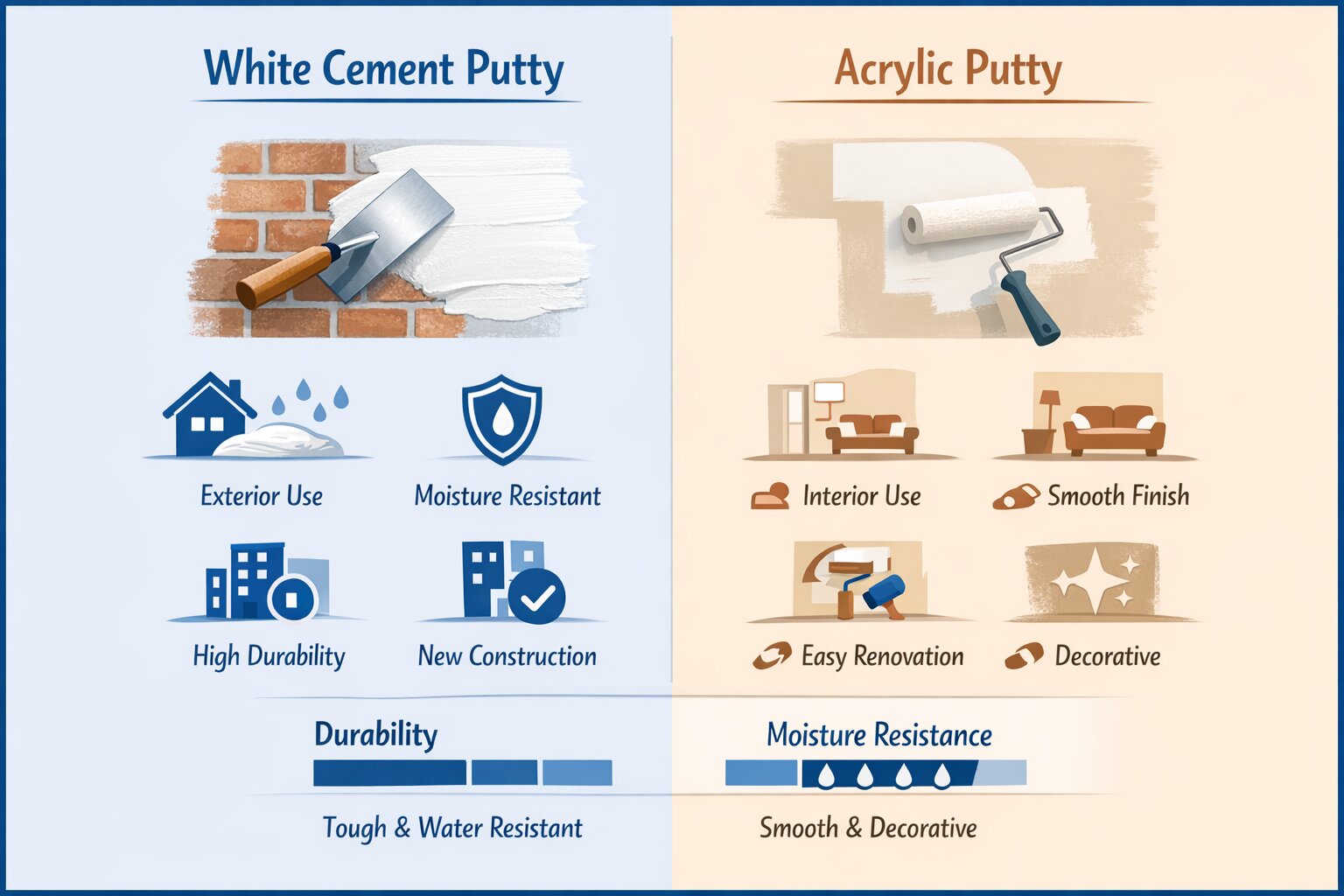
Choosing the right type of wall putty is essential for achieving both durability and surface protection. Not all putties perform the same, especially when it comes to strength and moisture resistance. The two most commonly used types are white cement-based putty and acrylic wall putty, each designed for specific applications.
White cement-based putty is the most widely used option in construction and home finishing. It is made from white cement, minerals, and polymers that enhance bonding strength and durability.
One of its biggest advantages is its strong adhesion to concrete and plastered surfaces. It forms a hard, long-lasting base that improves paint performance and helps the wall withstand wear and tear over time. This type of putty also offers better resistance to moisture compared to acrylic variants, which is why it is often associated with wall putty waterproof performance.
In real-world conditions, white cement putty performs well on both interior and exterior walls. It can handle exposure to humidity, minor dampness, and temperature changes without deteriorating quickly.
Best use cases:
Exterior walls exposed to rain and weather
Interior walls requiring long-lasting finish
Ceilings and high-traffic areas
New construction projects
Acrylic wall putty is a ready-to-use, water-based solution that is mainly designed for interior applications. It is made using acrylic resins and fillers, which give it a smooth texture and easy application.
Unlike cement-based putty, acrylic putty is less durable and offers limited resistance to moisture. It is more suitable for decorative purposes rather than structural strength. While it provides a smooth finish and good paint adhesion, it does not contribute much to wall protection in damp conditions.
Because of its lower moisture resistance, acrylic putty is not ideal where waterproofing is a concern. This makes it less effective when evaluating wall putty waterproof capabilities in demanding environments.
Best use cases:
Interior walls in dry areas
Repainting and renovation projects
Quick touch-ups and surface smoothing
Decorative finishes
The main difference between these two types lies in their strength and ability to handle moisture.
White cement-based putty is highly durable and provides better resistance against humidity and minor water exposure. It forms a tougher layer that lasts longer and supports exterior applications. On the other hand, acrylic putty is softer, less durable, and more suitable for controlled indoor environments.
When it comes to moisture protection, neither type is fully waterproof, but cement-based putty performs significantly better in resisting dampness. This distinction is crucial when deciding whether wall putty waterproof performance is sufficient for your needs.
Understanding where to use each type of putty can prevent common application mistakes and improve overall results.
White cement-based putty should be your go-to choice for areas exposed to moisture, such as exterior walls, kitchens, and spaces prone to humidity. It provides a stronger base and enhances the life of the paint.
Acrylic putty, on the other hand, works best in dry interior spaces where the focus is on achieving a smooth and premium finish rather than moisture protection.
In summary, selecting the right type of wall putty depends on your environment, surface condition, and performance expectations. Making the correct choice ensures better durability, improved aesthetics, and more reliable long-term results.
This is one of the most important questions for homeowners and builders: is wall putty waterproof, or does it only offer limited protection against moisture?
The simple and honest answer is: wall putty is not fully waterproof; it is water-resistant.
To make the right decision, it’s important to understand the difference between waterproof and water-resistant:
Waterproof means completely blocking water penetration, even under constant exposure
Water-resistant means resisting moisture to some extent but not preventing it entirely
Most wall putties, including cement-based ones, fall into the water-resistant category. They can slow down moisture absorption but cannot stop water from entering the wall if there is continuous exposure or leakage.
Wall putty works by filling pores and creating a smoother, denser surface. This reduces the chances of water seeping in quickly. High-quality white cement-based putty can resist humidity, minor splashes, and damp conditions effectively.
However, due to its micro-porous structure, wall putty still allows some level of moisture penetration over time. This means that relying solely on it for protection in high-moisture areas can lead to issues like damp patches, paint peeling, or surface damage.
So while many people search for wall putty waterproof solutions, it’s important to understand that putty alone cannot act as a complete barrier against water.
In dry or moderately humid environments, wall putty performs well and supports long-lasting paint
In rain-exposed exterior walls, it provides limited resistance but not full protection
In areas with leakage or heavy seepage, wall putty alone will fail without proper waterproofing
Wall putty plays an important role in improving surface quality and offering basic moisture resistance. However, it should not be considered a substitute for proper waterproofing systems.
If your goal is complete protection against water damage, the best approach is to use wall putty along with a dedicated waterproofing solution.
Understanding this difference helps you avoid costly mistakes and ensures better long-term performance of your walls.
Dampness and seepage are among the most common issues faced in buildings, especially in regions with high humidity or heavy rainfall. Many people assume that applying putty will solve these problems, but the reality is more nuanced.
Wall putty does contribute to moisture control but only to a limited extent. By filling surface pores and minor cracks, it creates a smoother and denser layer that slows down the absorption of moisture.
High-quality cement-based putty can:
Reduce minor dampness caused by humidity
Improve surface resistance against light moisture exposure
Support longer-lasting paint performance
This is why it is often linked with wall putty waterproof expectations. However, its function is more about resistance than protection.
The short answer is no. Wall putty cannot completely prevent dampness or seepage.
Dampness usually occurs due to:
Water leakage from pipes or roofs
External wall exposure to rain
Poor construction or cracks in the structure
Capillary rise of water from the ground
Since wall putty is only a surface-level application, it cannot block water coming from deeper structural issues. Over time, moisture can pass through and cause paint peeling, stains, or wall damage.
Even when using the best quality putty, there are certain limitations:
It does not seal deep cracks or structural gaps
It cannot withstand continuous water exposure
It is ineffective against active leakage
It may fail in highly damp or waterlogged areas
This clearly shows that relying solely on putty for waterproofing is not a long-term solution.
To truly prevent dampness and seepage, wall putty should be used in combination with waterproofing treatments. Waterproofing products are designed to penetrate surfaces and create a strong barrier that blocks water entry.
A proper system usually includes:
Surface repair and crack filling
Application of waterproofing coating or chemical treatment
Wall putty for smooth finishing
Final paint layer
This layered approach ensures both protection and aesthetics.
Use wall putty for surface finishing and minor moisture resistance
Use waterproofing solutions for complete protection against seepage
Wall putty can help reduce the impact of moisture but cannot eliminate the root cause of dampness. Understanding this distinction is crucial when evaluating wall putty waterproof performance.
For long-lasting results, always treat the source of water first then use wall putty as a finishing layer, not as a primary defense.
Understanding the difference between waterproof and normal wall putty is essential when choosing the right solution for your walls. While both serve as a base for painting, their performance varies significantly in terms of moisture resistance, durability, and long-term protection.
Below is a clear comparison to help you make an informed decision:
|
Feature |
Waterproof Wall Putty |
Normal Wall Putty |
|
Water Resistance Level |
High moisture resistance; forms a protective barrier that reduces water penetration |
Low resistance; absorbs moisture and is prone to dampness |
|
Durability |
Highly durable; resists cracks, peeling, and fungal growth |
Moderate durability; may deteriorate in humid conditions |
|
Application Areas |
Suitable for exterior walls, bathrooms, kitchens, basements, and damp areas |
Best for interior dry areas like bedrooms and living rooms |
|
Cost Difference |
Slightly higher upfront cost due to advanced formulation |
More affordable initially |
|
Long-Term Performance |
Long-lasting; reduces maintenance and repainting frequency |
Requires frequent repairs and repainting in moisture-prone areas |
Waterproof putty is specially formulated with polymers and hydrophobic additives that create a barrier against moisture. This helps prevent dampness, mold, and water damage. In contrast, normal putty lacks these properties and can absorb moisture over time.
Waterproof putty offers superior strength and longevity. It resists cracking, peeling, and efflorescence, ensuring the paint lasts longer. Normal putty, while effective for basic smoothing, may weaken in humid or wet conditions.
Waterproof putty is versatile and can be used in both interior and exterior environments, especially where moisture exposure is high like bathrooms, kitchens, and exterior walls. Normal putty is mainly recommended for dry indoor areas.
Normal wall putty is generally more budget-friendly, making it suitable for basic interior projects. Waterproof putty may cost slightly more, but it provides better protection and reduces future maintenance expenses.
In the long run, waterproof putty proves to be more cost-effective due to its durability and resistance to moisture damage. It minimizes repainting and repair needs, while normal putty may require frequent touch-ups in damp conditions.
If your goal is just a smooth finish, normal putty can work well. But for areas exposed to moisture, choosing waterproof putty is a smarter investment.
When evaluating wall putty waterproof performance, it’s clear that advanced waterproof formulations offer significantly better protection compared to standard options—especially in challenging environments.
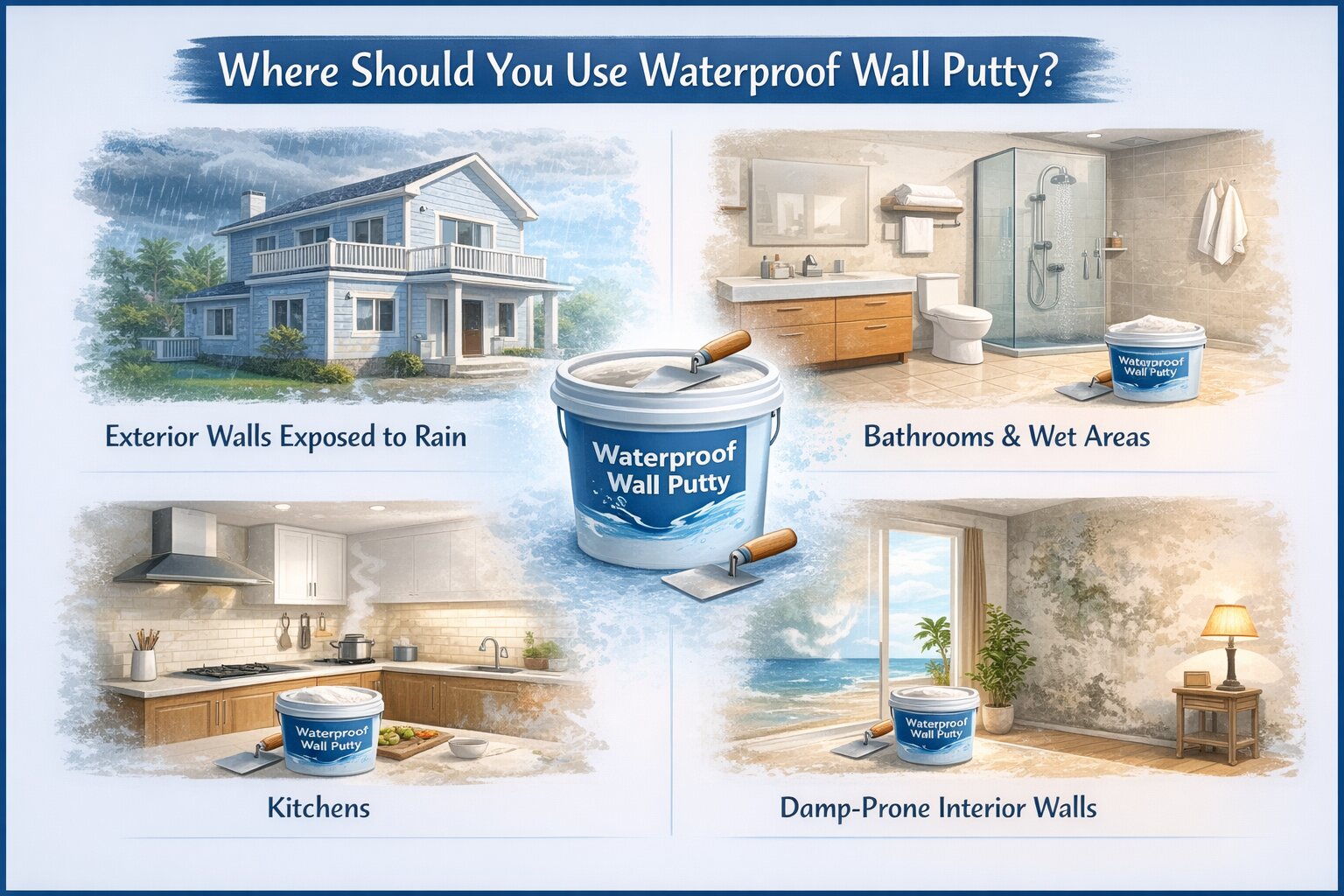
Choosing the right location for applying waterproof wall putty is just as important as selecting the right product. While many people assume it can be used everywhere, its real value comes into play in areas exposed to moisture, humidity, or environmental stress.
Understanding where wall putty waterproof performance is most effective will help you achieve better durability and avoid future wall damage.
Exterior walls are constantly exposed to harsh weather conditions like rain, sunlight, and temperature fluctuations. In such environments, standard putty may not perform well over time.
Waterproof wall putty provides better resistance against moisture absorption, helping to:
Reduce water penetration during rainy seasons
Prevent paint peeling and cracks
Improve the lifespan of exterior coatings
For homes in high-rainfall or coastal areas, using waterproof putty on exterior walls is highly recommended.
Bathrooms, wash areas, and utility spaces are exposed to continuous moisture, steam, and splashes of water. These conditions can quickly damage walls if not treated properly.
Using waterproof putty in these areas helps:
Minimize moisture absorption
Maintain paint quality
Reduce the chances of mold and damp patches
However, it’s important to note that putty alone is not enough. Proper waterproofing treatment should always be done before application.
Kitchens are another moisture-prone area due to cooking steam, oil vapors, and water usage. Over time, these factors can weaken wall surfaces and affect paint.
Applying waterproof wall putty in kitchens:
Enhances resistance to humidity
Keeps walls smooth and intact
Improves overall hygiene and cleanliness
Some interior walls may face dampness due to poor ventilation, leakage, or structural issues. In such cases, using standard putty can lead to recurring problems.
Waterproof putty works better in these areas by:
Slowing down moisture absorption
Supporting longer-lasting paint
Reducing visible damp patches
Still, identifying and fixing the root cause of dampness is crucial for permanent results.
In regions with high humidity levels, walls are more prone to moisture-related damage even without direct water exposure.
Using waterproof wall putty in such climates helps:
Protect walls from constant humidity
Maintain surface strength
Improve long-term durability
This makes it a practical choice for homes located near coastal areas or in tropical environments.
Waterproof wall putty is best suited for areas where moisture exposure is frequent or unavoidable. While it enhances resistance, it should always be used as part of a complete system that includes proper waterproofing.
By applying it in the right places, you can maximize the benefits of wall putty waterproof performance and ensure your walls remain strong, smooth, and damage-free for years.
Using a water-resistant wall putty is not just about achieving a smooth finish, it also adds an extra layer of protection that improves the overall performance of your walls. While it may not be completely waterproof, it plays a significant role in enhancing durability and maintaining the quality of your paint over time.
Understanding these benefits helps clarify why many people associate it with wall putty waterproof performance, especially in moisture-prone environments.
One of the biggest advantages of using water-resistant wall putty is that it extends the life of your paint. By creating a uniform and stable base, it allows paint to adhere better and last longer.
This results in:
Reduced chances of paint peeling or flaking
Better color retention
Less frequent repainting
Although it cannot stop heavy seepage, wall putty helps in controlling minor dampness caused by humidity or slight moisture exposure.
It works by:
Filling pores and small cracks
Slowing down moisture absorption
Minimizing surface-level damp patches
This makes it useful for interior walls and moderately humid conditions.
Water-resistant putty adds an extra layer of strength to the wall surface. It binds well with the substrate and improves resistance against wear and tear.
Benefits include:
Reduced surface cracks
Better impact resistance
Increased durability of plastered walls
A key reason for using wall putty is the flawless finish it delivers. It creates a smooth surface that enhances the final look of paint.
This leads to:
Even paint application
Improved wall aesthetics
Professional-quality finish
While not fully waterproof, it still provides a level of protection that helps maintain wall quality in everyday conditions.
This includes:
Resistance to humidity
Protection from minor water exposure
Reduced risk of surface damage
This is where the concept of wall putty waterproof often comes into discussion highlighting its partial but useful moisture resistance.
Using a good quality water-resistant putty can save money over time by reducing maintenance and repair needs.
It helps:
Avoid frequent repainting
Minimize wall damage
Improve long-term performance
Water-resistant wall putty is an essential part of modern wall finishing systems. It enhances durability, improves appearance, and provides basic moisture resistance.
While it should not replace proper waterproofing, it significantly contributes to overall wall protection making it a smart and practical choice for both residential and commercial spaces.
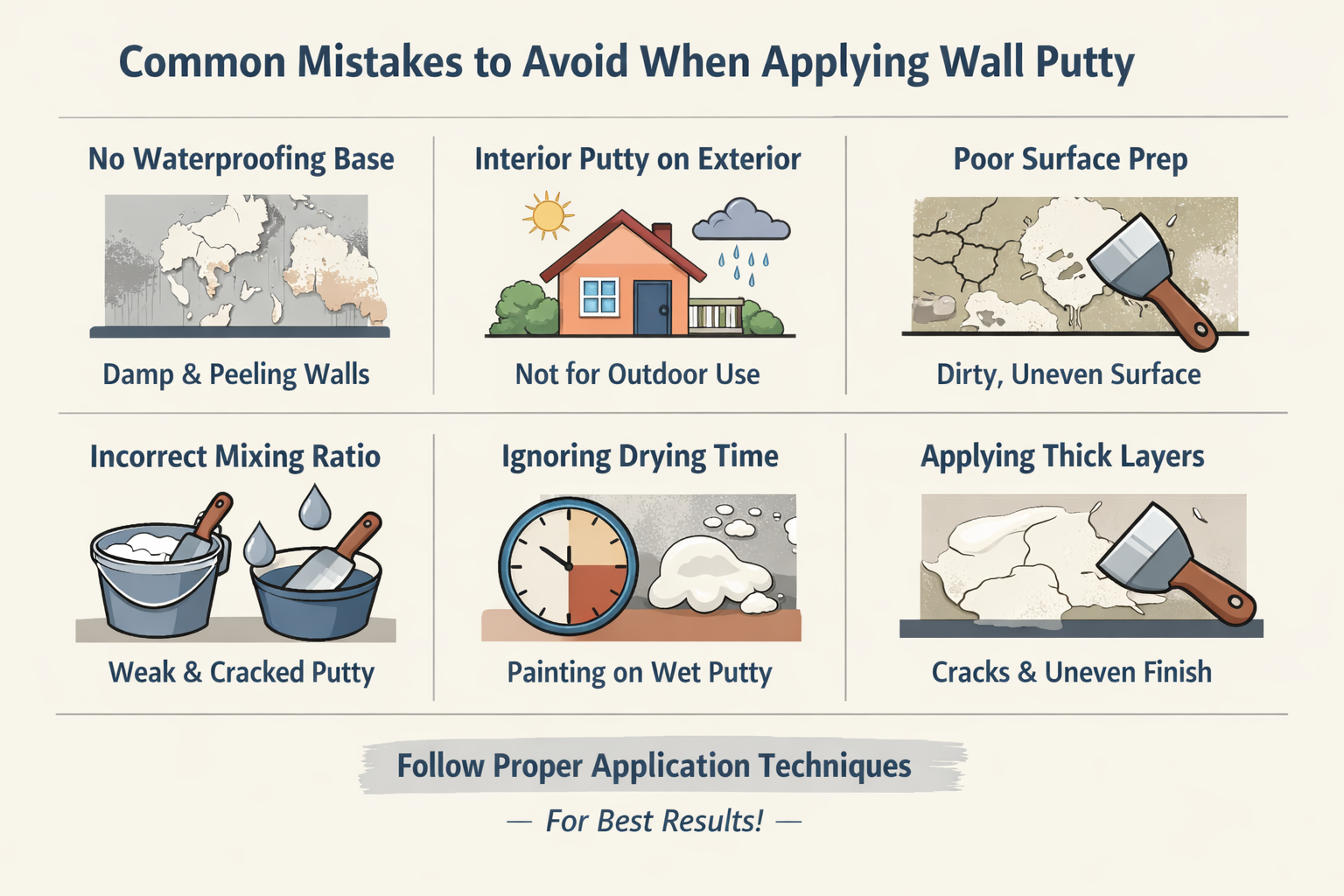
Even the best quality putty will not deliver proper results if it is applied incorrectly. Many wall-related issues like peeling paint, damp patches, and cracks are often caused by application mistakes rather than product failure.
To get the best results and make the most of wall putty waterproof performance, it’s important to avoid the following common errors:
One of the biggest mistakes is assuming that wall putty alone can stop water leakage or dampness. As discussed earlier, putty is only water-resistant, not fully waterproof.
Skipping proper waterproofing can lead to:
Recurring damp patches
Paint peeling and bubbling
Long-term wall damage
Tip: Always apply a waterproofing solution first in moisture-prone areas before using putty.
Interior-grade putty is not designed to handle harsh outdoor conditions like rain, UV exposure, and temperature changes.
Using it outside can result in:
Reduced durability
Cracking and surface damage
Faster deterioration
Tip: Always choose cement-based or waterproof putty for exterior applications.
Applying putty on an unclean or uneven surface reduces its bonding strength. Dust, grease, or loose particles can prevent proper adhesion.
This may cause:
Flaking or peeling of layers
Uneven finish
Reduced lifespan of paint
Tip: Clean the surface thoroughly and repair cracks before applying putty.
For cement-based putty, maintaining the correct water-to-powder ratio is crucial. Too much or too little water can affect consistency and performance.
Common issues include:
Weak bonding
Cracks after drying
Difficulty in application
Tip: Always follow the manufacturer’s recommended mixing guidelines.
Rushing the process is a frequent mistake. Applying paint before the putty is fully dry can trap moisture inside the wall.
This can lead to:
Paint failure
Blisters and bubbles
Reduced durability
Tip: Allow sufficient drying time between coats and before painting.
Applying a thick coat of putty might seem like a shortcut, but it can cause uneven drying and cracks.
Tip: Apply putty in thin, even layers and allow proper drying between coats.
Avoiding these mistakes is just as important as choosing the right product. Proper application ensures better performance, longer durability, and a flawless finish.
When used correctly, wall putty can enhance surface quality and support moisture resistance but only when combined with the right techniques and preparation.
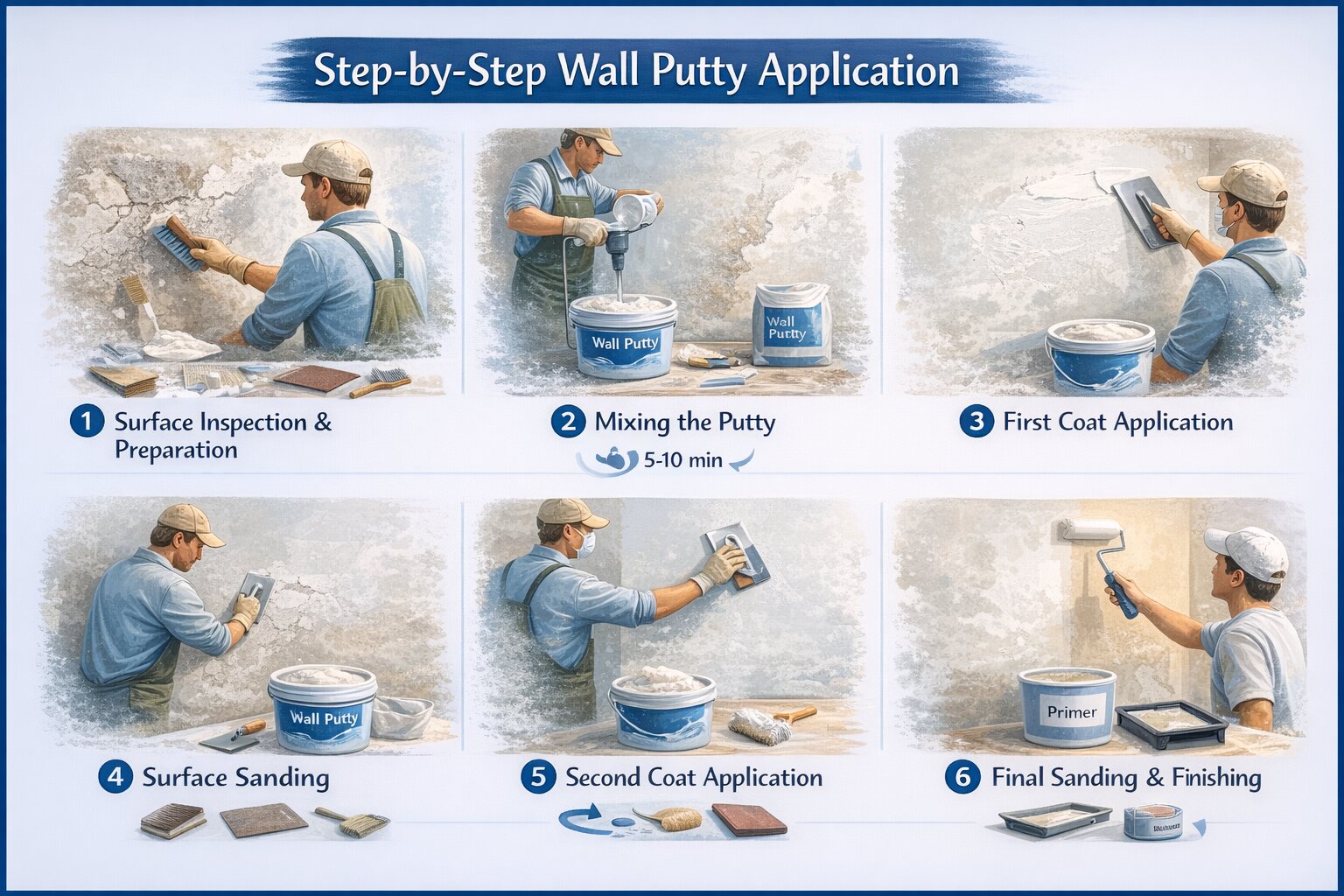
Applying wall putty correctly is crucial to achieving a smooth finish, strong adhesion, and long-lasting results. Even the best product will fail if the application process is not followed properly. Below is a detailed, professional step-by-step guide to help you get optimal performance especially when aiming to maximize wall putty waterproof benefits.
Before applying wall putty, carefully inspect the surface. This step lays the foundation for everything that follows.
What to check:
Cracks, holes, or uneven plaster
Dampness or leakage issues
Dust, grease, or loose particles
Preparation process:
Clean the wall using a wire brush or sandpaper
Remove all dust and contaminants
Repair cracks with suitable filler or mortar
Ensure the surface is dry and stable
Important: If there is any sign of leakage or seepage, fix it and apply a waterproofing solution first. Do not rely only on putty.
For cement-based putty, proper mixing is essential to achieve the right consistency and bonding strength.
How to mix:
Add clean water to a mixing container
Gradually add putty powder (as per manufacturer ratio)
Mix thoroughly until a smooth, lump-free paste is formed
Tips:
Avoid over-mixing or adding excess water
Let the mixture sit for 5–10 minutes before use
Use the mixture within the recommended time
The first coat acts as a base layer that fills pores and minor imperfections.
Application method:
Use a putty blade or trowel
Apply a thin, even coat across the surface
Maintain uniform pressure for smooth spreading
Key focus:
Fill all small cracks and uneven areas
Avoid thick application
Allow the first coat to dry completely (typically 6–8 hours depending on conditions).
Once the first coat is dry, sanding is required to smooth out the surface and remove any irregularities.
Process:
Use fine-grit sandpaper
Lightly sand the surface
Remove dust after sanding
This step ensures better adhesion for the second coat and improves the final finish.
The second coat enhances smoothness and prepares the wall for painting.
How to apply:
Apply another thin, even layer
Focus on achieving a uniform surface
Avoid overworking the material
Let the second coat dry completely (usually 6–8 hours).
After the second coat dries, perform final sanding to achieve a perfectly smooth surface.
Steps:
Use ultra-fine sandpaper
Smooth out any visible marks or lines
Clean the surface thoroughly
At this stage, the wall should feel smooth, even, and ready for painting.
Before applying paint, a primer is recommended to improve adhesion and finish quality.
Final steps:
Apply a suitable wall primer
Allow it to dry
Proceed with your chosen paint
Always apply putty in thin layers instead of thick coats
Maintain proper drying time between coats
Avoid application in extremely humid or wet conditions
Use high-quality materials for better durability
A proper application process not only improves the appearance of your walls but also enhances durability and moisture resistance. While following these steps, remember that wall putty waterproof performance depends heavily on correct surface preparation and application techniques.
When done right, wall putty creates a strong, smooth base that ensures your paint looks better and lasts longer.
Wall putty is water-resistant, not fully waterproof. It can resist minor moisture and humidity but cannot completely block water penetration. For full protection against leakage or seepage, a proper waterproofing solution is required along with putty.
No, wall putty cannot stop water leakage. It is only a surface-level material used for smoothing and improving paint adhesion. Leakage issues must be treated with dedicated waterproofing chemicals or structural repairs before applying putty.
White cement-based putty with added polymers offers better moisture resistance compared to acrylic putty. However, even the best option does not provide complete waterproofing. It works best when used in combination with waterproofing treatments.
Yes, especially in areas prone to dampness, bathrooms, or exterior walls. Waterproofing should always be done first to stop water entry, and then wall putty can be applied for a smooth finish and added protection.
Yes, but only as a finishing layer. Bathrooms are high-moisture areas, so proper waterproofing is essential before applying putty. Using only putty may lead to damp patches and paint damage over time.
When applied correctly, wall putty can last 8–12 years or more, depending on environmental conditions and product quality. Its lifespan also depends on proper surface preparation and whether waterproofing has been done.
No, wall putty alone is not enough to treat damp walls. It may temporarily improve appearance, but the root cause of dampness must be fixed using waterproofing solutions for long-term results.
Wall putty is an essential part of any painting process, helping create a smooth, durable, and visually appealing surface. It improves paint adhesion, enhances finish quality, and offers a basic level of moisture resistance. However, when it comes to the big question, whether the wall putty waterproof or not, the answer is clear.
The wall putty is not fully waterproof. It is water-resistant and can handle minor moisture exposure, but it cannot stop water leakage or seepage on its own. Relying solely on putty for moisture protection can lead to long-term issues like damp patches, peeling paint, and wall damage.
For the best results, wall putty should always be used as part of a complete system:
Fix the source of leakage or dampness
Apply proper waterproofing treatment
Use high-quality wall putty for surface finishing
Finish with a suitable primer and paint
This approach ensures both protection and aesthetics, giving your walls a longer lifespan and a flawless appearance.
In conclusion, while wall putty waterproof performance is often misunderstood, its real value lies in supporting durability and finish not replacing waterproofing. Making the right combination of materials and techniques will help you achieve strong, smooth, and long-lasting walls.